
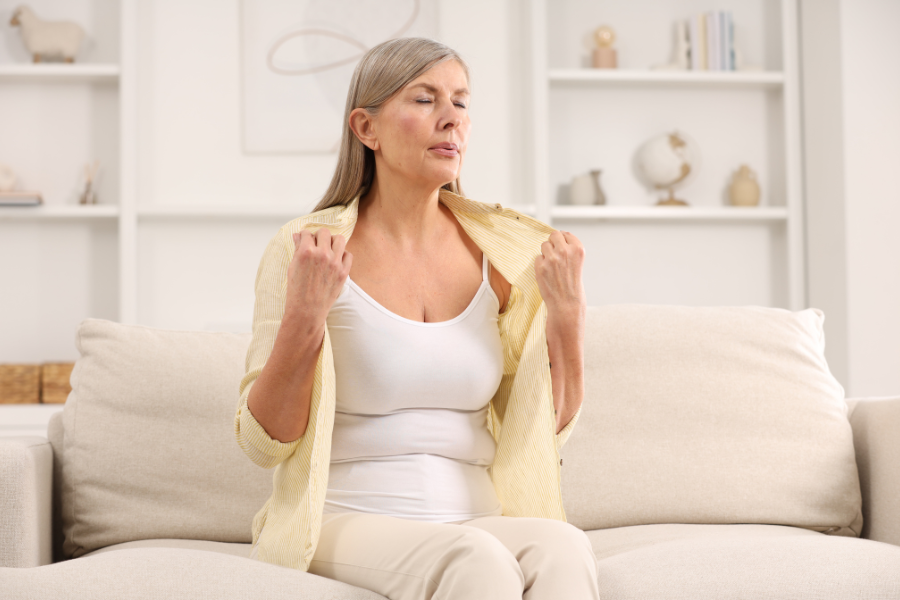
Menopause and Inflammation: Galen’s Cooling Body and the Change of Life
Menopause and inflammation are bound together more closely than the old phrase for this season, “the change of life,” ever let on. In the years on either side of the last period, from perimenopause through the decade after, the body rearranges its heat, its moisture and its defenses all at once. I came through it myself years ago, and I still find that Galen gives the clearest map.
A Change That Waited for a Name
Galen never wrote a book on menopause, and neither did anyone else until 1816. That year the Paris physician Charles de Gardanne published advice for women entering “the critical age” and coined a word for it, ménespausie, from the Greek for month and for ceasing. In the second edition of 1821 he shortened it to ménopause, and the name stuck.1
Gardanne still thought as a humoral physician. He tied the critical age to fevers, to inflammations of the skin, eyes, mouth and throat, and to aching joints.2 His list was long and gloomy, but he had noticed something real: this is a season when inflammation moves.
Galen’s Reading: A Cooler Body and a Closing Outlet
In On the Usefulness of the Parts, Galen says the female body was made somewhat colder than the male, cold enough that it cannot use up all the nourishment it prepares. The surplus gathers, and the monthly flow carries it away.3 In this scheme the period is the body’s outlet. In Hygiene he supplies the other half of the picture: old age is cold and dry, and its keeping calls for whatever warms and moistens.4
Put those two teachings side by side and you have a Galenist’s reading of the change. In perimenopause the outlet opens and closes without rhythm. In the years after, the body cools and dries toward old age. A Galenist would read a hot flush as heat and surplus that find no regular way out and rise instead. That reading is mine, built on Galen rather than quoted from him, but it explains why the old herbals reached for cooling plants in the middle years and for warming, moistening food later.
What the Laboratory Found
Modern research describes the same season in its own language. In 2002 Johannes Pfeilschifter and his colleagues gathered the evidence in Endocrine Reviews. As the ovaries slow, they found, the body’s output of inflammatory messengers rises, chiefly IL-1, IL-6 and TNF-alpha.5 They linked that rise most firmly to bone loss after menopause, and more tentatively to changes in the blood vessels. Estrogen, it turns out, had been holding part of the body’s inflammation in check.
| Galen’s teaching | What we know now |
|---|---|
| The female body is colder; the monthly flow carries off its surplus | Estrogen and the cycle help shape the immune system |
| At the change the outlet closes | As the ovaries slow, inflammatory messengers rise |
| Old age is cold and dry; warm it and moisten it | After menopause, bone and blood vessels lose estrogen’s shelter |
Sage, the Cooling Herb
Sage has been Europe’s herb for sweating for centuries. The European Medicines Agency recognizes sage leaf as a traditional herbal product for the relief of excessive sweating.6 In 2011 a Swiss study gave 71 women, each at least a year past her last period, one tablet of fresh sage a day for eight weeks. Their hot flush scores fell by half within four weeks and by nearly two thirds by the eighth.7 The study had no placebo group and was run by the tablet’s maker, so it is a beginning rather than a verdict. I’ve written about the plant in full in Salvia officinalis: Garden Sage Monograph.
Black Cohosh, With Care
Galen never knew black cohosh; it came to Europe from the woods of North America. It now has more study behind it than any other herb for the change. The agency’s Committee on Herbal Medicinal Products weighed about 20 clinical studies involving more than 6,000 women and accepted black cohosh extracts for hot flushes and excessive sweating at the change, on the strength of well-established use.8
The committee attached a warning. Liver problems have been reported, and a woman taking black cohosh should stop at once and see her doctor if she notices tiredness, loss of appetite, yellowing of the skin or eyes, dark urine, or pain in the upper stomach. Its limit is six months of use without a doctor’s oversight.
The Table at the Change
Food is where Galen and the evidence agree most easily. An Australian study followed more than 6,000 women through natural menopause for nine years. Those who ate the most fruit, or the most Mediterranean-style diet, were about a fifth less likely to report hot flushes and night sweats than those who ate the least. Women whose diet ran high in fat and sugar reported more of them.9 The study shows an association and cannot prove cause. Still, the Mediterranean table is one Galen would have known: bread, greens, olive oil, fruit, fish, and wine in measure. For the whole pattern, see The Complete Guide to Anti-Inflammatory Eating.
For a Galenic cook the season sets the menu. In the restless years of perimenopause, lighter and cooling foods suit: fresh fruit, salad greens, cucumber, barley water. Afterward, as the body dries, warm and moistening dishes take over: soups and stews, cooked grains, eggs, olive oil and a little wine. If you don’t yet know your own temperament, The Four Galenic Constitutional Types is the place to begin.
Safety Notes
- Black cohosh: stop at once and see a doctor at any sign of liver trouble. If you have had liver disease, talk with your doctor before taking it.
- If you have had breast cancer or another hormone-sensitive cancer, talk with your oncologist before taking any herb sold for the change, black cohosh and sage included.
- Sage leaf contains thujone. Keep sage tablets and teas to the amount and length of use printed on the label, and save the strong daily cups for a season, not for years.
- If you take prescription drugs, check first. See Herb-Drug Interactions.
- Very heavy bleeding, bleeding between periods, or any bleeding after a full year without a period should always be seen by a doctor.
The Change of Life
Gardanne gave this season a name and a long list of dangers. Galen gave it a logic: a body cooling, its old outlet closing, its heat looking for a new balance. Modern research has added the inflammatory messengers that rise as estrogen falls. Read together, they tell one story. The middle years ask for a new way of eating, of cooling and of warming, and for time while the body finds its footing. I followed the earlier seasons of this story in Fertility and Inflammation and Pregnancy and Inflammation.
© 2024 Carolyn Smith-Kizer
If this work is useful to you, you can buy me a coffee — buymeacoffee.com/cskizer

Notes
- Charles-Pierre-Louis de Gardanne, Avis aux femmes qui entrent dans l’âge critique (Paris, 1816); Gardanne, De la ménopause, ou de l’âge critique des femmes, 2nd ed. (Paris: Méquignon-Marvis, 1821).
- “Menopause,” DicoPolHiS, Le Mans Université, accessed November 3, 2026, https://dicopolhis.univ-lemans.fr/en/dictionary/m/menopause.html; see also Cécile Charlap, La fabrique de la ménopause (Paris: CNRS Éditions, 2019).
- Galen, On the Usefulness of the Parts of the Body, trans. Margaret Tallmadge May, 2 vols. (Ithaca, NY: Cornell University Press, 1968), bk. 14, chap. 6.
- Galen, Hygiene, ed. and trans. Ian Johnston, 2 vols., Loeb Classical Library 535–536 (Cambridge, MA: Harvard University Press, 2018), bk. 5.
- Johannes Pfeilschifter, Roland Köditz, Martin Pfohl, and Helmut Schatz, “Changes in Proinflammatory Cytokine Activity after Menopause,” Endocrine Reviews 23, no. 1 (2002): 90–119, https://doi.org/10.1210/edrv.23.1.0456.
- European Medicines Agency, Committee on Herbal Medicinal Products, European Union Herbal Monograph on Salvia officinalis L., folium, EMA/HMPC/277152/2015 (2016), sec. 4.1.
- Silvia Bommer, Peter Klein, and Andy Suter, “First Time Proof of Sage’s Tolerability and Efficacy in Menopausal Women with Hot Flushes,” Advances in Therapy 28, no. 6 (2011): 490–500, https://doi.org/10.1007/s12325-011-0027-z.
- European Medicines Agency, “Cimicifugae rhizoma: Herbal Medicinal Product,” summary of the HMPC’s conclusions on black cohosh, accessed November 3, 2026, https://www.ema.europa.eu/en/medicines/herbal/cimicifugae-rhizoma.
- Gerrie-Cor M. Herber-Gast and Gita D. Mishra, “Fruit, Mediterranean-Style, and High-Fat and -Sugar Diets Are Associated with the Risk of Night Sweats and Hot Flushes in Midlife: Results from a Prospective Cohort Study,” American Journal of Clinical Nutrition 97, no. 5 (2013): 1092–99, https://doi.org/10.3945/ajcn.112.049965.
Bibliography
Bommer, Silvia, Peter Klein, and Andy Suter. “First Time Proof of Sage’s Tolerability and Efficacy in Menopausal Women with Hot Flushes.” Advances in Therapy 28, no. 6 (2011): 490–500.
Charlap, Cécile. La fabrique de la ménopause. Paris: CNRS Éditions, 2019.
European Medicines Agency. “Cimicifugae rhizoma: Herbal Medicinal Product.” https://www.ema.europa.eu/en/medicines/herbal/cimicifugae-rhizoma.
European Medicines Agency, Committee on Herbal Medicinal Products. European Union Herbal Monograph on Salvia officinalis L., folium. EMA/HMPC/277152/2015. London: EMA, 2016.
Galen. Hygiene. Edited and translated by Ian Johnston. 2 vols. Loeb Classical Library 535–536. Cambridge, MA: Harvard University Press, 2018.
Galen. On the Usefulness of the Parts of the Body. Translated by Margaret Tallmadge May. 2 vols. Ithaca, NY: Cornell University Press, 1968.
Gardanne, Charles-Pierre-Louis de. Avis aux femmes qui entrent dans l’âge critique. Paris, 1816.
Gardanne, Charles-Pierre-Louis de. De la ménopause, ou de l’âge critique des femmes. 2nd ed. Paris: Méquignon-Marvis, 1821.
Herber-Gast, Gerrie-Cor M., and Gita D. Mishra. “Fruit, Mediterranean-Style, and High-Fat and -Sugar Diets Are Associated with the Risk of Night Sweats and Hot Flushes in Midlife.” American Journal of Clinical Nutrition 97, no. 5 (2013): 1092–99.
“Menopause.” DicoPolHiS. Le Mans Université. https://dicopolhis.univ-lemans.fr/en/dictionary/m/menopause.html.
Pfeilschifter, Johannes, Roland Köditz, Martin Pfohl, and Helmut Schatz. “Changes in Proinflammatory Cytokine Activity after Menopause.” Endocrine Reviews 23, no. 1 (2002): 90–119.