
Carolingian Garden Plants: 3 Lists, One Garden
What Charlemagne ordered, what St Gall drew, and what Walahfrid grew
Carolingian garden plants come down to us in three documents written within about fifty years of each other. Charlemagne’s Capitulare de Villis names what every royal estate had to grow. The Plan of St Gall draws a monastery’s gardens bed by bed. And Walahfrid Strabo, abbot of Reichenau, wrote a poem about the little plot outside his own door.
Most people meet these sources one at a time. I wanted to see them together, so I put all three on one table, plant by plant. What came out of it shocked me a little, and it changed how I read every one of them.
The Three Lists
The Capitulare de Villis (about 800). This is Charlemagne’s instruction to the stewards of his estates: Carolingian garden plants. Its seventieth chapter is the famous one: about seventy-three plants and sixteen kinds of trees that he wanted grown on every royal property.1 It is an order, written by a king who expected to be obeyed. I’ve written about the plant list itself and what it says about the table Charlemagne kept.
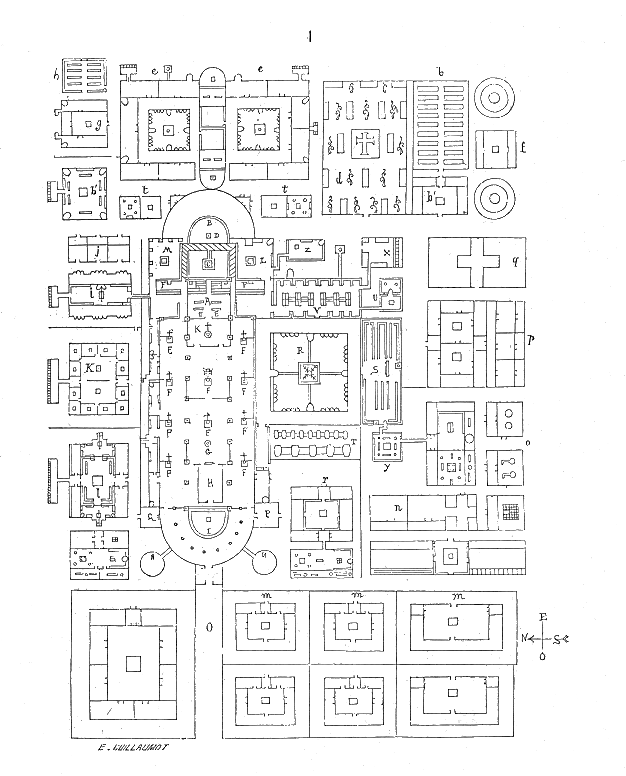
The Plan of St Gall (about 820). It was drawn on the island of Reichenau and sent to Abbot Gozbert of St Gall, who was planning to rebuild. It survives in the abbey library as Codex Sangallensis 1092.2 The plan labels three growing spaces: a kitchen garden of eighteen beds, a physic garden of sixteen beds beside the physicians’ house, and an orchard that doubled as the monks’ cemetery.3

The Hortulus (840s). Walahfrid Strabo was abbot of Reichenau, the same island where the plan was drawn. His poem of about 450 Latin lines walks through his own garden one plant at a time, twenty-three plants in all, beginning with sage and ending with the rose.4 He dedicated it to Grimald, abbot of St Gall.
So we have a king’s list, a monastery’s blueprint and an abbot’s poem. They come from the same world, the same few decades and partly the same island.
Side by Side
Here is the finding of note: every plant and tree drawn on the St Gall plan also appears in chapter 70 of the Capitulare. All eighteen kitchen beds, all sixteen physic beds and all fourteen orchard trees. The plan reads like Charlemagne’s list, chosen from and sorted by use.
| Where the plant appears | Plants |
|---|---|
| In all three sources | 13 |
| Capitulare and St Gall only | 33 |
| Capitulare and Hortulus only | 5 |
| Hortulus only | 5 |
| Capitulare only | 37 |
A few more things stand out once they sit on one page:
- Summer savory is the only plant the St Gall planner put in both the kitchen beds and the physic beds.
- The kitchen garden is a pot of pottage taken apart: onions, leeks, garlic, shallots, cabbage, chard, parsnips, and herbs to season them.
- The Capitulare is by far the longest list. Some plants appear only there, including dye plants like madder, field crops like broad beans, and several that are plainly dangerous (savin, squill, colocynth).
Get the full cross-reference, free
I’ve put all 93 plants and trees into one printable guide. It shows each plant’s botanical name, which of the three sources names it, the Latin spelling each source uses, and a note on the ones scholars still argue about.
Three Lists, One Garden is yours to download. Keep it beside your seed catalogue this winter.
The Thirteen at the Heart of It
Thirteen plants appear in all three sources: sage, rue, fennel, iris, lovage, lily, mint, pennyroyal, rose, chervil, poppy, celery and radish. If you want to plant one Carolingian bed, plant these.
Read them as Galen would and a pattern shows. Most of the thirteen are warming and drying in the old reckoning, and two are clearly cooling.5
| Plant | Galenic qualities (as the tradition records them) |
|---|---|
| Sage | Hot and dry |
| Rue | Hot and dry, third degree |
| Fennel | Hot, and dry in the first degree |
| Iris (root) | Hot and dry |
| Lovage | Hot and dry |
| Mint | Hot and dry |
| Pennyroyal | Hot and dry |
| Celery (smallage) | Hot and dry |
| Radish | Hot and dry |
| Chervil | Moderately hot |
| Lily (bulb) | Moderately hot |
| Rose | Cold and dry |
| Poppy | Cold, in the highest degree |
For a community of men living in a damp lakeside climate, much of it on bread, pottage and cold stone, that balance makes sense to me. The warming plants stand against cold and wet. Rose and poppy sit at the other end of the scale to cool and calm. I’ve written longer monographs on sage and fennel if you’d like to go deeper on two of them.
What Walahfrid Added
Five plants in the Hortulus appear on neither earlier list: wormwood, horehound, betony, agrimony and a plant he calls ambrosia, which nobody has identified for certain. These are his own choices, and four of the five are bitter.
Wormwood is the one that surprised me most. It isn’t in chapter 70 of the Capitulare at all. Charlemagne’s stewards were never told to grow it, yet the abbot of Reichenau gave it a place of honour in his poem. My wormwood monograph covers the plant itself.
Five more plants are shared by Charlemagne and Walahfrid but left off the St Gall plan: southernwood, the bottle gourd, melon, clary and catmint. Walahfrid spends more lines on the gourd than on anything else. He admires how it climbs, and notes that the dried fruit made a good bottle.4 That gourd was the Old World bottle gourd. Squashes and pumpkins came from the Americas centuries later.
I read Walahfrid’s list as a gardener’s list. Charlemagne was ordering supplies for an empire, and the St Gall planner was laying out a working monastery. Walahfrid was writing about the plants he knelt beside, and you can tell.
Planting It Now: the Carolingian Garden Plants
You don’t need an abbey to grow a Carolingian bed. The St Gall gardener and Walahfrid both give practical instructions you can follow next spring:
- Keep beds narrow enough to reach the middle from the path.
- Frame them with boards and raise them a little, as Walahfrid did, so they drain and warm early.
- Give each bed one plant, so anything else that comes up is a weed.
- Water seedlings slowly and low, so the seed stays where you sowed it.
- Let the best plant in each bed go to seed for next year.
Start with the thirteen. Then add from the other lists as your ground allows. The full cross-reference will tell you which source each plant came from, so you’ll know whose garden you’re planting.
A Note on Safety
This post is history and gardening, not advice on using any plant. Several plants on these lists are unsafe to take internally or in pregnancy, among them rue, pennyroyal, wormwood, southernwood, tansy and poppy. Savin, squill and colocynth are toxic. Please talk with a qualified practitioner before using any herb.
© 2026 Carolyn Smith-Kizer
If this work is useful to you, you can buy me a coffee — buymeacoffee.com/cskizer

Notes
1. Capitulare de villis, c. 70, in Alfred Boretius, ed., Capitularia regum Francorum, vol. 1, MGH Leges 2 (Hanover: Hahn, 1883), no. 32.
2. St. Gallen, Stiftsbibliothek, Cod. Sang. 1092, digitised at e-codices.
3. Walter Horn and Ernest Born, The Plan of St. Gall, 3 vols. (Berkeley: University of California Press, 1979).
4. Walahfrid Strabo, Hortulus, trans. Raef Payne, commentary by Wilfrid Blunt (Pittsburgh: Hunt Botanical Library, 1966).
5. Galen, De simplicium medicamentorum temperamentis ac facultatibus, in Claudii Galeni Opera Omnia, ed. C. G. Kühn, vols. 11–12 (Leipzig, 1826); Nicholas Culpeper, The English Physitian (London, 1652).
Bibliography
Boretius, Alfred, ed. Capitularia regum Francorum. Vol. 1. MGH Leges 2. Hanover: Hahn, 1883.
Culpeper, Nicholas. The English Physitian. London, 1652.
Galen. De simplicium medicamentorum temperamentis ac facultatibus. In Claudii Galeni Opera Omnia, edited by C. G. Kühn, vols. 11–12. Leipzig, 1826.
Horn, Walter, and Ernest Born. The Plan of St. Gall. 3 vols. Berkeley: University of California Press, 1979.
Walahfrid Strabo. Hortulus. Translated by Raef Payne, commentary by Wilfrid Blunt. Pittsburgh: Hunt Botanical Library, 1966.