
Inflammation in Ancient Bones: Neanderthals, Ötzi and the Mummies
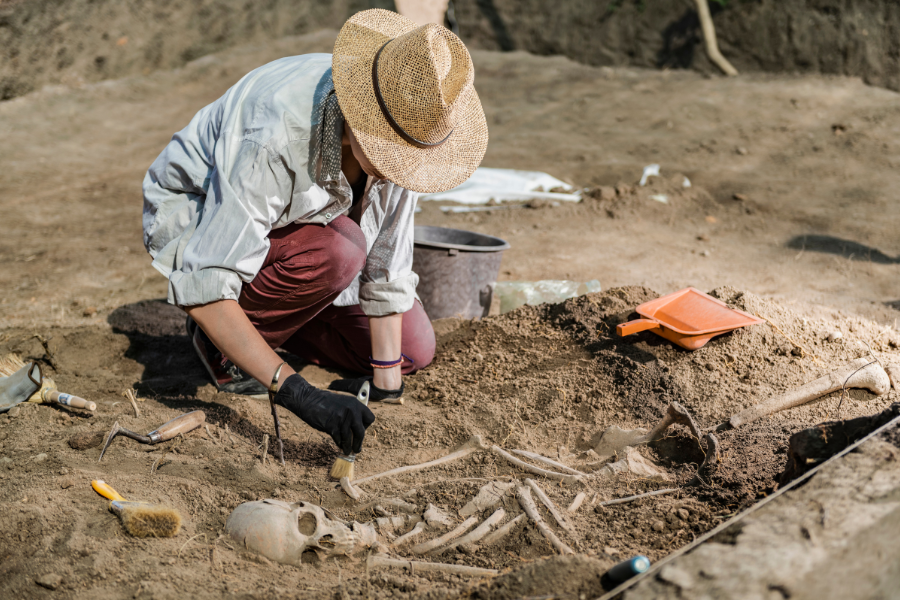
Inflammation in ancient bones is one of the places where archaeology and herbalism meet. When I studied anthropology at Boise State, we learned to read the skeleton as a diary. It records what a person ate, how hard they worked and what they lived through. Read with care, the teeth and the body’s own belongings also show which plants our ancestors reached for. Here are four witnesses, each with a real study behind it.
The Neanderthal Teeth of El Sidrón
About 50,000 years ago, in a cave in northern Spain, a Neanderthal chewed yarrow and chamomile. Karen Hardy and her team scraped hardened plaque from the teeth of five Neanderthals at El Sidrón. In one adult they found compounds that come from those two plants.1 Neither has much food value, and both are bitter. The El Sidrón group also carried the gene for tasting bitterness, so the choice was probably deliberate.2 The team suggests, carefully, that this individual chose them for their effects. Yarrow and chamomile are still two of the first herbs I reach for when tissue is hot and irritated.
Ötzi’s Birch Fungus and His Tattoos
Ötzi died in the Alps about 5,300 years ago and came out of the ice in 1991. Among his belongings were two pieces of birch polypore strung on a strip of hide. Luigi Capasso reported in The Lancet that Ötzi’s gut held whipworm eggs, and that the fungus is a strong purgative with antibiotic compounds. He proposed that Ötzi was dosing himself.3 Not every mycologist agrees, since the same fungus also made good tinder.
Ötzi’s skin tells a second story. He carried 61 tattoos, small groups of lines and a few crosses, and most of them sit on his lower back and on his legs from the knees down, where his skeleton shows wear.4 Many researchers read them as marks made to ease aching joints. If they are right, the oldest tattoos we know of were made for the oldest complaint we know of: joints that hurt.
Mummies and Their Arteries
In 2013 Randall Thompson’s team ran CT scans on 137 mummies from Egypt, Peru, the American Southwest and the Aleutian Islands. They found hardened arteries in 34 percent of them, and in every population, including the Unangan hunter-gatherers of the Aleutians. Those with hardened arteries had died older, at 43 on average against 32.5 The authors concluded that this kind of arterial disease belongs to human ageing and not only to modern life. They also pointed out that these people lived with constant infection and the smoke of open fires, and both keep inflammation burning.
What Farming Did to the Skeleton
The old story says farming made life better. Clark Spencer Larsen gathered the evidence from human remains around the world and found the opposite for the first farmers. Compared with the foragers before them, they had more tooth decay and poorer general health, and their bones grew less robust as daily movement declined.6 A narrower plate and a quieter body left their mark in the bone.
| Witness | What the remains show | What an herbalist hears |
|---|---|---|
| El Sidrón Neanderthal | Bitter yarrow and chamomile in dental plaque | Bitter, cooling plants for hot, irritated tissue |
| Ötzi | Birch fungus in his kit; tattoos over worn joints | Care for the gut and for the joints |
| The Horus mummies | Hardened arteries in a third of 137 bodies | Inflammation is old; age, infection and smoke feed it |
| The first farmers | More decay, less robust bones | Varied food and daily movement matter |
What Galen Wrote Down
Galen came late in this story, but he wrote down what the bones had been saying. He held that health is kept first by regimen: food, drink, sleep and exercise. He wrote a whole short book in praise of exercise with a small ball, a game that worked the whole body and lifted the spirits at the same time.7 His Hygiene sets out how food and exercise should change with a person’s age and with the seasons.8 Read the farmers’ bones forward and you reach Galen’s conclusion. When variety leaves the plate and movement leaves the day, the body pays.
What We Can Take From Them
- Eat widely, the way foragers did: many plants, changing with the seasons. The Complete Guide to Anti-Inflammatory Eating sets out the pattern.
- Keep bitter plants in the kitchen: chicory and dandelion greens in spring, a cup of chamomile in the evening.
- Move every day. Walking, carrying and play count for more than one hard hour at the gym.
- Keep the air clean. The mummies lived with smoke, and smoky, stale or heavily scented air still feeds inflammation.
- Know your temperament. The Four Galenic Constitutional Types explains how Galen matched food and exercise to the person.
Safety Notes
- Yarrow and chamomile belong to the daisy family. People allergic to ragweed, arnica or daisies can react to them.
- Talk with your doctor before using yarrow in pregnancy.
- Leave birch polypore to the archaeologists. It is a strong purgative and has no place in a home tea.
- If you take prescription drugs, check first. See Herb-Drug Interactions.
The Bones Speak
The bones do speak, but softly, and only to people who listen to what the evidence actually says. They tell us that inflammation is as old as we are and that age brings some of it with it. They also tell us that our ancestors chewed bitter plants on purpose, carried their own fungus into the mountains, and marked their aching joints. The farmers’ bones tell us that a narrow diet and a still body made things worse, which is exactly what Galen wrote down in Rome.
© 2024 Carolyn Smith-Kizer
If this work is useful to you, you can buy me a coffee — buymeacoffee.com/cskizer

Notes
- Karen Hardy et al., “Neanderthal Medics? Evidence for Food, Cooking, and Medicinal Plants Entrapped in Dental Calculus,” Naturwissenschaften 99 (2012): 617–26, https://doi.org/10.1007/s00114-012-0942-0.
- Karen Hardy, Stephen Buckley, and Michael Huffman, “Neanderthal Self-Medication in Context,” Antiquity 87, no. 337 (2013): 873–78, https://doi.org/10.1017/S0003598X00049528.
- Luigi Capasso, “5300 Years Ago, the Ice Man Used Natural Laxatives and Antibiotics,” The Lancet 352, no. 9143 (1998): 1864, https://doi.org/10.1016/S0140-6736(05)79939-6.
- Marco Samadelli, Marcello Melis, Matteo Miccoli, Eduard Egarter Vigl, and Albert R. Zink, “Complete Mapping of the Tattoos of the 5300-Year-Old Tyrolean Iceman,” Journal of Cultural Heritage 16, no. 5 (2015): 753–58, https://doi.org/10.1016/j.culher.2014.12.005.
- Randall C. Thompson et al., “Atherosclerosis across 4000 Years of Human History: The Horus Study of Four Ancient Populations,” The Lancet 381, no. 9873 (2013): 1211–22, https://doi.org/10.1016/S0140-6736(13)60598-X.
- Clark Spencer Larsen, “Biological Changes in Human Populations with Agriculture,” Annual Review of Anthropology 24 (1995): 185–213.
- Galen, On Exercise with a Small Ball, in Hygiene, ed. and trans. Ian Johnston, vol. 2, Loeb Classical Library 536 (Cambridge, MA: Harvard University Press, 2018).
- Galen, Hygiene, ed. and trans. Ian Johnston, 2 vols., Loeb Classical Library 535–536 (Cambridge, MA: Harvard University Press, 2018).
Bibliography
Capasso, Luigi. “5300 Years Ago, the Ice Man Used Natural Laxatives and Antibiotics.” The Lancet 352, no. 9143 (1998): 1864.
Galen. Hygiene. Edited and translated by Ian Johnston. 2 vols. Loeb Classical Library 535–536. Cambridge, MA: Harvard University Press, 2018. Volume 2 includes On Exercise with a Small Ball.
Hardy, Karen, Stephen Buckley, Matthew J. Collins, Almudena Estalrrich, Don Brothwell, Les Copeland, Antonio García-Tabernero, et al. “Neanderthal Medics? Evidence for Food, Cooking, and Medicinal Plants Entrapped in Dental Calculus.” Naturwissenschaften 99 (2012): 617–26.
Hardy, Karen, Stephen Buckley, and Michael Huffman. “Neanderthal Self-Medication in Context.” Antiquity 87, no. 337 (2013): 873–78.
Larsen, Clark Spencer. “Biological Changes in Human Populations with Agriculture.” Annual Review of Anthropology 24 (1995): 185–213.
Samadelli, Marco, Marcello Melis, Matteo Miccoli, Eduard Egarter Vigl, and Albert R. Zink. “Complete Mapping of the Tattoos of the 5300-Year-Old Tyrolean Iceman.” Journal of Cultural Heritage 16, no. 5 (2015): 753–58.
Thompson, Randall C., Adel H. Allam, Guido P. Lombardi, et al. “Atherosclerosis across 4000 Years of Human History: The Horus Study of Four Ancient Populations.” The Lancet 381, no. 9873 (2013): 1211–22.