
Wise Woman Tradition: Grandmothers’ Anti-Inflammatory Wisdom
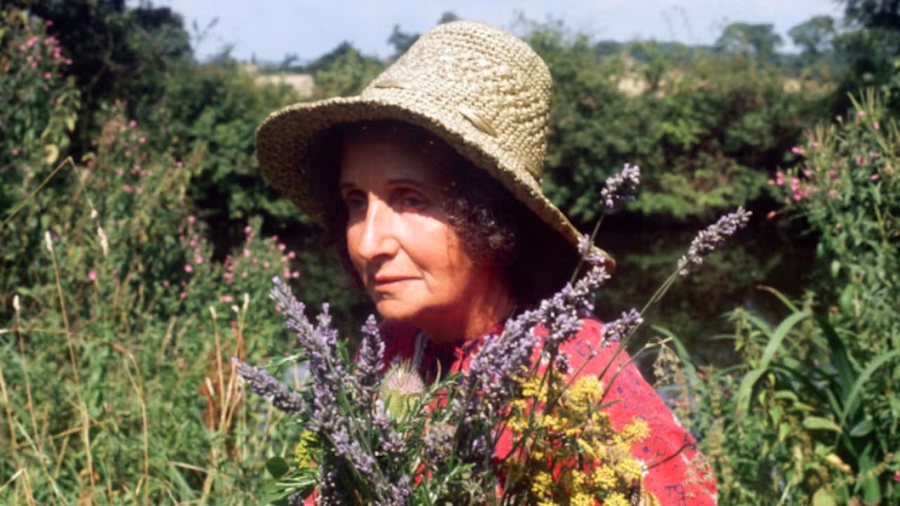
Featured Image: Juliette de Baïracli Levy was an English herbalist and author noted for her pioneering work in holistic practice.
Rewritten October 2026. An earlier version of this post cited studies that could not be verified. They have been removed, and every source below has been checked.
The wise woman tradition is older than any herbal ever printed. In nearly every village there was a woman people went to before they went anywhere else: the grandmother who knew which leaf to lay on a sting, which root to simmer for a cold stomach, and when a body needed rest more than anything she could pick for it. I came to herbs through that tradition myself, long before I studied Galen, and I still think it holds something the modern conversation about inflammation keeps missing.
Why the Grandmother Matters
Anthropologists have a name for the idea that grandmothers shaped us: the grandmother hypothesis. Kristen Hawkes and her colleagues, working among the Hadza of Tanzania, found that older women’s foraging fed their grandchildren and freed their daughters to bear more children. They argued that this help is part of why human beings live so long past their childbearing years.1
Whatever one makes of the evolutionary argument, the picture matches what every family knows. The grandmother is the one who has seen the same fever, the same sore throat and the same stiff knees many times over, and remembers what helped.
What Is Being Lost
That memory does not live in books. It lives in languages. In 2021 the ecologists Rodrigo Cámara-Leret and Jordi Bascompte compared 3,597 plant species and 12,495 plant uses across 236 Indigenous languages of North America, northwest Amazonia and New Guinea. More than three quarters of those plant uses were known in only one language.2
When the last speakers of a language are gone, what they knew about their plants goes with them. Most of it was never written down because it never needed to be. It passed from grandmother to granddaughter, at the stove and in the field.
Hot and Cold: The Old Reading of Inflammation
The Galenic physicians would have recognised the grandmother’s way of thinking. For them, inflammation was an inflow of hot blood and humours into a part of the body that could not carry them away again, and they described it with the four signs Celsus set down: redness, swelling, heat and pain.3 Yet not every swelling was hot. A red, throbbing joint called for cooling plants, and a cold, stiff, long-standing ache called for warming ones. I set out that distinction, and the herbs that suit each, in Anti-Inflammatory Herbs: A Galenic Field Guide.
The village grandmother worked the same way without ever reading Galen. She did not ask what a herb was “for.” She asked whether the person in front of her was running hot or cold, damp or dry, and chose accordingly. Elderflower and yarrow for a hot, restless fever; ginger and a pinch of cinnamon for a cold, slow stomach; chamomile for a child who could not settle.
Two Grandmothers of the Craft
Juliette de Baïracli Levy, whose photograph heads this post, was born in Manchester in 1912 and spent most of her long life on the move. She learned plant lore from Romani families, farmers and stock breeders in Spain, Turkey, North Africa, Israel and Greece.4 She began as a veterinary student and wrote first for dog breeders and farmers, then for everyone, in A Herbal Handbook for Everyone (1966).5 Many herbalists of my generation learned from her books, and she is often called a grandmother of modern herbalism.
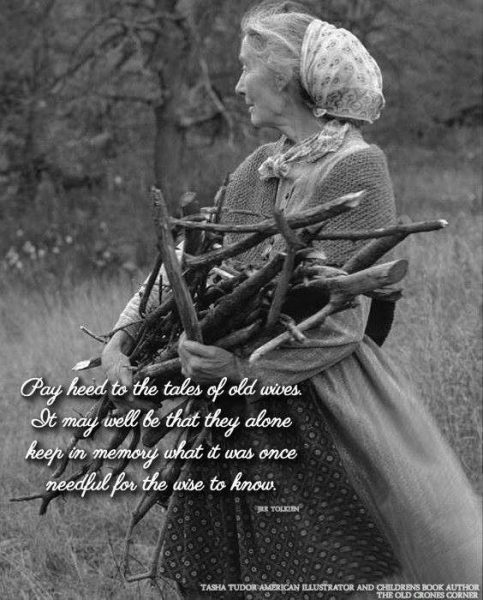
Tasha Tudor, pictured here, was not an herbalist at all. She was an American illustrator who chose to live in Vermont much as a farm wife of the 1830s would have, with her goats and her gardens. I include her because the wise woman tradition was never only about plants. It was a way of keeping a household: growing, gathering, cooking, mending and noticing.
I have written separately about the wise woman in Scripture.
What the Tradition Asks of Us
The grandmother’s lessons were small and practical. Watch the person, not just the complaint. Eat with the seasons. Keep a few gentle plants close at hand and know them well. And know when something is beyond the kitchen garden, and send for help.
That last lesson matters as much as the others. The wise woman of the village was the first person you went to, never the last, and she knew the difference between a cold stomach and something that needed a physician.
The same household knowledge fed the Carolingian gardens. Much of the Capitulare de Villis plant list reads like a grandmother’s garden: sage, rue, fennel, mint and lovage, ordered onto every royal estate. Three centuries later, Hildegard von Bingen wrote a good deal of that knowledge down.
Carrying It On
I am in my seventies now, and I find I think less about what I have learned than about who will carry it on. That is why I write it down here, as plainly as I can, with sources you can check. A grandmother’s knowledge is only as good as the trust it carries, and trust is kept by telling the truth about where things come from.
© 2024 Carolyn Smith-Kizer
If this work is useful to you, you can buy me a coffee — buymeacoffee.com/cskizer

Notes
1. Kristen Hawkes, James F. O’Connell, Nicholas G. Blurton Jones, Helen Alvarez and Eric L. Charnov, “Grandmothering, Menopause, and the Evolution of Human Life Histories,” Proceedings of the National Academy of Sciences 95, no. 3 (1998): 1336–39.
2. Rodrigo Cámara-Leret and Jordi Bascompte, “Language Extinction Triggers the Loss of Unique Medicinal Knowledge,” Proceedings of the National Academy of Sciences 118, no. 24 (2021): e2103683118.
3. Celsus, De Medicina 3.10.3, trans. W. G. Spencer, Loeb Classical Library (Cambridge, MA: Harvard University Press, 1935).
4. New Forest National Park Authority, “Juliette de Baïracli Levy, Herbalist,” newforestnpa.gov.uk.
5. “Juliette de Baïracli Levy,” Wikipedia, accessed 28 October 2026, en.wikipedia.org.
Bibliography
Cámara-Leret, Rodrigo, and Jordi Bascompte. “Language Extinction Triggers the Loss of Unique Medicinal Knowledge.” Proceedings of the National Academy of Sciences 118, no. 24 (2021): e2103683118.
Celsus. De Medicina. Translated by W. G. Spencer. Loeb Classical Library. Cambridge, MA: Harvard University Press, 1935.
Hawkes, Kristen, James F. O’Connell, Nicholas G. Blurton Jones, Helen Alvarez, and Eric L. Charnov. “Grandmothering, Menopause, and the Evolution of Human Life Histories.” Proceedings of the National Academy of Sciences 95, no. 3 (1998): 1336–39.
“Juliette de Baïracli Levy.” Wikipedia. Accessed 28 October 2026.
New Forest National Park Authority. “Juliette de Baïracli Levy, Herbalist.”