
From the Pays Illinois to the Gas Station: How Charlemagne Explains American Portions
A British man appeared recently on the internet, armed only with honesty and a sense of proportion.
“America has got pew-pews, space and lots of confidence. In the UK, we’ve just got Greggs and rain. There’s no match, honestly. We are like America’s tiny, tiny little baby brother and sister.”
The video — which you can watch embedded below — is funny in the way that good observations usually are: not because it’s unfair, but because it’s accurate. Americans are, measurably, physically larger. American portions are, measurably, larger. American confidence about food — the assumption that there will be enough, that you may eat until you’re done, that abundance is the baseline rather than the exception — is a cultural inheritance so deep that most Americans have never once questioned it.
I want to take that observation seriously. Not to mock it and not to explain it away with easy answers about industrialization or fast food or McDonalds. I want to trace it all the way back to its roots — which is to say, all the way back to the world that Charlemagne was trying to manage when he commissioned the Capitulare de Villis.
Because that’s where this story starts. Not in Illinois. Not in 1750. It starts in a Europe where hunger was not an occasional tragedy but a structural condition of life — built into the soil, the seasons, the yields, the very bodies of the people who worked the land.
The World Charlemagne Was Trying to Fix
The Capitulare de Villis — Charlemagne’s great agricultural capitulary, issued sometime around 800 CE — is a document I have spent considerable time with here at At Charlemagne’s Behest. If you haven’t read my introduction to it yet, that would be a good place to start. But for our purposes today, the most important thing to understand about the Capitulare is what kind of world it was written into.
It was written into a world of managed scarcity.
Charlemagne’s Frankish kingdom had experienced a serious famine in 778–79 CE, so devastating that it prompted both a capitulary mandating communal prayers and almsgiving, and the kind of administrative alarm that causes kings to start legislating gardens. Historians of the early medieval period have documented what they call a consistent pattern of subsistence crises in Carolingian Europe: crop failures, livestock pandemics, shortfalls in seed reserves, years in which even the royal estates — the wealthiest agricultural operations in the realm — came up short.
This is not a peripheral detail. It is the entire point of the Capitulare de Villis.
Charlemagne’s famous list of plants to be grown on every royal estate — the list that includes sage, fennel, wormwood, rosemary, and dozens of others — was not written by a man who took food for granted. It was written by a man who understood, at a fundamental level, that food did not simply exist. It had to be wrested from the ground by coordinated human effort, properly stored, properly managed, and carefully distributed. The document reads like what it is: an act of administrative willpower directed against the constant threat of not having enough.
The Carolingian cereal yields that historians have been able to reconstruct from estate records suggest ratios that would horrify a modern farmer — sometimes as low as 2:1 or 3:1, meaning two or three grains harvested for every one planted. In a bad year, after seed corn was set aside, there might be very little left. And bad years were not rare. They were, in the view of the peasants who lived through them, simply what years sometimes were.
This is the world that produced European food culture. Not the world of Escoffier. Not the world of the long French table with its magnificent courses. The world underneath all of that: the world of chronic agricultural uncertainty, of hunger held at bay by effort and luck, of a food supply that even the nobility could not entirely command.
What Small Plates Actually Mean
I have read, over the years, many elegant explanations for the French tradition of multiple small courses — the emphasis on variety over volume, the succession of dishes, the way a fine French meal is experienced as a series of tastes rather than an accumulation of mass. These explanations tend to emphasize sophistication, restraint, aesthetic refinement.
These explanations are not wrong. But they are incomplete.
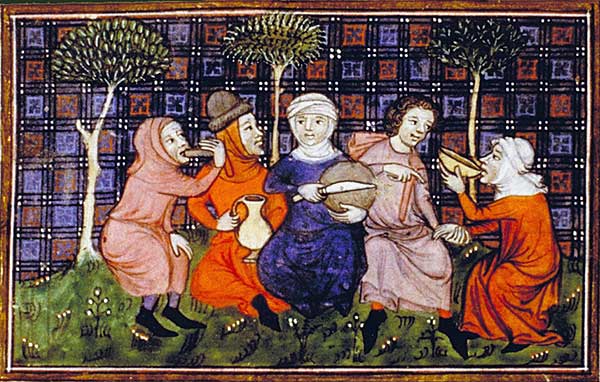
The tradition of small portions, many courses, and the grazing principle — one spoon of this, one spoon of that — is also the tradition of a society that could not guarantee its food supply even to the wealthy. When you cannot be certain that there will be enough of any one thing, you serve many small things. You spread the risk. You ensure that no single dish, if it fails or runs short, can collapse the meal entirely. You train the body to find satisfaction in variety rather than volume.
This is not cynicism about French cuisine. French cuisine is genuinely one of the great achievements of human civilization. But like all great culinary traditions, it was shaped by the conditions of the world that produced it. And the condition that produced it, at the deepest level, was scarcity.
Charlemagne understood this. His capitulary is a scarcity-management document dressed up as an agricultural directive. He wasn’t just trying to grow better herbs. He was trying to ensure that the imperial estates could weather the inevitable years when the harvest came up short — that there would be something in the stores, something in the ground, something to fall back on when the rye failed or the cattle sickened.
The culture that emerged from centuries of living inside that uncertainty was a culture that treated food carefully, ate deliberately, and never quite lost the knowledge — encoded in habit and custom long after the conscious fear was gone — that abundance was fragile.
The Rupture: Pays des Illinois
In the early eighteenth century, French soldiers, missionaries, and colonial officers began arriving in what they called the Pays des Illinois — the Illinois Country, the vast stretch of the upper Mississippi valley that is now the American Midwest. They came from a world shaped by exactly the food culture I’ve just described. They came from France, from Quebec, from the Jesuit missions and the garrison towns, carrying in their bodies and their expectations a European understanding of what land produced and what a man could reasonably eat.
What they found did not fit any category they had.
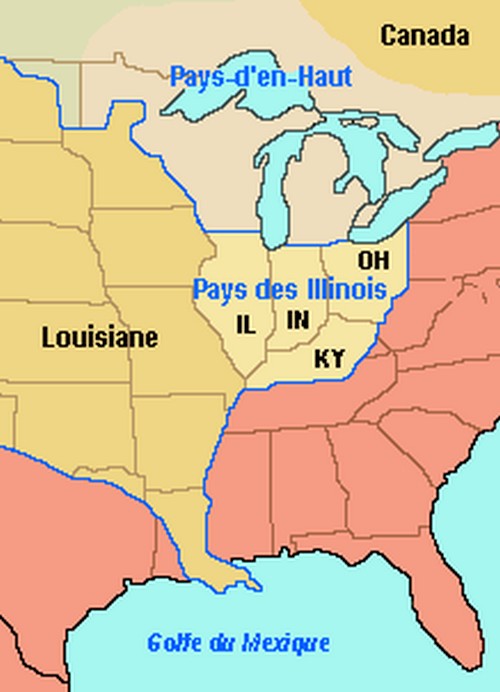
I encountered their accounts during the years I lived in southern Illinois — Little Egypt, as that corner of the state is still called — in the early 2000s, when American French Colonial reenactors had begun accessing and translating the officers’ letters and reports held in the French national archives. The translations circulated among people in our community who had the French to work with the originals, and what struck me then — and has never left me — was the quality of bewildered joy in those documents.
These were trained observers writing home to France. They were not romanticizing. They were, in several cases, military officers with a professional interest in accurate assessment. And what they reported, again and again, was something that seems almost impossible from the perspective of their European formation: that in the Pays des Illinois, you did not even have to till the ground. You laid the seed on top and it grew. That even poor settlers ate better than the French nobility. That the food supply was not a problem to be managed but a condition to be inhabited — that abundance was simply what this land did.
A man of wealth in France, they noted, could not have what he wanted at his own table — not because he lacked the money, but because the food simply was not there to be bought. The supply chains of eighteenth-century France, even for the wealthy, operated within the constraints of what the land produced. And the land of France, for all its beauty and its centuries of cultivation, produced within limits that the Pays des Illinois simply did not seem to have.
Peter Kalm Sees the Same Thing
The Swedish botanist Pehr Kalm — one of Linnaeus’s most accomplished students, sent to North America between 1748 and 1751 to collect seeds and plant specimens for Swedish agriculture — recorded what amounts to the same observation from a different angle.
Kalm’s Travels in North America, published in Swedish in 1753–61 and translated into English in 1770, is one of the foundational documents of colonial natural history. He was a trained scientist with a sharp eye and a habit of comparing what he saw in the New World to what he knew of the Old. And what he saw, traveling through the colonies, was a people who ate with a freedom and a completeness that had no European analogue.
Kalm documented the agricultural practices of the colonists in extraordinary detail — the soil quality, the crop yields, the variety of foods available, the ease with which even ordinary settlers kept themselves fed. His observations were not sentimental. They were the observations of an agricultural economist trained to assess what land could produce and what populations could sustain. And his conclusion, stated in various ways throughout the work, was that North America operated by different rules than Europe.
The soil of the Illinois country and the broader colonial frontier was not European soil. It had not been farmed for centuries. It had not been depleted by the intensive grain cultivation that had characterized the open-field systems of northern France and the Rhine valley since the Carolingian period. It was soil that gave back in proportions that Europeans had no framework for. And the people who lived in it — even the poorest of them — were eating accordingly.
For Kalm, this was an agricultural observation. For the French officers writing home, it was something closer to a philosophical shock. Their entire understanding of the relationship between human effort and food — an understanding that Charlemagne had encoded in his capitulary a thousand years before, an understanding that had produced the careful, deliberate, small-plate food culture of France — had just been rendered obsolete by a river valley in the middle of a continent they were only beginning to understand.
The Long Echo: How Abundance Became American
The settlers who poured into the American interior in the eighteenth and nineteenth centuries were not, for the most part, French. They were Scots-Irish, German, English, Welsh — people from the same European tradition of agricultural scarcity, carrying the same deep body-knowledge that food was hard, that enough was never guaranteed, that waste was sin.
And then they arrived somewhere that simply was not like that.
The psychological and cultural consequences of this encounter are still playing out. What the Englishman in the TikTok video is observing — the size, the confidence, the assumption of plenty — is not a product of industrial agriculture or fast food or post-war American prosperity, though all of those things have amplified it. It is the cultural inheritance of two or three generations of settlers who arrived in a land that did not behave like Europe, and who adapted to that abundance so thoroughly that the adaptation became who they were.
You eat big when you come from somewhere that ate carefully for a thousand years and then suddenly found you didn’t have to. The relief becomes the baseline. The baseline becomes the culture. The culture becomes the body.
The gas station linebacker is, in some strange way, a product of Charlemagne’s world — or rather, of what happened when people from Charlemagne’s world stepped out of it into something else entirely.
Reading the Capitulare de Villis From Inside Scarcity
I want to close by coming back to the document itself — because I think this history changes how we ought to read it.
The Capitulare de Villis is not a curiosity. It is not a medieval list of plants, interesting to herbalists and historians but otherwise remote from anything that matters today. It is a window into the mental world of a civilization that understood, at a level below conscious articulation, that food was not guaranteed — that it had to be planned for, legislated for, stored, diversified, and managed with care.
When Charlemagne lists the plants to be maintained on every royal estate — when he specifies sage and wormwood and fennel and dozens of others — he is not being whimsical. He is building a resilience system. He is ensuring that when the rye fails, there will be something else. When the stores run low, there will be medicinal plants, aromatic plants, plants that can season a thin broth into something that sustains. He is doing, in legislative form, what French cuisine did in culinary form: distributing risk across variety, ensuring that no single point of failure can collapse the whole.
The French officers who wrote home from the Pays des Illinois in the 1700s were astonished because they were reading that document — not literally, but culturally. They had been formed by a world that the Capitulare de Villis both reflected and helped create. And suddenly they were standing in a place where none of its anxieties applied.
Pehr Kalm was astonished for the same reason. A man trained in the careful agricultural economy of northern Europe, sent to assess what new plants might improve Swedish yields, found himself in a land where the question of improvement seemed almost beside the point — where the land itself was already doing things that European soil had not done in living memory.
The gap between those two worlds — the world of the Capitulare and the world of the Pays des Illinois — is the gap that produced American food culture. It is a gap measured in soil depth and growing seasons and centuries of use, but it is also a gap measured in human expectation, in the deeply held assumptions about what a body is owed and what a meal is for.
We are still living in that gap. The TikTok video is funny because it is true. And it is true because of something that happened a very long time ago, in a river valley in the middle of a continent, when Europeans first discovered that the world did not have to be the way they had always known it.
Further Reading
For those who wish to explore these threads further:
On the Capitulare de Villis: See my introductory essay, At Charlemagne’s Behest EP.1, at this site. The full Latin text with English translation is available through the Avalon Project at Yale Law School.
On the Pays des Illinois: Carl J. Ekberg’s French Roots in the Illinois Country: The Mississippi Frontier in Colonial Times (University of Illinois Press, 1998) is the definitive scholarly treatment of French colonial agriculture in the region and won the Kemper and Leila Williams Prize for the Best Book on Louisiana History. Rebecca Earle’s work on colonial food and identity is also valuable for context.
On Peter Kalm: Peter Kalm’s Travels in North America: The English Version of 1770, translated and edited by Adolph B. Benson (Dover Publications, 1987), remains in print and is an essential primary source for anyone interested in colonial North American natural history and agriculture.
On Carolingian famine and agricultural management: The academic literature here is rich. A useful entry point is Stephan Ebert’s work on “Starvation Under Carolingian Rule” (2017), and Timothy Newfield’s dissertation, The Contours of Disease and Hunger in Carolingian and Early Ottonian Europe (McGill, 2010).
On the French colonial officers’ letters: The archival letters I describe are held in the French national archives (Archives nationales) and have been accessed and translated by scholars and reenactors working with the French Colonial Midwest historical community. The French and Indian Colonial Historical Association (FICAS) and the Illinois Colony project (illinoiscolony.org) are good starting points for those wishing to pursue the primary sources.
I enjoyed the article. Thank you for sharing this information.
You’re very welcome–I’m glad you enjoyed it♥
Thank you for this fascinating and elegant essay! You write beautifully.
You are so welcome–I’m glad you enjoyed it♥