

Essential Capitulare de Villis Plant List: All 73 Species Identified
The botanical foundation of Carolingian herbalism: every plant in Chapter 70 of Charlemagne’s imperial estate ordinance, identified, classified, and set in Galenic context ~ the Capitulare de Villis Plant List.
Evergreen Reference·Free PDF Download Below
The Document Behind the Discipline
The Capitulare de Villis vel Curtis Imperialibus — the “Ordinance Concerning the Royal Estates and Imperial Farms” — is one of the most consequential documents in the history of European herbalism and horticulture. Issued under Carolingian authority, most likely finalized between 800 and 820 CE under Louis the Pious following his father Charlemagne’s framework, it was a practical administrative text: a set of instructions to the managers of royal estates (villae) throughout the Frankish realm, telling them precisely how those estates were to be run.
Chapter 70 is the passage that has interested herbalists, historians, and gardeners for centuries. It is a plant list — 73 species that every royal estate was to maintain in its gardens. Herbs, vegetables, medicinal plants, fruit trees, spice plants, and a handful of items that could not possibly have been grown in Frankish soil. It is, in the truest sense, a curriculum: this is what a properly ordered garden knows ~ the Capitulare de Villis plant list.
“We wish that in the garden shall be cultivated…” — and then follows a list that reaches from the most ordinary kitchen herbs to exotic trade resins from Persia and spices from the Maluku Islands. The ambition of that list is itself a theological and political statement. — Capitulare de Villis, Chapter 70 (c. 800–820 CE)
This reference document of the Capitulare de Villis plant list provides the complete botanical identification of all 73 species: the original Latin name as it appears in the text, the accepted modern botanical name, plant family, common English name, functional type, and contextual notes on Galenic character and historical use. It is the documentary spine of At Charlemagne’s Behest and a standing companion to every episode in the series.
How to Read the Capitulare de Villis Plant List
Medieval Latin plant names were not standardized in the Linnaean sense. A single name could denote related species, regional variants, or occasionally quite different plants depending on the scriptorium, the region, or the copying monk’s own botanical knowledge. Where identification is genuinely uncertain or disputed in the scholarly literature, this is noted.
Duplicate Entries
Several species appear more than once in the list — fennel four times, fava beans three times, lettuce twice. These duplications are preserved from the source text rather than silently corrected. They most likely reflect real distinctions that were obvious to a Carolingian gardener but require explanation today: cultivated versus wild forms, leaf versus root versus seed as distinct preparations, or large-seeded versus small-seeded garden varieties. The repetitions are data, not errors.
Trade Spice and Aspirational Entries
Four species on the list — costus root, galbanum, cloves, and capers — could not have been grown in the Frankish climate. Their presence is not a mistake. It is a statement. The Capitulare was not only a farming manual; it was a vision of what imperial Frankish civilization should look like, positioned as the legitimate heir to Roman cultural reach.
The inclusion of luxury imports from Arabia, Persia, and the Spice Islands signals that the Carolingian court expected its estates to maintain mastery over the entire known materia medica — including what had to be purchased at great expense along the trade routes.
On Galenic character notations: The hot/cold/dry/moist quality assignments in this reference follow classical Galenic theory as transmitted through Dioscorides, Hildegard of Bingen, the Salernitan corpus, and Culpeper’s later synthesis. They describe the plant’s energetic quality in Galenic humoral theory — they are not modern medical claims, diagnoses, or treatment recommendations. The purpose here is historical and educational: to recover how these plants were understood by the people who used them.
Selected Species — A Preview of the Full List
The complete 73-species reference with full notes is available as a free PDF download below. The table here offers a representative sample — twelve species chosen to illustrate the range of the list: kitchen staples, serious medicinals, exotic imports, and the plants most central to the At Charlemagne’s Behest episode series.
| # | Capitulare Name | Botanical ID | Common Name | Galenic Character | Type |
|---|---|---|---|---|---|
| 5 | Salviam | Salvia officinalis | Garden Sage | Hot & dry, 2nd degree | Medicinal |
| 16 | Blidas | Blitum virgatum / Chenopodium capitatum | Strawberry spinach | Cool & moist | Vegetable |
| 23 | Levisticum | Levisticum officinale | Lovage | Hot & dry | Medicinal |
| 26 | Foenuculum | Foeniculum vulgare | Fennel | Warm & dry | Medicinal |
| 42 | Git | Nigella sativa | Black cumin / Nigella | Hot & dry | Spice |
| 53 | Helenium | Inula helenium | Elecampane | Hot & dry | Medicinal |
| 60 | Cariofolum | Syzygium aromaticum | Cloves | Hot & dry, extreme | Trade spice ✦ |
| 62 | Rosas | Rosa gallica / Rosa canina | Rose (Gallic / Dog rose) | Cool & dry | Medicinal |
| 63 | Ros marinum | Salvia rosmarinus | Rosemary | Hot & dry | Medicinal |
| 70 | Glautem | Chelidonium majus | Greater celandine | Hot & dry | Medicinal |
| 71 | Absinthium | Artemisia absinthium | Wormwood | Hot & dry, 3rd degree | Medicinal |
| 72 | Consolida | Symphytum officinale | Comfrey | Moist & cooling | Medicinal |
Capitulare Plants in the ACB Series
Every episode of At Charlemagne’s Behest is rooted in this list. The series works outward from the Capitulare into Galenic constitutional theory, Hildegard of Bingen’s Physica, the Salernitan school, and the living continuity of these plants in the gardens and hedgerows of the Creuse valley. The cross-references below link each episode to its primary Capitulare entry.
Episode & Interstitial Cross-References
- EP.2 Salvia officinalis — Garden Sage · Entry #5
- EP.3 Artemisia absinthium — Wormwood · Entry #71
- EP.5 Foeniculum vulgare — Fennel · Entries #26, 37, 66, 73
- EP.6 Hildegard’s Bridge · Multiple species
- INT The Perpetual Vegetables Charlemagne Already Knew · Entries #15 (Atriplex) & #16 (Blidas)
A Living Continuity in the Creuse
Several species on the Capitulare de Villis plant list grow today as volunteers and weeds in the garden at 10 rue Martin Nadaud, Clugnat — greater celandine, comfrey, wormwood, nettles, elderberry. This is not coincidence but continuity: the Creuse sits within what was the heartland of Gaulish and then Gallo-Roman settlement, and the Capitulare itself was addressed to estates that included this region.
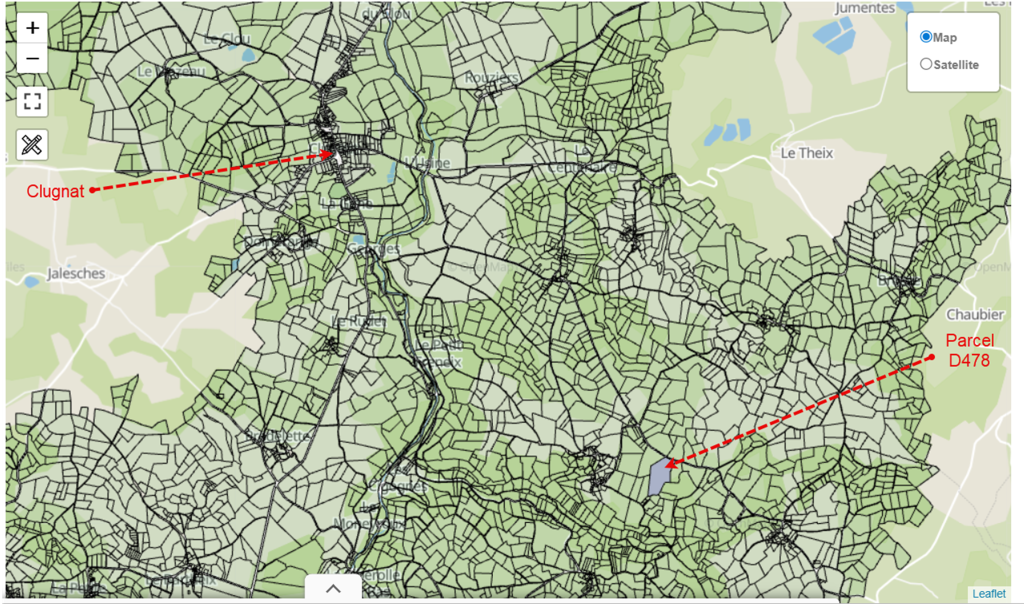
A recent archaeological survey (Bilan Scientifique Régional, Nouvelle-Aquitaine, 2020, p. 181) confirmed the presence of Roman hypocaust tiles at approximately 80 cm depth on parcel D478 in the southeast quadrant of Clugnat — a buried, heated Roman structure within a few hundred metres of this garden.
The landscape in which these plants are growing today is the same landscape that fed the Roman villa economy that the Carolingian estate system directly inherited. The plants in the Capitulare de Villis plant list are not historical artifacts. They are here.
The Complete 73-Species Reference ~ Capitulare de Villis Plant List
All 73 Capitulare plants in a single formatted PDF: original Latin names, full botanical identifications, plant families, Galenic character, and detailed notes on historical use, identification uncertainty, and ACB series connections. Download the Full PDF Reference
Free · No sign-up required · Companion to the ACB episode series
Supporting the series? Buy me a coffee · PayPal
Primary Sources & Identification References
- Charlemagne / Louis the Pious. Capitulare de Villis vel Curtis Imperialibus, c. 800–820 CE. Translated and discussed in Verhulst, A. (2002). The Carolingian Economy. Cambridge University Press.
- Mane, P. (2006). Le Jardin Médiéval. Editions du Patrimoine.
- Ambrosoli, M. (1997). The Wild and the Sown: Botany and Agriculture in Western Europe, 1350–1850. Cambridge University Press.
- Hildegard of Bingen. Physica. Trans. Throop, P. (1998). Healing Arts Press.
- Dioscorides, Pedanius. De Materia Medica. Laguna edition (1570); modern critical edition Beck, L.Y. (2011). Georg Olms Verlag.
- Culpeper, N. (1652). The English Physitian. London. (Consulted for Galenic continuity into 17th century.)
- Bilan Scientifique Régional, Nouvelle-Aquitaine (2020), p. 181. Direction Régionale des Affaires Culturelles.
At Charlemagne’s Behest
Galenic & Carolingian herbalism · atcharlemagnesbehest.com
The information on this site is educational in nature and is intended to inform and support wellness. It is not intended to diagnose, treat, or cure any disease or condition.