
On Being a Better Imager: What It Means To Live Fully
A meditation on finitude, calling, and the weight of being specifically you . . .
What it means to live fully is not, finally, an abstract question. There is a signal firing in your brain that has never fired in exactly that way before, in any brain, in the history of the world.
Neuroscientists recently confirmed what the structure of the human cortex had long suggested: that individual neurons in the brain’s outer layers use not only sodium ions to generate their action potentials, but calcium — producing a kind of dendritic firing so complex that a single cell can perform logical operations previously thought to require an entire network.
The technical term is calcium-mediated dendritic action potential, and it changes what we thought we knew about where computation happens in the brain. Not just between neurons. Inside them. In the branching.
What this means, practically, is that the architecture of your particular mind — shaped by every conversation you have absorbed, every garden you have knelt in, every grief you have carried through — is not a general kind of thing. It is irreducibly, specifically, unrepeatable you–your key to what it means to live fully.
The combinatorial space of possible human nervous systems is so astronomically large that your exact configuration of fired and unfired pathways, your specific dendritic branching in the second and third cortical layers, has existed once and will exist once. When it is gone, it is gone entirely.
I find myself sitting with this longer than I expected to.
What It Means to Live Fully
Paul writes, in the first letter to the Corinthians, a line that has the quality of a stone dropped into still water: woe to me if I do not preach the gospel. Not woe if I fail. Not woe if I am insufficient. Woe if I do not — if the thing I was made to do goes undone because I filled the container of my days with something else instead.
The angst in that statement is not performative. Paul is not feeling sorry for himself. He is stating a condition, the way you might state that water freezes at zero degrees. The knowing created an obligation he could not set down.
The specific configuration of what he was — his training, his encounter on the road, his particular mind with its particular capacity to hold Torah and Greek philosophy in the same hand — pressed outward into the world through the only channel it could: his preaching. His writing.
His exhausting, dangerous, ship-wrecked, imprisoned life of constant movement toward people who needed what only he could bring.
He was not interchangeable. And he knew it. And the knowledge was not comfortable.
—
Walafrid Strabo, the ninth-century abbot of Reichenau, wrote a poem about his garden. We call it the Hortulus — the little garden — and it is one of the most extraordinary documents of the Carolingian world, not because it contains secret wisdom, but because it is so entirely itself.
It is a monk on his knees in the mud, in the cold wind off Lake Constance, pulling weeds from around his wormwood plants and noticing, with the kind of attention that only comes from sustained practice, exactly what the light is doing.
He grew Artemisia absinthium not because it was required of him but because he understood it — its bitterness as medicine, its smell as threshold-marker, its deep tap root as stubbornness made botanical. He wrote about it for the same reason. Not for an audience. For the record.
Because the knowledge lived in him and he was the only one it lived in quite that way, and he seems to have understood, however imperfectly, that to let it go unwritten would be a kind of waste.
The garden was not a distraction from his calling. It was his calling taking the particular shape available to it in that body, in that place, on that cold island in that particular century. The poem was not separate from the prayer. The poem was the prayer, made legible.
—
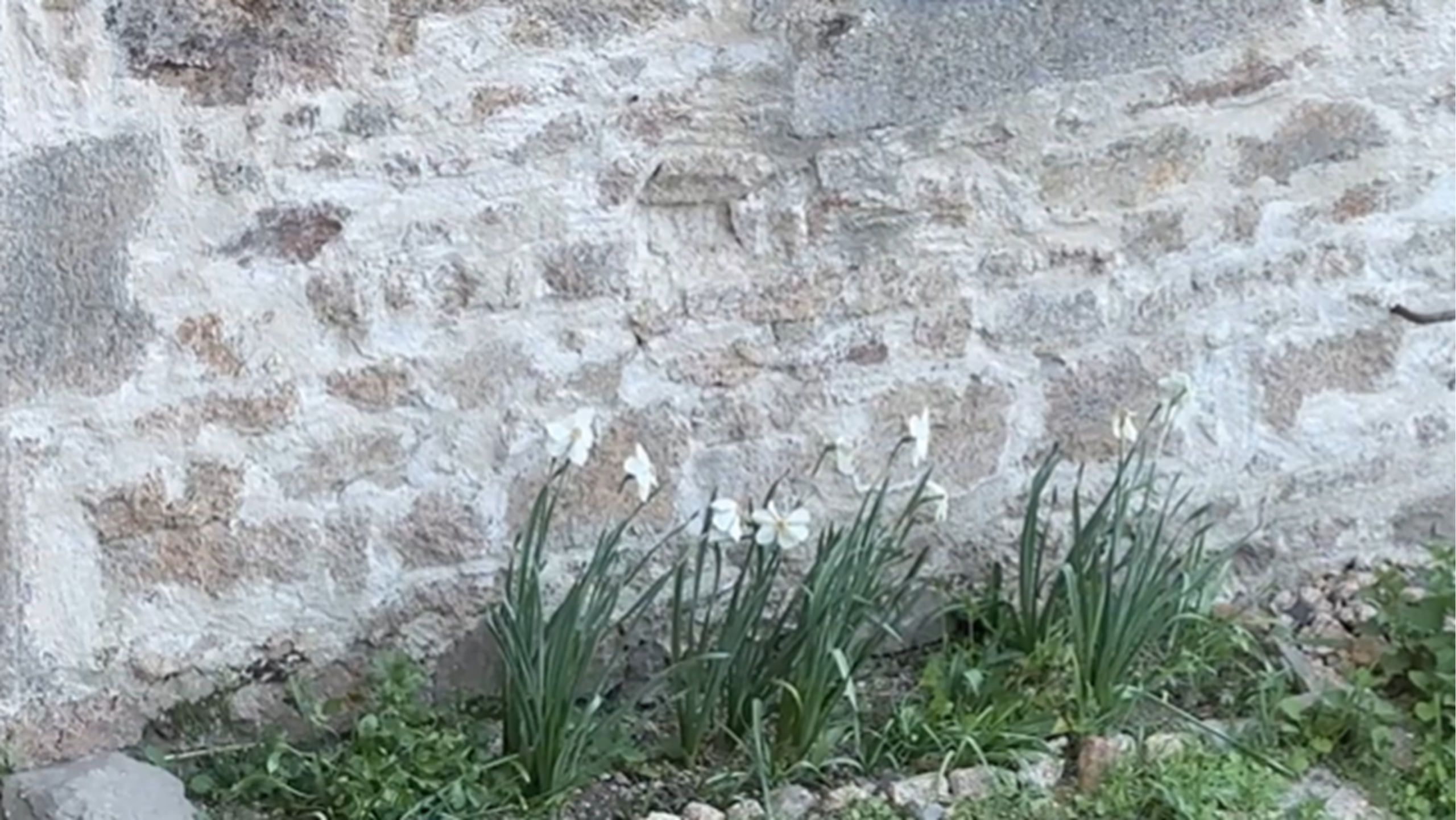
I think about this often, standing in my own garden in Creuse. The beds are not yet finished. The food forest is a plan and a collection of bare-root stock and a great deal of hope.
The east stone wall is 170 years old and patient in a way I am trying to learn. I am building something that will outlast me — the mulberry will be a canopy tree long after I am gone — and building something that only exists because I exist: because I came here with this particular knowledge, this particular formation, this particular set of hands that have spent twenty years touching medicinal plants and another twenty before that in the material culture of eighteenth-century French colonial life.
No one else is building this garden. No one else could. The combination of what I know and where I am and what I carry is not reproducible. This is not vanity. It is simply the condition I find myself in, the same condition Walafrid found himself in, the same condition Paul found himself in–what it means to live fully for each of us.
You are irreplaceable not because you are especially important in the cosmic scheme, but because specificity is how the world is made. It is made of this soil and not that one, this root and not that one, this person and not another.
—
The question that follows from all of this is uncomfortable: if the specific you exists once, and only once, and carries something the world cannot otherwise have — what are you doing with it?
Not as accusation. As genuine inquiry. The mundane is real. The bills are real. The administrative errands, the endless maintenance of a stone house, the hours that arrive and fill themselves without your having chosen them — all of it is real and most of it is necessary. The world does go round on the ordinary. I am not making an argument against the ordinary.
But there is a difference between the ordinary that is yours — the garden that is theology made dirt and root, the writing that puts serious knowledge into the hands of people who will never read a monograph, the hours of study that are formation whether or not they produce a product — and the ordinary that simply arrived and stayed. Most of us carry both. The question is proportion.
Paul’s woe was not about failure to be brilliant enough. It was about the danger of displacement — of letting the days fill with things that were not wrong, exactly, but were not the thing.
The race is not a metaphor for achievement. It is a metaphor for directed movement toward a finish line that is real and approaching. Woe is me if I run the race but don’t pass the finish line.
—
The neuroscience, the Carolingian garden, the apostolic anguish — they are pointing at the same thing from three different directions. You are not a general instance of a type.
You are a specific configuration of matter and memory and calling that the universe has assembled once. The dendritic architecture of your cortex is unrepeatable. The knowledge in your hands is unrepeatable. The particular angle at which your history intersects your present is unrepeatable–what it means to live fully for you.
Being, then, is not background. Being is not the stable platform on which the real work happens. What it means to inhabit a life fully — to be a specific, unrepeatable imager — is this: being is the work — and what it means to inhabit a life fully is simply this: to spend the specific you, carefully and attentively, on the things that are genuinely yours to do.
The specific you — inhabiting this body, in this place, with this formation — is the instrument and the offering simultaneously in what it means to live fully.
To spend it carefully, attentively, on the things that are genuinely yours to do, is not self-importance. It is faithfulness to the specificity with which you were made.
The garden will be here in the morning. The wall is patient. The work continues.
So does the race.
What It Means To Live Fully
Part II of this essay series can be found here: What We Set In Motion
Inspiration: https://www.sciencealert.com/a-first-of-its-kind-signal-has-been-detected-in-human-brains