
Camellia sinensis Green Tea: Herbal Monograph
Camellia sinensis green tea is the cooling, drying leaf of the tea plant. This herbal monograph sets out its botany, energetics, constituents, traditional uses and cautions, with references.
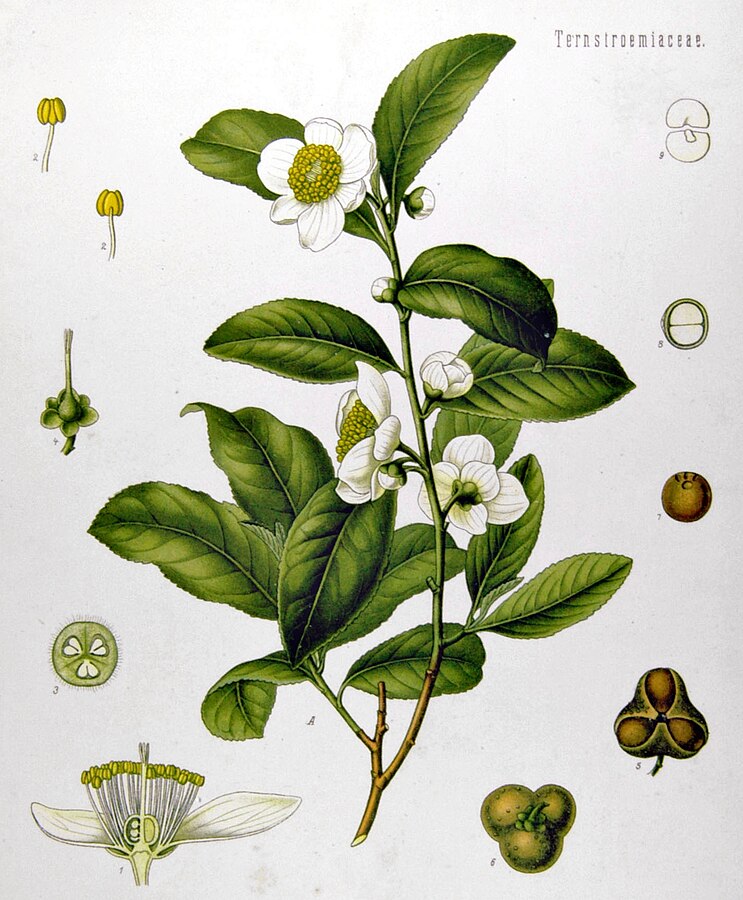
In short: Green tea is the cooling, drying leaf of Camellia sinensis, rich in catechins such as EGCG along with caffeine and calming theanine. It supports the heart, a clear mind and a healthy inflammatory response. Because it can reduce iron absorption and carries caffeine, people with iron-deficiency anaemia, anxiety, bleeding disorders or liver disease should go carefully with it.
Botanical Name
Camellia sinensis L. Kuntze
Latin Name
Camellia sinensis
Plant or Common Name
Green Tea, Tea Plant
Family
Theaceae
Actions
Antioxidant, thermogenic, diuretic, astringent, mild stimulant1
Energetics
Cooling, drying2
Chemical Constituents
- Catechins (Epigallocatechin gallate (EGCG), Epicatechin gallate (ECG), Epigallocatechin (EGC), Epicatechin (EC))
- Caffeine
- Theanine
- Flavonoids (quercetin, kaempferol, myricetin)
- Vitamins (C, B2, E)
- Minerals (zinc, selenium, chromium, manganese)
The polyphenolic compounds, particularly catechins, are responsible for many of green tea‘s biological activities3.
Part of Plant Used
Leaves (fresh or dried)
Uses
- Supports cognitive function
- Promotes cardiovascular health
- Supports healthy weight management
- Promotes oral health
- Supports healthy inflammatory response
- Promotes antioxidant activity
A comprehensive review by Xing et al.4 highlighted green tea’s potential in supporting various aspects of health, particularly in cardiovascular and metabolic wellness.
Contraindications
- Iron deficiency anemia (may impair iron absorption)
- Anxiety disorders (due to caffeine content)
- Bleeding disorders
- Liver disease
Side Effects
- Potential for sleep disturbances due to caffeine content
- Possible gastrointestinal discomfort in some individuals
- May cause mild headaches in sensitive individuals
While generally well-tolerated, these side effects have been noted, particularly with high consumption5.
Interactions with Other Drugs
- May interact with anticoagulant preparations
- May affect iron absorption
- May interact with certain stimulant preparations
- May interact with certain chemotherapy drugs
Take care when combining green tea with these preparations. In one study, drinking green tea for two weeks sharply lowered blood levels of the blood-pressure drug nadolol6.
Dosage
- Brewed tea: 3-5 cups daily (containing approximately 200-500 mg of polyphenols)
- Green tea extract: 250-500 mg daily (standardized to 50% polyphenols)
Clinical studies have used a wide range of doses, typically 200-1500 mg of green tea catechins daily for various applications7.
How to Take It
Oral consumption as brewed tea, extract, or capsules.
Duration of Use
Can be consumed daily as a beverage. For high-dose extracts, consult with a qualified medical practitioner for long-term use.
Risks
- Potential for caffeine-related side effects with high consumption
- Rare cases of liver toxicity reported with concentrated extracts
- May affect iron absorption with excessive consumption
A review by Hu et al.5 emphasized the importance of considering individual health concerns and potential interactions when using green tea in medicinal amounts.
Recipes
- Classic Green Tea
- 1 teaspoon green tea leaves
- 8 oz water at 175°F (80°C)
Steep for 2-3 minutes, strain, and enjoy.
- Green Tea Latte
- 1 teaspoon matcha green tea powder
- 1 cup steamed milk (dairy or plant-based)
- Honey to taste (optional)
Whisk matcha with a small amount of hot water, add steamed milk and honey if desired.
- Iced Green Tea
- 4 green tea bags
- 4 cups cold water
Steep tea bags in cold water for 6-8 hours in the refrigerator, remove bags, and serve over ice.
Brewing for Physic
- Water and time: keep the water below boiling, about 70–80 °C, and steep for 1–3 minutes. Boiling water and long steeping turn the tea harsh and bitter.
- Drink the whole leaf. The Japanese drink matcha as a whisked suspension, so they swallow all of the tea. I encourage you to grind your tea blends fine, sometimes twice, and drink the sludge at the bottom of the cup. Your microbiome will take it as a small gift of fibre — a micro-salad.
- A squeeze of lemon helps protect the catechins through digestion8.
- Timing: drink green tea between meals rather than with them. The tannins reduce iron absorption, especially iron from plants.
- Caffeine: a cup holds roughly a third of the caffeine in a cup of coffee. The theanine in tea softens its edge, but sensitive sleepers should still stop by mid-afternoon.
Remember to always consult with a qualified medical practitioner before incorporating new herbs into your wellness routine, especially if you have existing health concerns or are taking other preparations.
Return to: The Complete Guide to Anti-Inflammatory Eating
© 2024 Carolyn Smith-Kizer
If this work is useful to you, you can buy me a coffee — buymeacoffee.com/cskizer

Notes
- Sabu M. Chacko, Priya T. Thambi, Ramadasan Kuttan, and Ikuo Nishigaki, “Beneficial Effects of Green Tea: A Literature Review,” Chinese Medicine 5 (2010): 13, https://doi.org/10.1186/1749-8546-5-13.
- Michael Tierra, The Way of Herbs (New York: Pocket Books, 1998).
- Naghma Khan and Hasan Mukhtar, “Tea Polyphenols in Promotion of Human Health,” Nutrients 11, no. 1 (2019): 39, https://doi.org/10.3390/nu11010039.
- Lijun Xing, Hua Zhang, Renlei Qi, Rong Tsao, and Yoshinori Mine, “Recent Advances in the Understanding of the Health Benefits and Molecular Mechanisms Associated with Green Tea Polyphenols,” Journal of Agricultural and Food Chemistry 67, no. 4 (2019): 1029–43, https://doi.org/10.1021/acs.jafc.8b06146.
- Jiang Hu, Donna Webster, Joyce Cao, and Andrew Shao, “The Safety of Green Tea and Green Tea Extract Consumption in Adults: Results of a Systematic Review,” Regulatory Toxicology and Pharmacology 95 (2018): 412–33, https://doi.org/10.1016/j.yrtph.2018.03.019.
- Shingen Misaka et al., “Green Tea Ingestion Greatly Reduces Plasma Concentrations of Nadolol in Healthy Subjects,” Clinical Pharmacology & Therapeutics 95, no. 4 (2014): 432–38, https://doi.org/10.1038/clpt.2013.241.
- Tomokazu Ohishi, Shingo Goto, Pervin Monira, Mamoru Isemura, and Yoriyuki Nakamura, “Anti-inflammatory Action of Green Tea,” Anti-Inflammatory & Anti-Allergy Agents in Medicinal Chemistry 15, no. 2 (2016): 74–90, https://doi.org/10.2174/1871523015666160915154443.
- Rodney J. Green, Ann S. Murphy, Burkhard Schulz, Bruce A. Watkins, and Mario G. Ferruzzi, “Common Tea Formulations Modulate In Vitro Digestive Recovery of Green Tea Catechins,” Molecular Nutrition & Food Research 51, no. 9 (2007): 1152–62, https://doi.org/10.1002/mnfr.200700086.
Bibliography
Chacko, Sabu M., Priya T. Thambi, Ramadasan Kuttan, and Ikuo Nishigaki. “Beneficial Effects of Green Tea: A Literature Review.” Chinese Medicine 5 (2010): 13.
Green, Rodney J., Ann S. Murphy, Burkhard Schulz, Bruce A. Watkins, and Mario G. Ferruzzi. “Common Tea Formulations Modulate In Vitro Digestive Recovery of Green Tea Catechins.” Molecular Nutrition & Food Research 51, no. 9 (2007): 1152–62.
Hu, Jiang, Donna Webster, Joyce Cao, and Andrew Shao. “The Safety of Green Tea and Green Tea Extract Consumption in Adults: Results of a Systematic Review.” Regulatory Toxicology and Pharmacology 95 (2018): 412–33.
Khan, Naghma, and Hasan Mukhtar. “Tea Polyphenols in Promotion of Human Health.” Nutrients 11, no. 1 (2019): 39.
Misaka, Shingen, Junichi Yatabe, Fabian Müller, et al. “Green Tea Ingestion Greatly Reduces Plasma Concentrations of Nadolol in Healthy Subjects.” Clinical Pharmacology & Therapeutics 95, no. 4 (2014): 432–38.
Ohishi, Tomokazu, Shingo Goto, Pervin Monira, Mamoru Isemura, and Yoriyuki Nakamura. “Anti-inflammatory Action of Green Tea.” Anti-Inflammatory & Anti-Allergy Agents in Medicinal Chemistry 15, no. 2 (2016): 74–90.
Tierra, Michael. The Way of Herbs. New York: Pocket Books, 1998.
Xing, Lijun, Hua Zhang, Renlei Qi, Rong Tsao, and Yoshinori Mine. “Recent Advances in the Understanding of the Health Benefits and Molecular Mechanisms Associated with Green Tea Polyphenols.” Journal of Agricultural and Food Chemistry 67, no. 4 (2019): 1029–43.