
Calendula officinalis Pot Marigold: Herbal Monograph
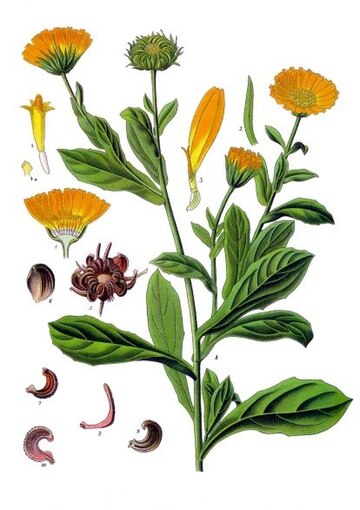
In short: Calendula, Calendula officinalis, the pot marigold, is a slightly warming and drying flower long used for the skin and for mending wounds. It also supports lymphatic flow, a healthy inflammatory response and menstrual wellness. It is best avoided in pregnancy and by anyone allergic to the daisy family.
Botanical Name
Calendula officinalis L.
Latin Name
Calendula officinalis
Plant or Common Name
Calendula, Pot Marigold, Marigold, Souci
Family
Asteraceae
Actions
Vulnerary, anti-inflammatory, antimicrobial, lymphatic, emmenagogue1
Energetics
Slightly warming and drying2
Chemical Constituents
- Flavonoids (quercetin, rutin, kaempferol)
- Triterpene saponins (calendulosides)
- Carotenoids (lutein, zeaxanthin, beta-carotene)
- Essential oils (alpha-cadinol, alpha-cadinene, limonene)
- Polysaccharides
- Sterols
The complex phytochemical profile of calendula contributes to its diverse biological activities3.
Part of Plant Used
Flowers (fresh or dried)
Uses
- Supports skin health
- Promotes wound-mending
- Supports healthy inflammatory response
- Promotes lymphatic function
- Supports menstrual wellness
- Promotes oral health
A comprehensive review by Givol et al.4 highlighted calendula’s potential in supporting various aspects of health, particularly in dermatological and wound-mending applications.
Contraindications
- Pregnancy (due to potential uterine stimulating effects)
- Known allergy to plants in the Asteraceae family
Side Effects
- Potential for allergic reactions in sensitive individuals
- Rare cases of contact dermatitis reported
While generally well-tolerated, these side effects have been noted in some individuals5.
Interactions with Other Drugs
- May interact with sedative preparations
- Theoretical interaction with hypoglycemic preparations
Take care when combining calendula with these types of preparations due to potential interactions6.
Dosage
- Infusion: 1-2 teaspoons of dried flowers per cup of boiling water, steep for 10-15 minutes, three times daily
- Tincture (1:5 in 60% alcohol): 2-4 mL, three times daily
- Topical application: Creams or ointments containing 2-5% calendula extract
Clinical studies have used a wide range of doses, particularly for topical applications7.
How to Take It
Oral consumption as tea or tincture. Topical application as cream, ointment, or compress.
Duration of Use
Can be used short-term for acute situations or long-term for long-standing complaints. For extended use, consult with a qualified medical practitioner.
Risks
- Potential for allergic reactions, especially in individuals sensitive to plants in the Asteraceae family
- May affect blood glucose levels (theoretical risk)
A review by Arora et al.1 emphasized the importance of considering individual sensitivities when using calendula.
Recipes
- Calendula Tea
- 1-2 teaspoons dried calendula flowers
- 1 cup boiling water
Steep for 10-15 minutes, strain, and enjoy.
- Calendula-Infused Oil
- 1 cup dried calendula flowers
- 2 cups carrier oil (e.g., olive or jojoba)
Combine in a jar, let sit for 4-6 weeks, shaking daily. Strain and use topically.
- Calendula Compress
- 1/4 cup dried calendula flowers
- 2 cups hot water
Steep flowers in water for 15 minutes, strain. Soak a clean cloth in the liquid and apply to affected area.
Remember to always consult with a qualified medical practitioner before incorporating new herbs into your wellness routine, especially if you have existing health concerns or are taking other preparations.
Return to: The Complete Guide to Anti-Inflammatory Eating
© 2024 Carolyn Smith-Kizer
If this work is useful to you, you can buy me a coffee — buymeacoffee.com/cskizer

Notes
- Disha Arora, Anita Rani, and Anupam Sharma, “A Review on Phytochemistry and Ethnopharmacological Aspects of Genus Calendula,” Pharmacognosy Reviews 7, no. 14 (2013): 179–87, https://doi.org/10.4103/0973-7847.120520.
- Peter Holmes, The Energetics of Western Herbs: Treatment Strategies Integrating Western and Oriental Herbal Medicine, 3rd ed. (Boulder, CO: Snow Lotus Press, 1997).
- B. P. Muley, S. S. Khadabadi, and N. B. Banarase, “Phytochemical Constituents and Pharmacological Activities of Calendula officinalis Linn (Asteraceae): A Review,” Tropical Journal of Pharmaceutical Research 8, no. 5 (2009): 455–65, https://doi.org/10.4314/tjpr.v8i5.48090.
- Or Givol et al., “A Systematic Review of Calendula officinalis Extract for Wound Healing,” Wound Repair and Regeneration 27, no. 5 (2019): 548–61, https://doi.org/10.1111/wrr.12737.
- Norbert Reider et al., “The Seamy Side of Natural Medicines: Contact Sensitization to Arnica (Arnica montana L.) and Marigold (Calendula officinalis L.),” Contact Dermatitis 45, no. 5 (2001): 269–72, https://doi.org/10.1034/j.1600-0536.2001.450503.x.
- Ethan Basch et al., “Marigold (Calendula officinalis L.): An Evidence-Based Systematic Review by the Natural Standard Research Collaboration,” Journal of Herbal Pharmacotherapy 6, no. 3–4 (2006): 135–59, https://doi.org/10.1080/J157v06n03_08.
- Mahesh Shankar Khairnar, Bipin Pawar, Prerna Prakash Marawar, and Ameet Mani, “Evaluation of Calendula officinalis as an Anti-plaque and Anti-gingivitis Agent,” Journal of Indian Society of Periodontology 17, no. 6 (2013): 741–47, https://doi.org/10.4103/0972-124X.124491.
Bibliography
Arora, Disha, Anita Rani, and Anupam Sharma. “A Review on Phytochemistry and Ethnopharmacological Aspects of Genus Calendula.” Pharmacognosy Reviews 7, no. 14 (2013): 179–87.
Basch, Ethan, Stephen Bent, Ivo Foppa, et al. “Marigold (Calendula officinalis L.): An Evidence-Based Systematic Review by the Natural Standard Research Collaboration.” Journal of Herbal Pharmacotherapy 6, no. 3–4 (2006): 135–59.
Givol, Or, Rachel Kornhaber, Denis Visentin, Michelle Cleary, Josef Haik, and Moti Harats. “A Systematic Review of Calendula officinalis Extract for Wound Healing.” Wound Repair and Regeneration 27, no. 5 (2019): 548–61.
Holmes, Peter. The Energetics of Western Herbs: Treatment Strategies Integrating Western and Oriental Herbal Medicine. 3rd ed. Boulder, CO: Snow Lotus Press, 1997.
Khairnar, Mahesh Shankar, Bipin Pawar, Prerna Prakash Marawar, and Ameet Mani. “Evaluation of Calendula officinalis as an Anti-plaque and Anti-gingivitis Agent.” Journal of Indian Society of Periodontology 17, no. 6 (2013): 741–47.
Muley, B. P., S. S. Khadabadi, and N. B. Banarase. “Phytochemical Constituents and Pharmacological Activities of Calendula officinalis Linn (Asteraceae): A Review.” Tropical Journal of Pharmaceutical Research 8, no. 5 (2009): 455–65.
Reider, Norbert, Peter Komericki, Björn M. Hausen, Peter Fritsch, and Werner Aberer. “The Seamy Side of Natural Medicines: Contact Sensitization to Arnica (Arnica montana L.) and Marigold (Calendula officinalis L.).” Contact Dermatitis 45, no. 5 (2001): 269–72.