
The Physician’s Eye
Reading the Tongue from Galen to the Last Eclectics
Before the stethoscope, before the microscope, before a blood panel could tell a physician anything at all, the body still spoke. It spoke through the pulse, through the color of the skin, through urine held up to the light, and through the tongue, offered up at every visit, plain to see, changing by the hour with fever and food and fear. A physician trained to read it could learn in seconds what a modern clinician now waits days for a lab to confirm.
That habit of reading has a continuous history in the West, distinct from its better-known counterpart in Chinese medicine, and it runs in an unbroken, if thinning, line from the Hippocratic writers of the fourth century BC to a handful of American physicians still practicing it in Chicago as late as 1909.
A Humoral Habit
The physicians of the Hippocratic Corpus held that the body’s four fluids, blood, phlegm, yellow bile, and black bile, determined health when balanced and illness when not, and that the physician’s task was to diagnose which humor had slipped and to correct it.
Their case notes read as close, patient observation rather than theory for its own sake. In one of the most detailed surviving accounts, the illness of a man named Philiscus is tracked almost hour by hour across six days: his fever, his thirst, his sweat, the color of his urine, and repeatedly the state of his tongue, dry through the worst of it, read alongside everything else as the disease moved toward its end.
The tongue’s dryness carried enough diagnostic weight on its own that Hippocratic writers attributed even stuttering to it, understood as a symptom of excess black bile drying the organ.
Galen, writing four centuries later, kept this observational core and built a pharmacology on top of it. Where the Hippocratics mostly withheld medicine and waited for the body to right itself, Galen began prescribing herbs and compounds matched to the humor in excess.
That pairing, a directly observable sign read against humoral theory and corrected with a plant chosen for its opposing quality, is the same logic a Carolingian infirmarian would have used two centuries after the Capitulare de Villis was drafted, working from Latin compendia that carried Galen’s method forward even where his name had been forgotten. No capitulary survives that names tongue-reading by name. But the interpretive habit is the same one: an herb’s degree of heat, cold, moisture, or dryness selected to answer a bodily sign read directly off the patient.
Dodoens later formalized this same calculus for cultivated Europe, and Culpeper, working from Nicholas Parkinson’s earlier survey more than from any doctrine entirely his own, brought it into English for readers the College of Physicians would rather have kept out.
Both classified their herbs by exactly the qualities, heating or cooling, drying or moistening, that a humoral tongue reading was built to diagnose in the first place. The tongue told the physician which way to reach on the shelf.
The Last Physicians to Use It
The habit persisted, more or less intact, into a specific and short-lived American school: Eclectic medicine, which combined botanical treatment with direct physical diagnosis and flourished from the mid-nineteenth century until it was largely absorbed into conventional practice by the 1930s. Its two most systematic writers on materia medica, Harvey Wickes Felter and Finley Ellingwood, represented two slightly different flavors of the same tradition, Felter the more restrained “Cincinnati style,” Ellingwood a more assertive Chicago practice built on close case observation.
Ellingwood, in particular, organized his major text by organ system rather than by plant, an arrangement that only makes sense for a physician who diagnosed from the body first and reached for the herb second.
In December 1909, Ellingwood published a short essay in his own journal, plainly titled “Some General Facts in Diagnosis Shown by the Tongue.” It is the clearest surviving statement of this entire lineage before it went largely quiet, and it reads like a compressed field guide.
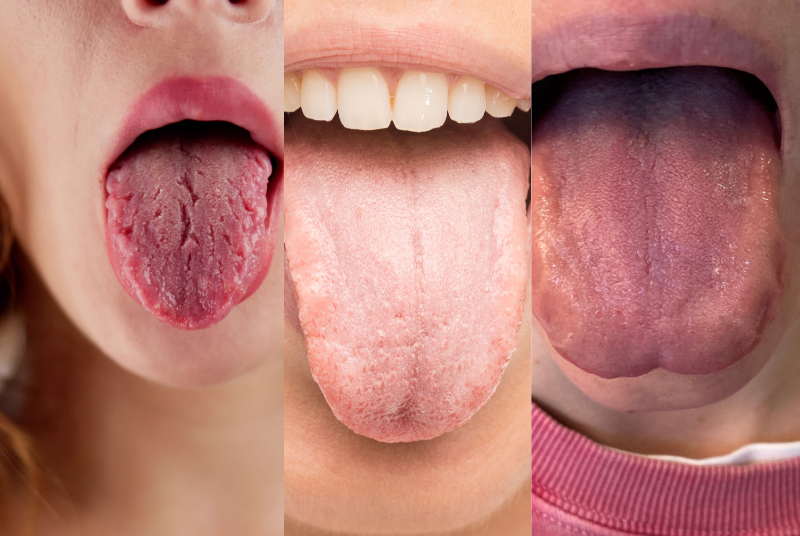
Moisture came first for him, and he treated it as the tongue’s most basic report: its dryness or wetness, he wrote, denoted the extent of intestinal disease and its effect on gastrointestinal secretion.
From there he moved through form: a fissured tongue pointing toward the kidneys, a shrunken and “pinched” tongue marking functional inactivity of digestion and demanding the greatest care with both food and remedy, a contracted tongue the patient could not hold still signaling trouble reaching toward the nervous system or the brain itself.
He read color and coating together: yellow coatings tied to a sluggish liver and a want of bile, a broad thick tongue with the papillae “looking raw” marking a septic condition of the blood and favoring typhoid, its exact shade of red or pallor telling him which acid preparation to reach for next.
None of this was read in isolation. Every observation sat inside the rest of the clinical picture, checked against pulse, sleep, and the stage of the illness, exactly as the Hippocratics had done with Philiscus two thousand years before him.
What Is Left of It Now
Ellingwood had no way to know why a yellow coating tracked liver trouble, or why a heavily coated tongue tended to accompany a broader systemic complaint. He had only the correlation, built from repeated cases. Current research on the tongue-coating microbiome supplies some of the missing mechanism.
The coating itself is now understood as a living biofilm, composed of bacteria, fungi, exfoliated epithelium, and saliva, sitting at the base of what researchers now describe as an oral-gut-brain axis.
The specific correlation Ellingwood drew a century ago has a genuinely striking modern echo: in a 2023 study of patients with type 2 diabetes, yellow tongue coating tracked with significantly elevated Lactobacillus species in both the tongue and gut microbiome, compared with patients whose coating was not yellow.
He was reading a real signal. He simply lacked the sequencing to say what it was made of.
This is not an argument that a tongue can replace a blood panel, and nothing here should be read as diagnosis of any condition, named or otherwise; that was never what this tradition, at its most careful, claimed for itself. It is an argument that a habit of looking closely, built and refined over two thousand years and nearly lost inside a single century, deserves to be recovered on its own terms, as a discipline of attention that current research keeps finding new reasons to take seriously.
Go Further
If this piece has you wanting to build the habit of looking yourself, there is a free companion guide: a self-study mini-course covering the four-register method (form, color, coating, moisture), Ellingwood’s full 1909 correlations, and where current microbiome and nutrient research now confirms or updates them. [Download the companion guide]

If this work is useful to you, you can buy me a coffee — buymeacoffee.com/cskizer
Notes
1. On Hippocratic humoral theory generally, see “The Legacy of Humoral Medicine,” Journal of Ethics (American Medical Association) 4, no. 7 (July 2002).
2. Hippocrates, Epidemics I, the case of Philiscus; discussed in “Funny medicine: Hippocrates and the four humours,” Gavi: The Vaccine Alliance, August 9, 2022.
3. Judy Duchan, “Ancient Theory of Elements and Humors,” History of Speech-Language Pathology (University at Buffalo), citing Noga Arikha, Passions and Tempers: A History of the Humours (New York: HarperCollins, 2007).
4. “The Legacy of Humoral Medicine,” Journal of Ethics.
5. On Culpeper’s debt to Parkinson, see “Culpeper’s herbal The English Physitian and its debt to apothecary John Parkinson,” PMC, National Library of Medicine.
6. On Felter and Ellingwood and the Cincinnati/Chicago distinction within Eclectic medicine, see “Introduction to Ellingwood’s Materia Medica,” Henriette’s Herbal Homepage, henriettes-herb.com.
7. Finley Ellingwood, The American Materia Medica, Therapeutics and Pharmacognosy (Chicago, 1919).
8–10. Finley Ellingwood, “Some General Facts in Diagnosis Shown by the Tongue,” Ellingwood’s Therapeutist 3, no. 12 (December 1909): 17–18.
11. “The tongue microbiome: A gateway to systemic health and disease,” ScienceDirect, January 2025.
12. “Distinct microbiome of tongue coating and gut in type 2 diabetes with yellow tongue coating,” ScienceDirect, November 2023.
Bibliography
“Culpeper’s herbal The English Physitian and its debt to apothecary John Parkinson.” PMC, National Library of Medicine.
Duchan, Judy. “Ancient Theory of Elements and Humors.” History of Speech-Language Pathology. University at Buffalo.
“Distinct microbiome of tongue coating and gut in type 2 diabetes with yellow tongue coating.” ScienceDirect, November 2023.
Ellingwood, Finley. The American Materia Medica, Therapeutics and Pharmacognosy. Chicago, 1919.
Ellingwood, Finley. “Some General Facts in Diagnosis Shown by the Tongue.” Ellingwood’s Therapeutist 3, no. 12 (December 1909): 17–18.
“Funny medicine: Hippocrates and the four humours.” Gavi: The Vaccine Alliance, August 9, 2022.
“Introduction to Ellingwood’s Materia Medica.” Henriette’s Herbal Homepage. henriettes-herb.com.
“The Legacy of Humoral Medicine.” Journal of Ethics (American Medical Association) 4, no. 7 (July 2002).
“The tongue microbiome: A gateway to systemic health and disease.” ScienceDirect, January 2025.