
Bellis perennis L.: Herbal Monograph
Bellis perennis L., the English or lawn daisy, is a humble, cooling and drying herb of European lawns and meadows, long paired with arnica for bruising and swelling. This herbal monograph sets out its botany, energetics, constituents, traditional uses and cautions, with references.
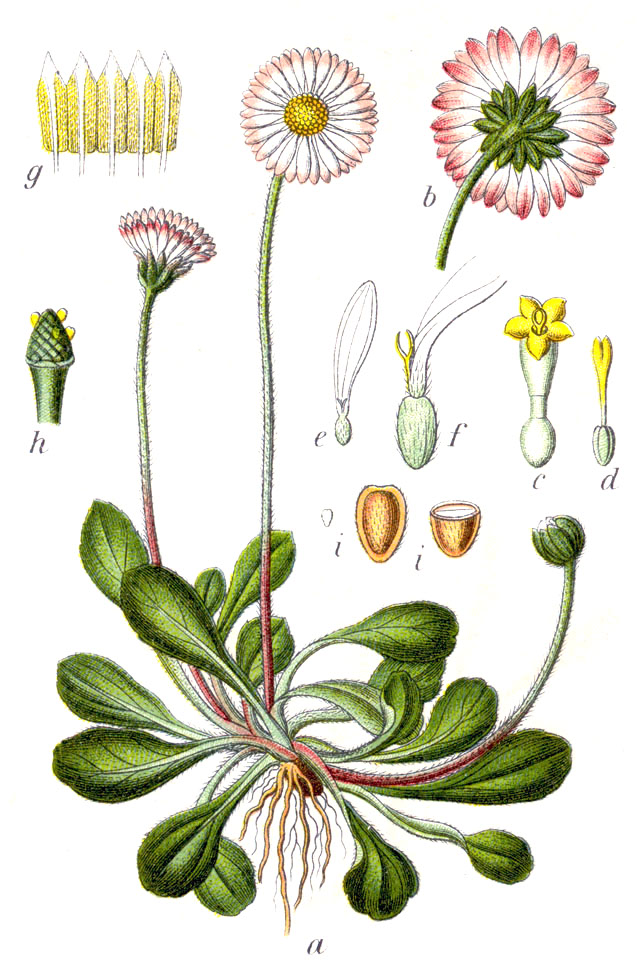
Family:
Asteraceae
Native Region:
Bellis perennis is native to Europe and the British Isles. It has been naturalized in many other temperate regions around the world, including:
• North America
• New Zealand
• Australia
• Parts of Asia
The plant thrives in temperate climates and is commonly found in:
• Lawns
• Meadows
• Pastures
• Roadsides
• Open woodlands
Chemical Constituents:
• Saponins
• Flavonoids (apigenin, kaempferol, quercetin)
• Polyacetylenes
• Essential oils
• Tannins
• Mucilage
• Organic acids (malic, oxalic, tartaric)
Actions:
• Vulnerary (traditionally applied to wounds and bruises)
• Haemolytic (its saponins help break down blood that has pooled in bruised tissue so the lymph can clear it)
• Lymphatic (moves stagnant fluid and congestion)
• Anti-inflammatory
• Astringent
• Expectorant
• Mild analgesic
• Diuretic
• Antispasmodic
(Herbal Reality, n.d.)
Energetics:
Cooling and drying. Temperature: cool. Moisture: drying (Herbal Reality, n.d.).
Part of Plant Used:
Flowers, leaves, and occasionally roots
Harvesting Guidelines and any sustainability issues:
• Harvest flowers when fully open, preferably in the morning after dew has evaporated
• Collect leaves before flowering for best potency
• Sustainably abundant in most areas; not considered at risk
Uses (Traditional, Modern, Scientific Research):
• Traditional: Minor wounds, bruises, skin inflammation
• Modern: Cough suppressant, digestive aid, mild pain relief
• Scientific Research: Potential antiinflammatory and antioxidant properties; studies on wound-mending and antimicrobial effects
Pliny the Elder ~ Plin. Nat. 26.13 ~ 77 CE

CHAP. 13.—THE PLANT CALLED BELLIS: TWO REMEDIES.
~ Bellis is the name of a plant that grows in the fields, with a white flower somewhat inclining to red; if this is applied with artemisia [mugwort], it is said, the remedy is still more efficacious. ~
Pliny’s Latin is brief: Bellis in pratis nascitur, flore albo, aliquatenus rubente. Hanc cum artemisia inlitam efficaciorem esse produnt (Pliny, Natural History 26.13). It is a fair portrait of the lawn daisy, whose white rays are so often pink at the tips, and it sits just after his chapter on scrofula. When Linnaeus named the plant Bellis perennis in 1753, he kept Pliny’s word and added perennis, “lasting through the years” (Linnaeus, 1753).
Specific Indications or Affinities:
• Moves stagnant blood and lymph; long called a gentler, cooler companion to arnica for bruising, deep muscle soreness and swelling (Herbal Reality, n.d.)
• Skin conditions (minor wounds, bruises, inflammation)
• Respiratory system (cough, bronchitis)
• Digestive system (mild gastritis, diarrhea)
• Musculoskeletal system (rheumatic pain)
Types of Preparations:
• Infusion (tea)
• Tincture
• Poultice
• Ointment
• Compress
• Syrup
Recipes:
- Daisy Tea: Steep 12 teaspoons of dried daisy flowers in a cup of boiling water for 1015 minutes. Strain and drink up to 3 times daily.
- Daisy Poultice: Crush fresh daisy flowers and leaves, apply directly to minor wounds or bruises, and cover with a clean cloth.
- Daisy Syrup: Simmer 1 cup of daisy flowers in 2 cups of water for 20 minutes. Strain and add 1 cup of honey. Simmer until thickened.
Contraindications:
• Pregnancy (due to lack of safety data)
• Individuals with known allergies to plants in the Asteraceae family
Side Effects:
• Generally considered safe when used appropriately
• Rare cases of allergic reactions
Interactions with Other Drugs:
• Potential interaction with bloodthinning medications due to its mild bloodthinning effects
• May enhance the effects of diuretic drugs
Dosage:
• Tea: 12 teaspoons of dried herb per cup of boiling water, 3 times daily
• Tincture: 24 mL of 1:5 tincture, 3 times daily
Mode of Administration:
• Internal: Tea, tincture, syrup
• External: Poultice, ointment, or compress
Duration of Administration:
• For acute conditions: 12 weeks
• For chronic conditions: Up to 46 weeks, under professional guidance
Safety/Risks:
• Generally considered lowrisk when used appropriately
• Potential for allergic reactions in sensitive individuals
• Longterm use or high doses may cause gastric irritation
Return To: A Wise Woman’s Guide to Reducing Inflammation with Herbs, Foods, and Lifestyle
© 2024 Carolyn Smith-Kizer
If this work is useful to you, you can buy me a coffee — buymeacoffee.com/cskizer

References:
Blumenthal, M., Goldberg, A., & Brinckmann, J. (2000). Herbal Medicine: Expanded Commission E Monographs. Integrative Medicine Communications.
Wichtl, M. (2004). Herbal Drugs and Phytopharmaceuticals: A Handbook for Practice on a Scientific Basis. Medpharm Scientific Publishers.
Basso, F. et al. (2018). “Bellis perennis L. (Daisy) extract promotes wound healing in HaCaT cells.” Biomedicine & Pharmacotherapy, 107, 13491356.
Karakas, F. P. et al. (2012). “The effects of Bellis perennis L. on skin infections.” Journal of Ethnopharmacology, 139(2), 562567.
Grieve, M. (1931). A Modern Herbal. Dover Publications.
Herbal Reality. (n.d.). Daisy (Bellis perennis). https://www.herbalreality.com/herb/daisy/
Linnaeus, C. (1753). Species Plantarum (Vol. 2, p. 886). Laurentius Salvius.
Pliny the Elder. (1956). Natural History, Volume VII: Books 24–27 (W. H. S. Jones, Trans.; Loeb Classical Library 393). Harvard University Press. (Original work c. 77 CE), 26.13.
Pliny the Elder. (1856). The Natural History of Pliny (Vol. 5; J. Bostock & H. T. Riley, Trans.). Henry G. Bohn. Book 26, ch. 13.