
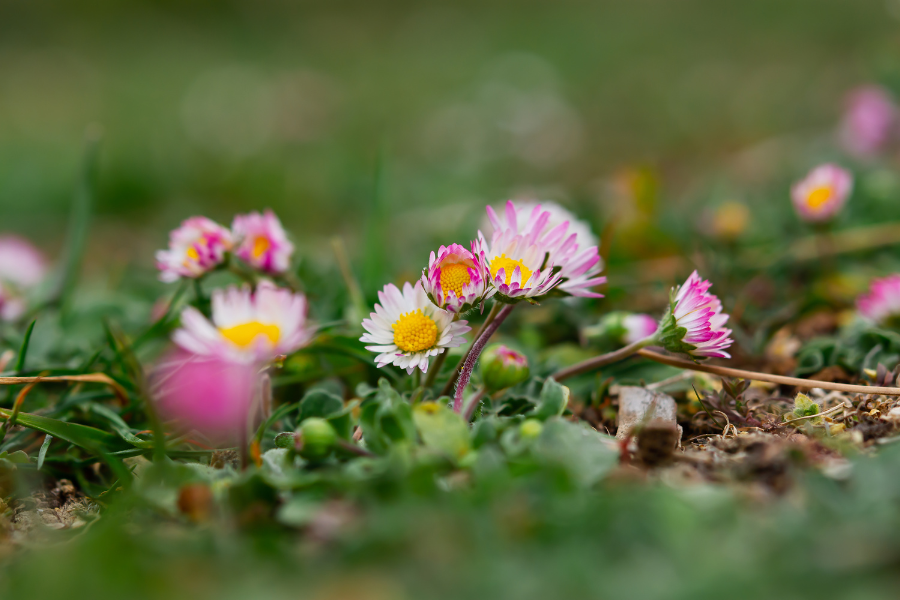
Bellis Perennis For Skincare: The Humble Daisy’s Beauty Secrets
Bellis perennis for skincare is one of the oldest uses of the humble lawn daisy. The English daisy grows in nearly every lawn and meadow in Europe, and for two thousand years people have pressed it, steeped it in oil and laid it on bruises and sore places. Here is what the old writers said about it, what modern research has and has not shown, and how I make a simple daisy oil.
In short: Using the daisy on the skin is an old tradition: Pliny paired it with mugwort, and Culpeper kept it in oils and ointments for wounds and bruises. Modern research on Bellis perennis is still at the laboratory and animal stage, with antioxidant, antimicrobial and wound-repair findings but no trials on human skin. A daisy and mugwort infused oil is a gentle way to keep the tradition, as long as you are not allergic to the daisy family.
The Daisy in the Old Writers
The Roman naturalist Pliny the Elder knew the daisy as bellis, a plant of the fields with a white flower inclining to red, and he paired it with mugwort.1
Pliny the Elder ~ Plin. Nat. 26.13 ~ 77 CE
CHAP. 13.—THE PLANT CALLED BELLIS: TWO REMEDIES.
~ Bellis is the name of a plant that grows in the fields, with a white flower somewhat inclining to red; if this is applied with artemisia [mugwort], it is said, the remedy is still more efficacious. ~
In the sixteenth century John Gerard wrote that daisies “mitigate all kinde of paines, but especially in the joints.” A generation later Nicholas Culpeper put daisies under Venus in the sign Cancer, called them “very fitting to be kept both in oils, ointments, and plaisters,” and named the larger wild daisy “a wound herb of good respect,” used for “bruises and hurts that come of falls and blows.”2 That bruise reputation has stayed with the daisy ever since, and it is the use I keep it for. You will find the plant itself in my Bellis perennis monograph.
Bellis perennis L. (English daisy)
Family: Asteraceae (the daisy family).
Part used: Flowers, with their green calyx.
Energetics: Cooling; Gerard counted it cold and moist.
Traditional uses on the skin: bruises, knocks and minor wounds.
Cautions: Avoid if you are allergic to daisy-family plants; patch test before regular use.
What Research on Bellis perennis for Skincare Has Shown So Far
Modern work on the daisy is real but early, and I want to be plain about where it stands.
- What is in it: a 2023 review from the Technical University of Munich gathered more than 310 compounds identified in the daisy, among them flavonoids, saponins and polyacetylenes, along with laboratory reports of antioxidant, antimicrobial and wound-repair activity. The authors are candid that most studies stop at a crude extract, so it is still unclear which compounds do the work.3
- Antimicrobial compounds: polyacetylenes isolated from the daisy showed antimicrobial activity in laboratory tests.4
- Wounds: a study in rats tested a daisy fraction applied to skin wounds, which fits the old wound reputation.5
What does not exist yet is a trial of daisy preparations on human skin. So the daisy oil below is a traditional preparation, made for comfort and pleasure, not a proven product.

Recipe: Daisy Infused Oil
This follows Pliny’s pairing of daisy with mugwort.
Ingredients:
- 1 cup fresh Bellis perennis L. flowers (common daisy)
- 2 tablespoons dried, crushed Artemisia vulgaris (mugwort)
- 2 cups carrier oil (e.g., jojoba, sweet almond, or olive oil)
Instructions:
- Place fresh-picked daisy heads on a tray or paper towel and allow to wilt for at least 4 hours to remove as much moisture as possible. DO NOT remove the calyx, or green back of the flower. In other words, you DO NOT want only daisy petals in this preparation.
- Place the wilted flowers and crushed mugwort in a clean, dry glass jar.
- Pour the carrier oil over the flowers, ensuring they are completely covered.
- Seal the jar and place it in a warm, sunny spot for 2-4 weeks, shaking gently daily.
- Strain the oil through cheesecloth or a fine mesh strainer.
- Store the infused oil in a dark glass bottle in a cool, dry place.
To use: Apply a small amount to the skin as a moisturizer, smooth it over a bruise, or add it to homemade creams and lotions. Keep it off broken skin, and patch test it first on the inside of your arm. Leave it alone if you react to daisy-family plants, and since mugwort is not for pregnancy, make yours with daisies alone if you are expecting.

© 2024 Carolyn Smith-Kizer
If this work is useful to you, you can buy me a coffee — buymeacoffee.com/cskizer

Notes
- Pliny the Elder, The Natural History, 26.13, trans. John Bostock and H. T. Riley (London: Henry G. Bohn, 1855–57); Perseus Digital Library. ↩
- Nicholas Culpeper, The Complete Herbal, “Daisies”; Project Gutenberg. ↩
- Anna-Lena Albien and Timo D. Stark, “(Bio)active Compounds in Daisy Flower (Bellis perennis),” Molecules 28, no. 23 (2023): 7716, https://doi.org/10.3390/molecules28237716. ↩
- P. Avato et al., “Antimicrobial Activity of Polyacetylenes from Bellis perennis and Their Synthetic Derivatives,” Planta Medica 63, no. 6 (1997): 503–7. ↩
- F. P. Karakaş et al., “The Evaluation of Topical Administration of Bellis perennis Fraction on Circular Excision Wound Healing in Wistar Albino Rats,” Pharmaceutical Biology 50, no. 8 (2012): 1030–37. ↩