

My Birth Chart & Charlemagne’s Garden: Finding My Plants in the Capitulaire de Villis
The garden already knew. I just needed the chart to tell me why.
There is a question I have been turning over for years, ever since I first began working with the Capitulaire de Villis — Charlemagne’s 9th-century imperial decree mandating which plants every royal estate must cultivate. The list is extraordinary: over 70 medicinal and culinary herbs, vegetables, and trees, ordered by an emperor who understood, through the lens of Galenic medicine, that the health of a kingdom began in its gardens.
The question is not a scholarly one. It is personal. Of the 70-plus plants on that list, which ones are mine?
Not mine because I grow them. Not mine because I find them clinically interesting. Mine in the constitutional sense — the sense that the old physicians understood when they matched a patient’s complexion, temperament, and season of birth to the plants that would speak most directly to their terrain. The astro-herbal sense.
I recently sat down with my natal chart and ran it, properly, through the classical planetary herbalism framework. What I found confirmed something the land here in the Creuse has been quietly telling me since I arrived: some plants are not just useful. They are yours. And the Capitulaire de Villis had them catalogued in the 9th century, waiting.
Why Astro-Herbalism Is Not What You Think
Let me be clear about something before we go further: I am not talking about horoscopes. I am not talking about the Instagram version of astrology where Scorpios are told to drink nettle tea in October.
I am talking about the classical, Galenic, Arabic-influenced medical framework that was the operating system of Western medicine for over a thousand years — and that Charlemagne’s court physicians were actively working within when they compiled the Capitulaire de Villis.
In this system, every plant had a planetary ruler. That rulership was not arbitrary; it was derived from the plant’s observed qualities — its temperature, moisture, taste, tissue affinity, and the types of conditions it reliably treated. Jupiter-ruled plants were warm and expansive, beneficial to the liver and to phlegmatic or cold conditions. Saturn-ruled plants were dry, contracting, and preserving. Venus-ruled plants had affinity for the reproductive system, kidneys, and the pleasure of beauty as medicine.
Simultaneously, every person had a constitutional type — their complexion — derived partly from their season of birth, partly from observation of their temperament, tissue tendencies, and chronic patterns. The physician’s task was to match the plant to the person: to find which planetary energies were dominant in your constitution, which were deficient, which were causing trouble, and to prescribe accordingly.
This is clinical herbalism. It always has been. The chart is simply the most precise map we have of a person’s constitutional starting point.
The Capitulaire de Villis is not just a garden list. It is a Galenic formulary written in soil.
Reading My Chart: The Constitutional Picture
Here is what my natal chart shows, read through the classical lens:
The Pisces Stellium: Triple Jupiter-Neptune Signature
My Sun, Venus, and Mars are all in Pisces. In traditional Western astrology, Pisces is ruled by Jupiter, and its qualities are moist, warm-to-cool, and deeply receptive. Three planets clustered here creates what is called a stellium — a concentration of energy in a single sign that dominates the constitutional picture.
In humoral terms, this is a phlegmatic signature with strong sanguine undercurrents. Phlegmatic constitutions tend toward coolness, moisture, receptivity, and permeability. They have extraordinary intuitive capacity and deep empathy — but their vulnerabilities run toward lymphatic sluggishness, fluid retention, boundary dissolution, and conditions that are slow, diffuse, and hard to pin down. The phlegmatic person feels things in their body before they can name them.
The plants that speak most directly to a Pisces-dominant constitution are those ruled by Jupiter — warming, expansive, liver-supportive, lymph-moving — and those with a particular affinity for the subtle, the liminal, and the boundary between body and spirit.
Moon in Taurus: The Grounding Wire
My Moon is in Taurus, which changes everything. Fixed earth, ruled by Venus — this placement is the constitutional counterweight to the Pisces stellium. Where Pisces dissolves, Taurus anchors. Where Pisces perceives, Taurus touches, tastes, and grows.
The Moon in Taurus is the herbalist’s Moon. It is the placement of someone who knows plants through the body — through smell, texture, the satisfaction of watching something you planted push through the soil in spring. It is also a deeply food-oriented placement: the body as terrain, nourishment as medicine, the kitchen as apothecary. This Moon keeps my Piscean permeability grounded in the physical world, in the sensory reality of roots and leaves and the weight of a harvest basket.
Venus-ruled plants, particularly those with affinity for the skin, the heart, the throat, and the simple pleasure of beauty, are native to this Moon.
Saturn Retrograde in Virgo: The Clinical Edge
This is the defining tension in my chart, and the one that most directly explains my clinical practice. Saturn retrograde in Virgo sits in direct opposition to my Pisces stellium.
Virgo is the sign of the herbalist, the healer, the analyst. It is precise, systematic, critical, and deeply oriented toward service through skill. Saturn here — especially retrograde, which turns the planet’s energy inward and makes it harder-won, more carefully earned — demands methodical rigor. It is the force that says: your intuition is real, but you must test it. Your knowing is genuine, but you must be able to articulate it. The mystical and the clinical are not opposites; they are partners, and you must hold both.
In practice, this Saturn-Virgo opposition to my Pisces Sun is exactly the engine of clinical herbalism: the tension between Piscean felt-sense perception and Virgoan systematic analysis. Between the vitalist and the diagnostician. Between the wise woman tradition and the clinical record.
Mercury Conjunct Ascendant in Aquarius: Mind as First Impression
My Mercury — the planet of communication, pattern recognition, and the transmission of knowledge — sits almost exactly on my Aquarius Ascendant. This means my mind is my first impression. I lead with ideas. I make unexpected connections. I speak in synthesis.
Aquarius Mercury is the placement that allows a person to look at a 9th-century Carolingian plant list and a 21st-century patient’s terrain and see the same conversation happening across twelve hundred years. It is not a leap — it is a straight line, once you can see it.
Jupiter Exalted in Capricorn, MC in Sagittarius, Chiron Conjunct MC
My chart’s calling is Jupiterian: teaching, far horizons, the transmission of earned wisdom. Jupiter is exalted in Capricorn, which means the expansion happens through discipline and structured effort — not inspiration alone. The MC in Sagittarius reinforces this: the public face is the philosopher-teacher, the one who ranges widely but always comes home to the essential thing.
Chiron conjunct the MC is the detail that matters most. Chiron is the wounded healer — the placement where your deepest wound and your greatest gift are the same thing, inseparable, and both are public. Whatever I have had to learn the hard way is exactly what I am here to teach.
My Plants in the Capitulaire: A Constitutional Matching
Now we arrive at the question I have been building toward. Of the plants Charlemagne ordered grown on every imperial estate — plants chosen within the same Galenic framework I have just used to read my own chart — which ones are constitutionally mine?
I have organized them by planetary ruler and constitutional function. These are not all the plants I use, nor all the plants in the Capitulaire. These are the ones the chart calls for directly.
Strongly Mine: Jupiter & Neptune / Pisces Signature
These are the plants most aligned with my dominant constitutional signature — warm, expansive, lymph-moving, liver-supportive, and deeply resonant with the phlegmatic-Pisces terrain.
| ☿ Jupiter / Sun Pisces • Sagittarius | Fennel (fenicolum) Jupiter-ruled, traditionally prescribed for the phlegmatic constitution to warm digestion, clear lymphatic congestion, and lift the spirits. Its hollow stems and feathery lightness are Piscean in quality. The Capitulaire lists it as fenicolum — it was non-negotiable on every Carolingian estate. |
| ♃ Jupiter Pisces • Sagittarius | Fenugreek (fenum grecum) Warm, moist, mucilaginous — a classic for the phlegmatic terrain. It moves stuck fluids, warms cold digestion, and supports the liver. Prescribed in medieval Galenic practice specifically for cold, damp constitutions that cannot complete their digestive fire. My constitution, precisely. |
| ♃ Jupiter / ☉ Sun Pisces • Leo | Rosemary (ros marinus) Warming, clarifying, and deeply aromatic — rosemary is the primary antidote to the phlegmatic tendency toward stagnation and low-grade melancholy. It warms the head, clears the sensorium, and strengthens the heart. In 9th-century practice, it was specifically for constitutions that run cold and need fire rekindled. |
| ♃ Jupiter Sagittarius • Pisces | Iris ( iris) Traditionally under Jupiter and the Moon. Used for phlegmatic conditions involving excess mucus, lymphatic sluggishness, and emotional heaviness. The root was the primary medicinal part — dried, aged, powdered. The Capitulaire lists iris specifically. I find it endlessly interesting that this plant, so associated with liminality and the goddess Iris who bridges heaven and earth, belongs to the most liminal of signs. |
The Opposition Plants: Saturn & Virgo — My Clinical Counterweights
These are the plants that speak to the Saturn-Virgo side of my chart — the drying, regulating, systematizing function. Not constitutional in the way the Jupiter plants are, but therapeutically essential as correctives to my own tendencies, and the plants through which my clinical precision expresses itself.
| ♄ Saturn Virgo • Capricorn | Wormwood (absinthium) The great Saturnine regulator. Bitter beyond measure, drying, contracting, anti-parasitic, and deeply corrective to the phlegmatic tendency toward sluggish digestion and excess moisture. The Capitulaire lists it as absinthium. I have a complicated and deeply respectful relationship with this plant. |
| ♄ Saturn / ♀ Venus Virgo • Libra | Tansy (tanacetum) Saturn-Venus in action: bitter and astringent enough to address phlegmatic excess, but with Venus’s affinity for the feminine terrain. Traditional use in European herbalism was expansive — digestive, parasitic, and ceremonial. The Capitulaire includes it. I grow it. The bees are devoted to it. |
| ♄ Saturn Virgo • Capricorn | Lovage (levisticum) A Saturn-Virgo digestive par excellence — warming to digestion but drying to excess moisture. It is the plant equivalent of the Saturn-Virgo function in my chart: it takes what is too loose and diffuse and gives it structure and direction. The Capitulaire lists it as levisticum. |
Venus & Moon: Taurus Moon / Sensory-Material Nature
These are the plants of my Taurus Moon and my Venus-ruled sensory life. They work through pleasure, through the skin, through the simple and profound medicine of beauty.
| ♀ Venus / ☽ Moon Taurus • Libra | Rose (rosa) Venus in her fullness. The Capitulaire specifies roses — both for medicine and for beauty, which the medieval world understood as the same thing. Rose is heart medicine, skin medicine, grief medicine, and the medicine of simple pleasure as a legitimate therapeutic act. My Taurus Moon understands this in its bones. |
| ♀ Venus / ☽ Moon Taurus • Cancer | Lily (lilium) Moon-Venus, cooling and protective. Traditional use included conditions of excess heat and agitation — the counterpoint to my warming Jupiter plants. The Capitulaire lists lilium. I find that the plants most at home in my garden tend to cluster around Venus and the Moon, which makes sense for a Taurus Moon gardener. |
| ♀ Venus / ☽ Moon Taurus • Cancer | Mint (menta) The Capitulaire’s menta encompasses multiple mint species. Venus-Moon, cooling, digestive, aromatic, and deeply grounding to the nervous system. For a chart with as much Pisces as mine — with the permeability and the tendency to absorb other people’s states — mint is a regular ally. It clarifies boundaries without hardening them. |
The Plant That Ties It All Together: Sage
Salvia — from salvare, to save. The plant that sits exactly on the axis between my Jupiter and my Saturn. The plant that is simultaneously both.
I saved sage for last because it deserves its own treatment.
Sage sits precisely on the tension axis of my chart — the Saturn-Virgo opposition to my Pisces-Jupiter stellium. It is simultaneously a Jupiter plant and a Saturn plant, warm and expansive in some of its actions (supporting digestion, warming the respiratory system, lifting the spirits) and dry, preserving, and contracting in others (reducing excess secretions, strengthening tissue integrity, preserving against decay and infection).
Sage was prescribed in Galenic medicine specifically for constitutions like mine: phlegmatic-Pisces types who run damp and cool, who tend toward lymphatic sluggishness, who need warming and drying and fortifying without becoming too dry or too hot. It is the corrective that respects the terrain while addressing its tendencies.
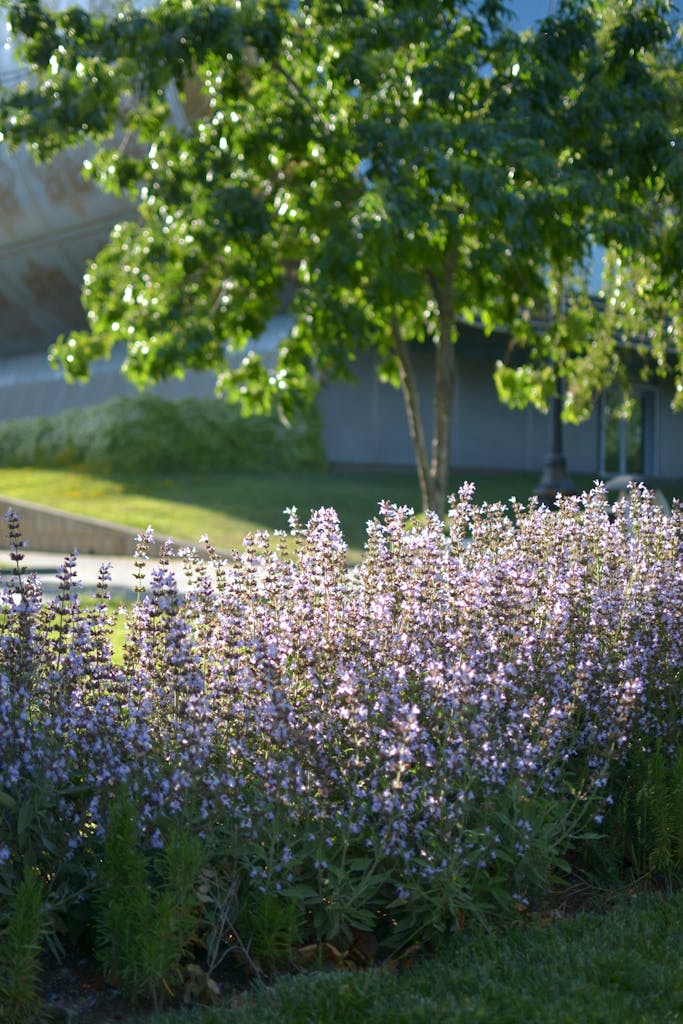
The Latin name says everything. Salvia, from salvare — to save, to heal, to keep safe. The Romans called it herba sacra, the sacred herb. Hildegard von Bingen devoted significant attention to it in her 12th-century Physica, the text that bridges the Carolingian medical tradition and the later medieval herbalism I work within.
And it was listed in the Capitulaire de Villis. Charlemagne’s court demanded that every imperial estate grow sage. On their Galenic understanding of constitutional medicine, this was not a culinary decision. It was a health policy.
My sage has been growing in this garden since before I arrived. When I dug the beds for the Carolingian project — recreating the Capitulaire plant list on this 170-year-old farm — the sage I found already naturalized in a corner of the kitchen garden was a variety I had not planted. Old stock. Rooted deep.
The land already knew. The chart just explained why.
What This Means for You
I am not suggesting everyone run out and get an astrological reading before they choose their herbs. But I am suggesting something that the Galenic tradition has always known and that we have largely forgotten in the age of isolated compounds and generic protocols:
Constitutional medicine is personal medicine. The plant that is most yours is not necessarily the trendiest herb of the moment, or the one with the most research behind it. It is the one that speaks most directly to your terrain — your particular combination of temperature, moisture, tissue tendency, elemental quality, and seasonal disposition.
The Capitulaire de Villis is, among other things, a record of which plants a sophisticated medical culture considered essential enough to mandate across an empire. Running my natal chart through that list was not an academic exercise. It was a recognition: these plants were chosen by people who understood what I understand about how medicine works. And they chose well.
If you are curious about your own constitutional type and which Capitulaire plants might be most resonant for your terrain — that is exactly the kind of question I explore in the Archives tier of my YouTube membership at youtube.com/@thelittleoldlady_101. Monthly live Q&A, case-based teaching, and the full depth of constitutional herbalism as a working framework.
The garden is waiting. It always has been.