
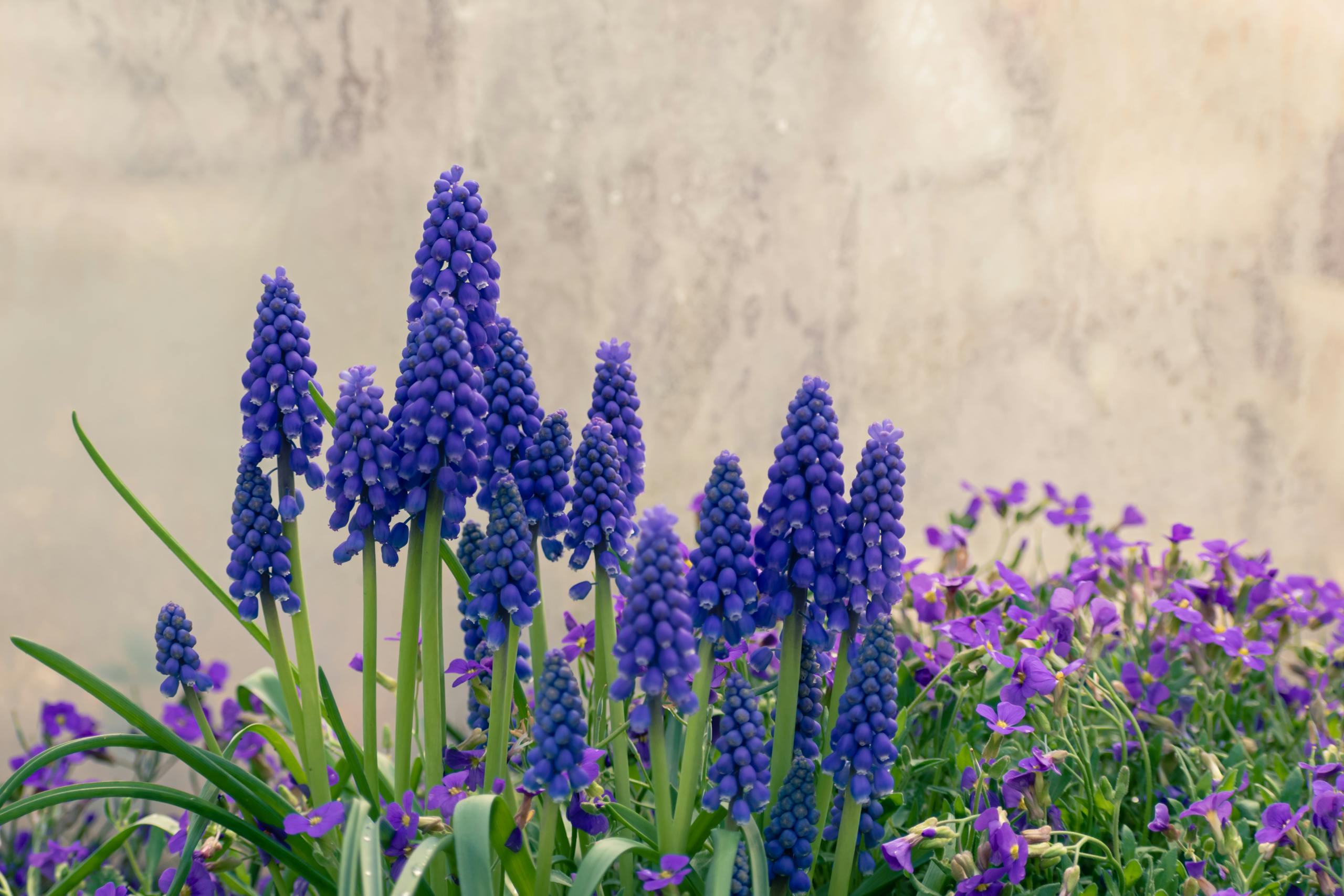
What Charlemagne’s Scribes Didn’t Write Down: Muscari neglectum and the Silence of the Capitulaire
Key Takeaways
The Argument The Capitulaire de Villis is a cultivation directive, not a botanical encyclopedia. Absence from the list signals a plant was too ubiquitous to require instruction — not that it was unknown or unvalued.
The Historical Logic
- Plants on the list required deliberate effort: importing, sowing, tending, accounting for
- Muscari neglectum was a self-seeding, frost-hardy, meadow plant already everywhere in Carolingian France — no memo needed
- The parallel: no one writes instructions about nettles or dandelions either
The Botanical Connection
- Squill (Scilla maritima) is on the list — a coastal Mediterranean plant that required active cultivation in northern France
- Muscari and Scilla belong to the same tribe (Hyacintheae) and share a distinctive chemical fingerprint: homoisoflavanones
- Charlemagne’s world valued squill’s medicine; Muscari’s chemical cousin was growing free in the meadow
What Modern Science Confirms
- 2025 Granada study: 72 compounds identified in bulbs; bulbs are dramatically richer than flowers
- Validated traditional uses: anti-inflammatory (lipoxygenase + nitric oxide inhibition), antioxidant, antimicrobial, diuretic
- Bulbs contain 65.5 mg GAE/g phenolics vs. flowers’ ~18.2% — the bulb is the medicine
The Folk Tradition (Pre-Science) Consistent cross-cultural use across Turkey, Iran, Spain, Italy, and the Balkans: antirheumatic, stomachic, diuretic, expectorant, and food — bulbs eaten raw, boiled, pickled; flowers used as dye
Why It Belongs in the ACB Garden Not as a reconstruction of Chapter 70, but as a reconstruction of the living Carolingian estate — what grew without instruction, what was foraged alongside what was cultivated, what the cook and healer already knew

There is a question I am asked regularly about the plans for this garden and by readers of this project: “If a plant isn’t on Charlemagne’s list, why is it here?” It is a fair question, and it deserves a serious answer. But embedded within it is a deeper question — one that most people never think to ask: What does it mean when a plant is absent from the Capitulaire de Villis? Does absence indicate that 9th-century Carolingian estate managers didn’t know a plant? Didn’t value it? Didn’t use it?
Or does it mean something else entirely?
The plant I want to talk about today is Muscari neglectum — the common grape hyacinth, that small bulbous geophyte whose violet-blue flower spikes appear every March and April across southern Europe, the Mediterranean basin, and the rural farmland of France, including here in the Creuse. It is not on the Capitulaire’s list of seventy-three plants. It never was. And I want to make the case that its absence tells us not that Charlemagne’s agronomists ignored it, but that they were so thoroughly surrounded by it that writing it down would have been as superfluous as listing the grass.
How to Read a Medieval Plant List
The Capitulaire de Villis, issued sometime around 812 CE under Charlemagne’s authority, is a remarkable administrative document. It is not an encyclopaedia of plants known to the Carolingian world. It is a management directive — a set of instructions to the stewards of royal estates, specifying what those estates should grow, maintain, and supply to the imperial household. The plant list in Chapter 70, the famous list that animates this entire garden project, enumerates plants that required deliberate cultivation: plants that needed to be planted, tended, harvested, and accounted for.
This distinction matters enormously. A plant appears on the Capitulaire’s list because it required human intervention to be reliably present on an estate. Rosemary needed to be started from cuttings in a sheltered location. Fenugreek had to be sown. Colocynth — a bitter desert gourd with powerful purgative properties — had absolutely no business growing wild in Frankish France and required both importation and careful cultivation. These are the plants that made the list.
Plants that were everywhere — that seeded themselves into every meadow, field, roadside, and disturbed patch of ground — had no reason to appear on a cultivation directive. You do not instruct your estate managers to grow dandelions. You do not write memos about nettles. And in Carolingian France, in a landscape of meadows and fields and old stone walls, you did not need to cultivate Muscari neglectum.
It was already there.
The Botanical Evidence: A Mediterranean Native in a Frankish Landscape
Muscari neglectum is native to southern Europe, north Africa, and southwest Asia. It belongs to the family Asparagaceae, subfamily Scilloideae — the same great family of bulbous geophytes that includes hyacinths, squills, and the ornamental stars-of-Bethlehem. It is a plant that is, in the words of one recent botanical review, “hardy and adaptable,” capable of growing in meadows, fields, lawns, roadsides, and disturbed areas. It tolerates frost, drought, and poor soil. It spreads readily by both seed and bulb offsets.
In short, it is precisely the kind of plant that would have been a ubiquitous feature of the rural Carolingian landscape. It would have grown in every orchard margin, every fallow field, every hedgerow and rough pasture on an imperial estate in France. Its narrow leaves emerge in autumn and persist through winter. Its violet-blue flower spikes appear reliably every March to May. Its bulbs are edible and have been eaten across Mediterranean cultures for centuries.
There would have been nothing to manage. Nothing to instruct. It simply was.
The Scilla Connection: When the List Speaks by Contrast
Here is where the Capitulaire’s list becomes genuinely illuminating, not by what it includes but by the comparison it invites. Chapter 70 does list one bulbous plant from the same botanical subfamily as Muscari: squilla, which is maritime squill — Scilla maritima, now classified as Drimia maritima or Urginea maritima.
Maritime squill is a coastal Mediterranean plant. It grows naturally on rocky, sandy soils near the sea — not in the interior of Frankish France. For it to be present on a Carolingian estate in what is now Burgundy or the Loire Valley, it would have needed to be deliberately obtained, planted, and maintained. It required human attention. And so it appears on the list.
Muscari neglectum did not require that attention. And so it does not appear.
But the botanical relationship between the two plants is not merely a matter of historical curiosity. Scilla maritima and Muscari neglectum belong to the same tribe — tribe Hyacintheae — within the subfamily Scilloideae. And recent phytochemical research has confirmed that this tribal relationship corresponds to a shared and distinctive chemistry. Both plants produce a class of phenolic compounds called homoisoflavanones — a chemical signature so consistent across the tribe that researchers now consider it a chemotaxonomic marker, a chemical fingerprint that identifies membership in tribe Hyacintheae.
In other words: Charlemagne’s agronomists valued squill for its medicinal properties and went to the trouble of cultivating it. Muscari, its close botanical and chemical cousin, was simply growing in the meadow outside the garden wall. The therapeutic tradition surrounding these plants in the Carolingian world was almost certainly inclusive of both.
What Folk Medicine Knew: The Deep Tradition
Long before phytochemists arrived with their HPLC columns and mass spectrometers, the people who lived alongside Muscari neglectum had already worked out what it was good for. Across centuries and cultures — from Turkey to Iran to Spain to Italy — a remarkably consistent folk medical tradition built up around this small bulbous plant.
Muscari species appear in traditional medicine as antirheumatic, stomachic, diuretic, and expectorant remedies. In Turkey, the fruits were decocted and taken internally for rheumatism. The roots were credited with pectoral stimulatory effects, anti-inflammatory and anti-allergic properties, and aphrodisiac action. In Mediterranean and Balkan traditional medicine, species of this genus were employed for their diuretic, anti-inflammatory, and digestive properties. The bulbs — which the 2025 University of Granada phytochemical study has now established as the most pharmacologically rich part of the plant — have been eaten across the Mediterranean since antiquity: raw, boiled, grilled, or pickled. The flowers have been used as a food coloring, boiled with eggs at Nowroz in Iran to dye them purple. The leaves are edible.
This is not a marginal plant. This is a plant so thoroughly woven into the daily life and medicine of the people who lived with it that it simply never needed formal documentation in a cultivation directive. The Capitulaire’s silence on Muscari neglectum is not evidence of ignorance. It is evidence of intimacy.
What Modern Science Has Confirmed
One of the ongoing pleasures of working at the intersection of traditional herbalism and modern phytochemistry is watching the research catch up to what empirical tradition already knew. In the case of Muscari neglectum, the science is now beginning to do exactly that.
The Phytochemical Profile
A landmark 2025 study from the University of Granada — the first comprehensive phytochemical characterization of Muscari neglectum bulbs using high-resolution mass spectrometry — identified 72 distinct compounds in the bulb extract. These span an impressive range of chemical families: flavonoids (the most abundant class), hydroxycinnamic acids, terpenoids, fatty acids, iridoid glycosides, and triterpenoid saponins.
The homoisoflavanones were particularly prominent — muscomin isomers, muscomosin isomers, and related derivatives that are characteristic of the Muscari genus and the broader tribe Hyacintheae. Among the other identified compounds: caffeic acid, dihydroferulic acid, kaempferol derivatives, hesperetin isomers, dimethylquercetin, linoleic acid, eicosapentaenoic acid, and triterpenoid saponins including ginsenoside-related structures. Several oxylipin derivatives were identified in this plant for the first time.
One finding deserves particular emphasis: the bulbs contain dramatically higher concentrations of phenolic compounds than the flowers. Earlier research on the flower ethanol extract reported a total phenolic content of approximately 18.2% and a total flavonoid content of 0.94%. The bulb extract from the 2025 Granada study reached 65.5 mg GAE/g dry extract for total phenolics and 14.3 mg Epi/g dry extract for flavonoids — a difference that underscores the bulb as the pharmacologically dominant tissue of the plant, and that explains why traditional medicine across so many cultures focused specifically on the bulb.
Antioxidant and Anti-Inflammatory Activity
The Granada study demonstrated significant antioxidant activity in the bulb extract: measurable reducing power by FRAP and TEAC assays, radical scavenging activity against superoxide anion and hypochlorous acid, and inhibition of xanthine oxidase — a key enzyme in the oxidative stress pathway and a target of clinical interest in gout and inflammatory conditions.
Of equal interest to anyone reading traditional folk medicine with a clinical eye: the extract demonstrated meaningful anti-inflammatory activity by two distinct mechanisms. It scavenged nitric oxide radicals — nitric oxide being a central mediator of both vasodilation and inflammatory oxidative stress — and it inhibited lipoxygenase activity. Lipoxygenase is the enzyme that converts polyunsaturated fatty acids into pro-inflammatory leukotrienes. Its inhibition is one of the mechanisms through which plants with long anti-inflammatory reputations are now understood to work.
The researchers attributed these anti-inflammatory effects to a synergistic interplay between the phenolic compounds, the flavonoids, and the triterpenoid saponins — precisely the chemical families that traditional herbalism, working entirely empirically, had identified as medicinally relevant over centuries of use.
Antimicrobial Properties
A 2016 study published in Herba Polonica evaluated the antimicrobial activity of Muscari neglectum flower ethanol extract against food-poisoning pathogens including Escherichia coli, Shigella flexneri, Salmonella typhimurium, Candida albicans, and Aspergillus niger. The extract showed inhibitory activity against all tested organisms, with Gram-negative bacteria — including the food-borne pathogens most relevant to preservation — showing the greatest sensitivity. The researchers concluded that the extract could serve as a natural preservative in food production.
This is not a finding that would have surprised a Carolingian cook or a medieval herbalist. Plants with antimicrobial properties were the food preservation technology of the ancient and medieval world. Their inclusion in cooking, pickling, and storage was not mysticism — it was empirical knowledge refined over generations.
Muscari neglectum as Food: The Edible Bulb Tradition
It is worth dwelling on the edible dimension of Muscari neglectum, because this is where the case for its presence in a Carolingian estate context becomes almost self-evident.
The bulbs are edible — though bitter, and traditionally prepared by slicing them into thin fibers, soaking them in water to draw out the bitterness, then drying and using them as a condiment. The flowers and flower buds can be eaten raw, boiled, grilled, or pickled. The leaves are edible in their fresh form. In Spain, ethnobotanical surveys have documented the wild harvest and consumption of Muscari neglectum across multiple regions. In Italy, the plant has traditionally been used as a household dye plant and as food.
A Carolingian estate in northern France would not have needed to cultivate this plant any more than it needed to cultivate nettles or sorrel — both of which were certainly eaten and used medicinally, neither of which appears on the Capitulaire’s list. The grape hyacinth would have been foraged from the estate’s own meadows and margins, its bulbs dug in autumn, its flowers picked in spring. It was a commons plant, a peasant plant, a plant so woven into the daily economy of rural life that it existed beneath the level of formal documentation.
Why It Is in This Garden
The At Charlemagne’s Behest garden is not a museum reconstruction of Chapter 70’s plant list. It is something more interesting than that: an attempt to reconstruct the living botanical world of a Carolingian estate — including what would have grown there without anyone’s instruction, what would have been gathered from the meadow as readily as from the garden bed, what would have been known to the cook and the healer and the dyer as surely as it was known to the head gardener.
Muscari neglectum belongs in this garden for precisely the reasons it was never listed in the Capitulaire. It is native to this landscape. It is hardy and self-sustaining. It has a documented folk medicine tradition spanning the same Mediterranean and European cultures that fed into Carolingian estate management. It is chemically related to Scilla maritima, which Charlemagne’s administrators valued enough to specify by name. And it has now been subjected to rigorous phytochemical analysis that validates every traditional use attributed to it: anti-inflammatory, diuretic, antimicrobial, antioxidant, and food.
It is also, in March, one of the most beautiful things growing in this old garden. The flower spikes come up through the cold soil while winter is still arguing with spring, and they are an intense violet-blue that needs no improving. That, too, is a form of historical authenticity. A Carolingian estate in the Creuse in March would have looked, in some small measure, exactly like this.
A Note on Sources and Method
The phytochemical findings discussed in this post draw on four peer-reviewed studies: Moghaddasi (2011) on Muscari comosum and Persian shallot medicinal usages; Mahboubi and Taghizadeh (2016) on the antimicrobial and antioxidant activity of Muscari neglectum flower ethanol extract, published in Herba Polonica; Alkhamaiseh (2024) reviewing antioxidant and cytotoxic effects of Muscari neglectum in the International Journal of Complementary and Alternative Medicine; and Villegas-Aguilar, Segura-Carretero, and Suárez-Santiago (2025), the first comprehensive phytochemical characterization of Muscari neglectum bulbs, published in Molecules.
The historical argument about what the Capitulaire’s silence does and does not mean is my own, grounded in twenty years of working with traditional plant knowledge and historical texts. I hold it with confidence and with appropriate scholarly humility. Medieval estate management was not designed to document the obvious. The obvious was Muscari neglectum.
❧
At Charlemagne’s Behest — Making old ways new again