
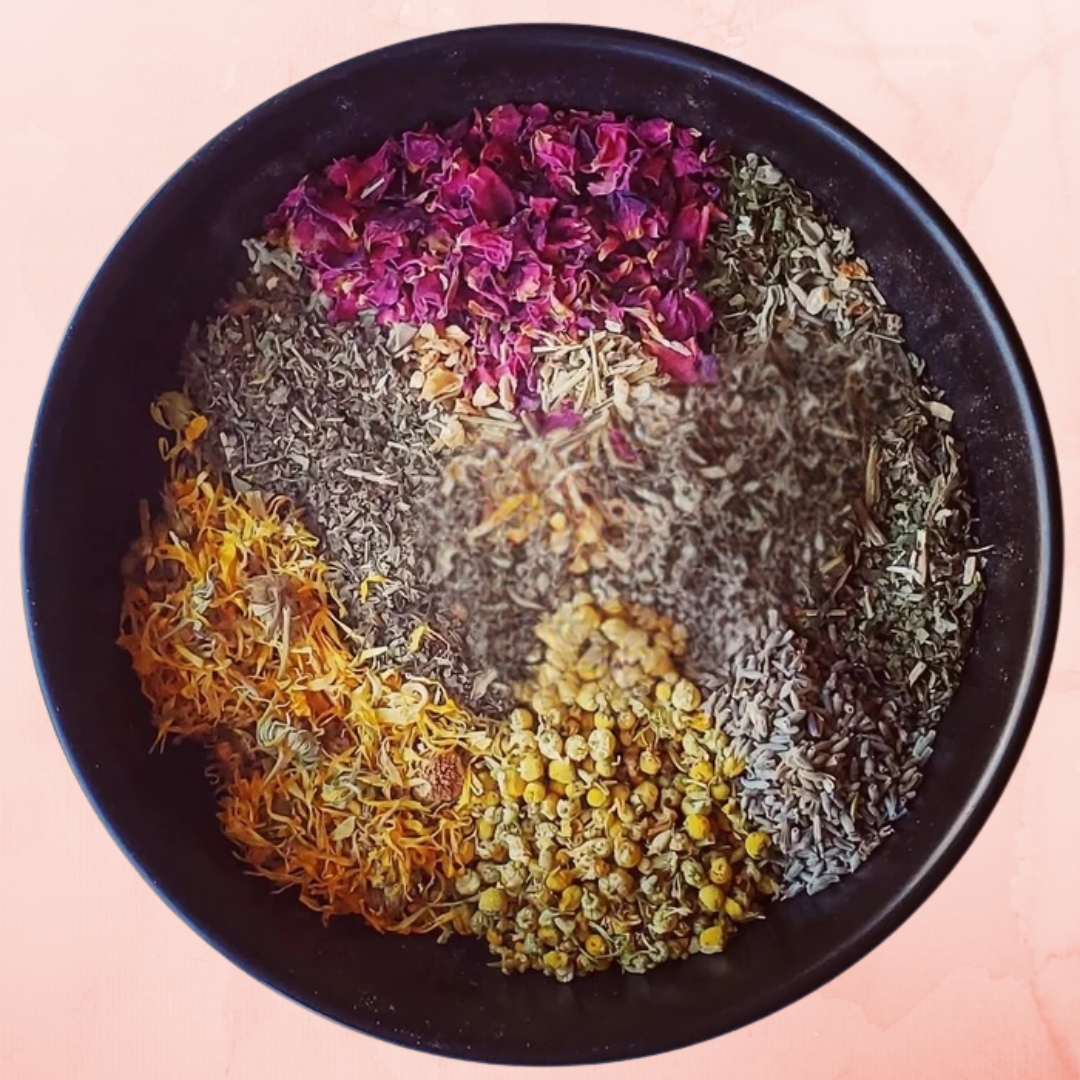
Queen of Hungary Water: A Historical Skincare Elixir
Queen of Hungary Water is a spirit of rosemary: the fresh herb steeped in strong alcohol and distilled. For three centuries it was the most famous scented water in Europe, sold by apothecaries in little flasks and carried in the pockets of French ladies. It came wrapped in a legend about an old queen made young again, and the legend is far better known than the truth. Here is what the sources actually say, what its herbs can and cannot claim, and how I make it at home.
In short: Queen of Hungary Water is a rosemary spirit that first appears in print in the 1650s and was the rage of France by the 1670s, when Madame de Sévigné wrote that she kept it in her pocket. The story of a hermit, an aged queen of Hungary and a proposal from the King of Poland is a legend, and very likely a seller’s one. Its herbs have real traditional standing for the skin, but no one has studied the water itself, so make it as a fragrant toner and enjoy its history.
The Legend of the Queen and the Hermit
The story comes from a physician, Johann Prevot, who died in 1631. His sons published his little book after his death, in 1659, and in it he wrote that he had once seen, at the front of a very old breviary, a note in the queen’s own hand: “I Elizabeth, queen of Hungary, being very infirm and much troubled with the gout in the 72d year of my age…” A hermit, she wrote, had given her this water. It restored her strength, and she grew so beautiful that the King of Poland asked to marry her, and she refused him.1
The queen usually named is Elizabeth of Poland, wife of Charles Robert, King of Hungary, who died in 1380.1 In the eighteenth century Professor Johann Beckmann of Göttingen went looking for the widowed King of Poland who proposed to her and could not find him. He judged the whole tale a romance, and suspected that the royal name had been chosen by the people who sold spirit of rosemary, because a queen sells better than a herb.2 I think he was right.
What is older than the legend is the plant and the still. Charles Estienne and Jean Liébault’s L’Agriculture et maison rustique already described distilling a spirit from rosemary in 1564, long before anyone attached a queen to it. The earliest recipe printed under her name, in a Paris book of secrets of 1660, steeps rosemary flowers in brandy distilled four times, leaves them fifty hours, and distils the whole again.3
In France: Madame de Sévigné’s Pocket Flask
By the 1670s the water was everywhere in France. In October 1675 Madame de Sévigné thanked her daughter for a bottle: “Elle est divine… je m’en enivre tous les jours; j’en ai dans ma poche.” It is divine; I intoxicate myself with it every day; I keep some in my pocket. She found it “bonne contre la tristesse,” good against sadness.4 A few months later, laid up with rheumatism, she admitted that the same water had disagreed with her all through the illness.5
Charles Perrault put it into Sleeping Beauty in 1697. When the princess pricks her finger and falls, the old woman cries for help, and they throw water in her face, loosen her laces and rub her temples with eau de la reine de Hongrie, but nothing will wake her.6 Chemists such as Nicolas Lémery printed their own methods, the rosemary of Montpellier was held to make the best, and the water kept its place in French dressing tables until eau de Cologne displaced it in the early nineteenth century.3
What the Herbs Can and Cannot Claim
The old sellers promised everything. I won’t. No one has studied Queen of Hungary Water itself, so anything said about the finished water is borrowed from its herbs. Here is what those herbs honestly have to their name.
- Rosemary and sage: in laboratory tests, the essential oils of both showed antimicrobial and antioxidant activity.7 That is a test tube, not a face, but it fits the water’s old use as a cleansing wash. The European Medicines Agency also recognises rosemary oil applied to the skin for traditional use in minor muscle and joint pain and minor circulation complaints, which sits rather well with a gouty queen.8
- Chamomile: recognised for traditional use on minor inflammation of the skin, such as sunburn, and on superficial wounds.9
- Witch hazel: the distillate is recognised for traditional use in minor skin inflammation and dryness of the skin, which makes it a gentle base for the modern versions below.10
“Traditional use” in the Agency’s sense means long and safe use, at least thirty years of it, not proof from clinical trials.9 Rose, lemon balm, lavender and mint are in the jar for their scent and their gentleness.

Recipe
Here’s my modern adaptation of the Queen of Hungary Water recipe. If you would rather try the old way, the same herbs can be steeped in spirit and distilled, as I describe in making herbal tinctures at home.
Ingredients:
- 2 cups organic vodka or witch hazel or organic apple cider vinegar
- 1/4 cup fresh rosemary leaves
- 1/4 cup fresh lemon balm leaves
- 1/4 cup dried rose petals
- 2 tablespoons dried chamomile flowers
- 2 tablespoons fresh lavender flowers
- 1 tablespoon lemon peel
- 1 tablespoon sage leaves
- 1 tablespoon mint leaves
Instructions:
- Combine all herbs and flowers in a clean glass jar.
- Pour the vodka, or witch hazel, or vinegar over the herbs, ensuring they are completely covered.
- Seal the jar tightly and store in a cool, dark place for 2-4 weeks, shaking daily.
- Strain the liquid through a cheesecloth or fine mesh strainer.
- Store in a dark glass bottle.
To use: Apply to the face with a cotton pad after cleansing, or add a few tablespoons to bathwater. It can also be used as the liquid component of homemade DIY skincare creams and balms.
DIY Queen of Hungary Water Recipe Variations
Here are several recipe variations for making Queen of Hungary Water at home, ranging from traditional to modern adaptations:
Classic Queen of Hungary Water
- 2 cups fresh rosemary leaves and flowers
- 1 tablespoon dried sage
- 1 tablespoon dried mint
- 1 tablespoon dried lemon balm
- 1 tablespoon dried chamomile
- 1 tablespoon dried lavender
- 1 tablespoon lemon zest
- 2 cups high-proof vodka or brandy
- 1/2 cup distilled water (added after infusion)
Instructions: Combine herbs with alcohol in a glass jar. Seal and store in a cool, dark place for 2-4 weeks, shaking daily. Strain through cheesecloth, add distilled water, and transfer to dark glass bottles.
Simplified Modern Version
- 1 cup fresh rosemary sprigs
- 1/4 cup fresh lavender
- 2 tablespoons fresh lemon peel
- 2 cups witch hazel
- 1/4 cup apple cider vinegar
Instructions: Combine ingredients in a glass jar, seal, and let infuse for 1-2 weeks. Strain and bottle.
Spa-Inspired Variation
- 1 cup fresh rosemary
- 1/4 cup dried rose petals
- 1 tablespoon dried thyme
- 2 tablespoons dried calendula
- 1 cinnamon stick
- 5 whole cloves
- 2 cups vodka
- 1/4 cup rose water (added after infusion)
Instructions: Combine herbs and spices with vodka, infuse for 3 weeks, strain, and add rose water before bottling.
Sensitive Skin Formula
- 1/2 cup fresh rosemary
- 2 tablespoons chamomile flowers
- 2 tablespoons calendula petals
- 1 tablespoon dried cucumber peel
- 1 tablespoon aloe vera gel
- 1 1/2 cups witch hazel
- 1/2 cup distilled water
Instructions: Infuse herbs in witch hazel for 2 weeks, strain, then blend with aloe vera gel and distilled water.
Citrus-Enhanced Version
- 1 cup fresh rosemary
- 1/4 cup dried lavender
- 2 tablespoons orange peel
- 2 tablespoons lemon peel
- 1 tablespoon grapefruit peel
- 2 cups vodka
- 2 tablespoons glycerin (added after infusion)
Instructions: Infuse citrus peels and herbs in vodka for 2-3 weeks, strain, and add glycerin before bottling.
Notes on Preparation and Use:
- Always use organic herbs when possible
- Store in dark glass bottles to preserve potency
- Shelf life is typically 6-12 months when properly stored
- Test on a small patch of skin before full application
- Keep it away from the eyes and off broken skin
- Leave out the chamomile and calendula if you react to daisy-family plants
- Use as a toner after cleansing or as a refreshing facial mist

A Queen’s Water for Ordinary Days
Make Queen of Hungary Water for the pleasure of it. Splash it on after washing, mist it over your face on a hot afternoon, or keep a little bottle in your bag the way Madame de Sévigné did. If your skin runs dry, choose the witch hazel or vinegar base over vodka, since strong alcohol dries the skin, and remember that the queen in the story is a legend, but the rosemary is real.
From Charlemagne’s Garden to Your Kitchen
The Little Old Lady’s Guide to Herbal Bitters
Wormwood, gentian, angelica, dandelion and the other bitter herbs of the Capitulare de Villis: how the Galenic physicians read them, how to grow and harvest them, and how to make your own tinctures, vinegars, bitter wines and signature blends at home. A 40-page illustrated, printable PDF.
© 2024 Carolyn Smith-Kizer
If this work is useful to you, you can buy me a coffee — buymeacoffee.com/cskizer

Notes
- “Hungary-Water,” in Encyclopaedia Britannica, 3rd ed. (Edinburgh, 1797), 8:501, quoting the memorandum as first published in 1659 in the posthumous work of Johann Prevot; transcription. ↩
- Johann Beckmann, A History of Inventions, Discoveries, and Origins, trans. William Johnston, 4th ed., rev. William Francis and J. W. Griffith (London: Henry G. Bohn, 1846), 1:315–18, “Hungary Water”; Project Gutenberg. ↩
- “L’eau de la Reine de Hongrie – première partie,” Scalpel et Matula, accessed November 4, 2026, scalpeletmatula.org, which reviews the 1660 Nouveaux secrets rares et curieux, Estienne and Liébault’s Maison rustique (1564), Lémery’s Cours de chymie (1675), the Montpellier trade, and the water’s replacement by eau de Cologne. ↩
- Madame de Sévigné to Madame de Grignan, October 1675, in Lettres de Madame de Sévigné, de sa famille et de ses amis, ed. Louis Monmerqué, vol. 4 (Paris: Hachette, 1862); Wikisource. Translation mine. ↩
- Madame de Sévigné to Madame de Grignan, February 9, 1676, in Monmerqué, Lettres, 4:356–59; Wikisource. ↩
- Charles Perrault, “La Belle au bois dormant,” in Histoires ou contes du temps passé (Paris: Barbin, 1697); Wikisource. ↩
- Biljana Bozin et al., “Antimicrobial and Antioxidant Properties of Rosemary and Sage (Rosmarinus officinalis L. and Salvia officinalis L., Lamiaceae) Essential Oils,” Journal of Agricultural and Food Chemistry 55, no. 19 (2007): 7879–85, https://doi.org/10.1021/jf0715323. ↩
- European Medicines Agency, Committee on Herbal Medicinal Products, European Union Herbal Monograph on Rosmarinus officinalis L., aetheroleum, Rev. 1, EMA/HMPC/513893/2021 (2024); EMA. ↩
- European Medicines Agency, Committee on Herbal Medicinal Products, European Union Herbal Monograph on Matricaria recutita L., flos, EMA/HMPC/55843/2011 (2015); EMA summary. ↩
- European Medicines Agency, Committee on Herbal Medicinal Products, Community Herbal Monograph on Hamamelis virginiana L., folium et cortex aut ramunculus destillatum (2009); EMA. ↩