
Cayenne Pepper: The Hottest Herb in the Galenic Kitchen
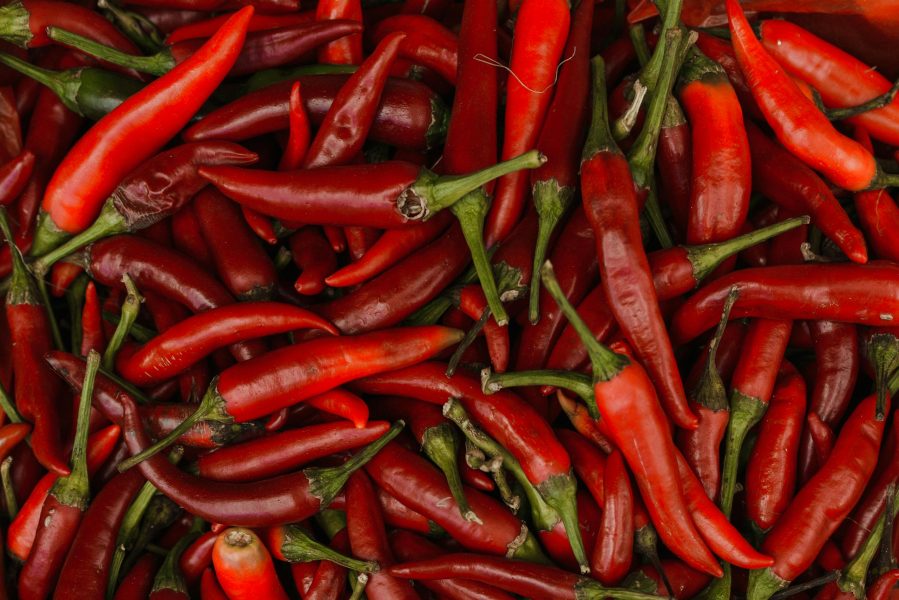
Most mornings my coffee gets a pinch of cayenne pepper along with the cinnamon. It is a small fire, and I have come to depend on it. Cayenne is the hottest thing in my kitchen and one of the most useful things in my stillroom, and it is the clearest example I know of a plant whose temperament you can taste in a single grain.
Cayenne is a New World plant. Peppers had been cultivated in the Americas for thousands of years before Columbus carried them back to Spain, and within fifty years they were growing in German gardens. Leonhart Fuchs drew them in his great herbal of 1542.1 Unlike holy basil or hibiscus, then, cayenne has had nearly five centuries to be read through Galenic eyes, and the reading was never in doubt.
At a Glance
- Botanical name: Capsicum annuum L. (cayenne types); also C. frutescens L.
- Common names: cayenne, chilli, red pepper, piment de Cayenne (French)
- Family: Solanaceae (the nightshade family)
- Part used: ripe fruit
- Taste: pungent, burning
- Galenic qualities: hot and dry in the highest degree
- Modern energetics: hot, dry, stimulating, dispersing — the systems agree
- Actions: circulatory stimulant, rubefacient, carminative, diaphoretic, counter-irritant, analgesic (topically)
- Main cautions: reflux and ulcers, eyes and broken skin, blood thinners, ACE-inhibitor cough
- Conservation status: a cultivated crop; not at risk
The Plant
Cayenne is a bushy, branching plant 50–100 cm tall, grown as an annual in temperate gardens though it is a perennial in the tropics. The leaves are smooth, oval and pointed. The small white flowers hang singly from the leaf joints, five-petalled and nodding like their potato and tomato cousins. The fruit is a long, slender, often slightly curved pod, green at first and ripening to scarlet, with a hollow interior and pale seeds clinging to a central placenta. That placenta and the inner ribs hold most of the heat.
The Galenic Reading
Pungency is the taste of heat. A taste that burns the tongue, makes the eyes water and brings out a sweat is, in Galenic terms, hot and dry in the extreme, and cayenne is about as far along that scale as any plant goes. It is a dispersing, opening, penetrating herb: it drives blood to the surface, opens the pores, and moves anything that has become cold, stuck or sluggish.
- Phlegmatic (cold and moist): the clearest match. A pinch in soup or tea warms a cold stomach, clears catarrh and brings colour back to cold hands and feet.
- Melancholic (cold and dry): the heat helps, but cayenne dries further. Use it in small amounts, always with food and a little fat or oil.
- Choleric (hot and dry): generally avoid. Cayenne adds fire to fire and will aggravate irritability, heartburn and flushing.
- Sanguine (hot and moist): sparingly, and mostly in winter.
In nineteenth-century America the botanic physician Samuel Thomson built an entire system on the principle that heat is life and cold is death, and cayenne was his chief herb for “raising the heat.”2 That is a thoroughly Galenic instinct. Cayenne is a winter herb and an herb for the old and cold, which is why it lives in my kitchen.
Uses
1. Circulation and the Heart
Cayenne’s best-known traditional use is to move the blood: to warm cold extremities, to bring the circulation out to the surface, and to stimulate a sluggish heart and pulse. As someone who has lived with lymphoedema, I value anything that keeps fluid and blood moving. A large Chinese study following nearly half a million adults found that people who ate spicy food most days had a lower overall death rate, including from heart disease, than those who rarely did.3 That is an association, not proof, but it fits the old use.
2. Digestion
In small amounts cayenne is a warming carminative. It wakes a cold, slow stomach, increases the flow of digestive juices and eases wind. The key is the dose: a pinch stimulates, a spoonful irritates. This is the classical distinction between an herb that corrects a cold stomach and one that inflames a hot one.
3. Pain and the Joints (External Use)
Applied to the skin, cayenne is a counter-irritant. Its capsaicin first excites the heat-and-pain receptor known as TRPV1 and then, with repeated use, exhausts it, so that the nerve endings send fewer pain signals.4 This is why cayenne ointments burn at first and soothe later. In osteoarthritis, a network meta-analysis found topical capsaicin about as effective as topical anti-inflammatory gels.5 A high-strength capsaicin patch from the doctor helps some people with nerve pain, though not everyone.6

4. Metabolism and Appetite
A systematic review found that capsaicin and related compounds modestly increase energy expenditure and fat burning and reduce appetite, while cautioning that the effects are small.7 In Galenic language, cayenne quickens a slow, cold metabolism. That is useful for the phlegmatic type, but it is not a short cut.
Constituents
The main active groups are:8
- Capsaicinoids: chiefly capsaicin and dihydrocapsaicin, the source of the heat, concentrated in the placenta and ribs
- Carotenoids: capsanthin and capsorubin (the red colour), plus β-carotene
- Vitamins: vitamin C when fresh, and vitamin E
- Flavonoids and a small amount of volatile oil
Heat is measured in Scoville units. Cayenne usually runs between 30,000 and 50,000.
Preparations and Dosage
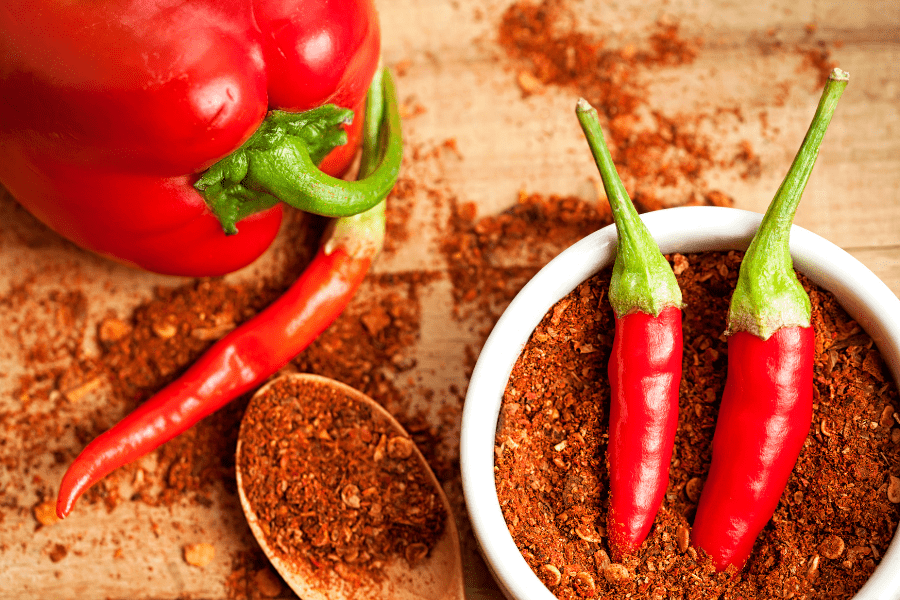
- In food: a pinch to ¼ teaspoon of powder in soups, stews, eggs or a morning drink. This is where most of us should take it.
- Infusion: a small pinch of powder in a cup of hot water with lemon and honey at the start of a cold, to bring on a sweat.
- Tincture: a few drops in water, often added to other formulas as a “carrier” to drive them through the body, as Thomson used it.
- Infused oil and salve: warm a tablespoon of cayenne powder in a cup of olive oil over very low heat for an hour, strain through fine cloth, and thicken with beeswax. Patch-test first and wash your hands well afterwards.
- Plaster or compress: a little powder in a flour-and-water paste on a cloth, applied for a few minutes only, for a stiff, cold back. Never on broken skin.

Harvesting, Growing and Sustainability
Cayenne needs warmth but is easier than roselle. In the Creuse, sow indoors in February or March, pot on, and plant out after the last frost against a warm wall or in a greenhouse. Pick the pods when they are fully red and glossy. Thread them on string and hang them in a dry, airy place, then grind the dried pods in a coffee mill. Wear gloves, and do not breathe the dust.
Cayenne is grown on a huge scale and is not at risk. Buy organic powder from a source that turns its stock over quickly; old cayenne fades from scarlet to brick.
Safety and Interactions
- Reflux, gastritis and ulcers: cayenne can aggravate burning in the stomach. Use very little, always with food, or avoid it.
- Eyes and mucous membranes: capsaicin burns. Wash hands thoroughly after handling, and never use cayenne preparations near the eyes or on broken skin.
- Topical use: the first applications sting; that is expected. Stop if the skin blisters or the burning is severe.9
- Blood thinners: large amounts may add to their effect. Keep to culinary doses and tell your doctor.
- ACE inhibitors: capsaicin may worsen the dry cough these blood-pressure drugs can cause.
- Pregnancy and breastfeeding: culinary amounts are fine for most women; avoid medicinal doses.
- The choleric constitution: if you run hot, flush easily or have heartburn, cayenne is probably not your herb.
Common Questions
Is cayenne the same as chilli powder?
Not always. Cayenne is ground red pepper alone. “Chilli powder” is often a blend with cumin, oregano and garlic.
Why does a cayenne cream burn before it helps?
Capsaicin first excites the pain-sensing nerve endings and then exhausts them. After a few days of regular use the burning fades and the pain relief remains.
Can I take cayenne every day?
In culinary amounts, yes, for most people. If you have reflux or an ulcer, or take blood thinners, keep it small or avoid it.
Which constitution benefits most?
In Galenic terms, the cold, damp phlegmatic type, because cayenne is hot and dry in the highest degree. Hot choleric types should generally avoid it.
© 2024 Carolyn Smith-Kizer
If this work is useful to you, you can buy me a coffee — buymeacoffee.com/cskizer

Notes
- Leonhart Fuchs, De historia stirpium commentarii insignes (Basel: Isingrin, 1542). ↩
- Samuel Thomson, New Guide to Health; or, Botanic Family Physician (Boston: printed for the author, 1822). ↩
- Jun Lv et al., “Consumption of Spicy Foods and Total and Cause Specific Mortality: Population Based Cohort Study,” BMJ 351 (2015): h3942, https://doi.org/10.1136/bmj.h3942. ↩
- Victor Fattori et al., “Capsaicin: Current Understanding of Its Mechanisms and Therapy of Pain and Other Pre-Clinical and Clinical Uses,” Molecules 21, no. 7 (2016): 844, https://doi.org/10.3390/molecules21070844. ↩
- Monica S. M. Persson et al., “The Relative Efficacy of Topical Non-Steroidal Anti-Inflammatory Drugs and Capsaicin in Osteoarthritis: A Network Meta-Analysis of Randomised Controlled Trials,” Osteoarthritis and Cartilage 26, no. 12 (2018): 1575–82, https://doi.org/10.1016/j.joca.2018.08.008. ↩
- Sheena Derry et al., “Topical Capsaicin (High Concentration) for Chronic Neuropathic Pain in Adults,” Cochrane Database of Systematic Reviews, no. 1 (2017): CD007393, https://doi.org/10.1002/14651858.CD007393.pub4. ↩
- S. Whiting, E. Derbyshire, and B. K. Tiwari, “Capsaicinoids and Capsinoids. A Potential Role for Weight Management? A Systematic Review of the Evidence,” Appetite 59, no. 2 (2012): 341–48, https://doi.org/10.1016/j.appet.2012.05.015. ↩
- Fattori et al., “Capsaicin.” ↩
- Fattori et al., “Capsaicin.” ↩
Bibliography
Derry, Sheena, Andrew S. C. Rice, Peter Cole, Toni Tan, and R. Andrew Moore. “Topical Capsaicin (High Concentration) for Chronic Neuropathic Pain in Adults.” Cochrane Database of Systematic Reviews, no. 1 (2017): CD007393. https://doi.org/10.1002/14651858.CD007393.pub4.
Fattori, Victor, Miriam S. N. Hohmann, Ana C. Rossaneis, Felipe A. Pinho-Ribeiro, and Waldiceu A. Verri. “Capsaicin: Current Understanding of Its Mechanisms and Therapy of Pain and Other Pre-Clinical and Clinical Uses.” Molecules 21, no. 7 (2016): 844. https://doi.org/10.3390/molecules21070844.
Fuchs, Leonhart. De historia stirpium commentarii insignes. Basel: Isingrin, 1542.
Lv, Jun, Lu Qi, Canqing Yu, et al. “Consumption of Spicy Foods and Total and Cause Specific Mortality: Population Based Cohort Study.” BMJ 351 (2015): h3942. https://doi.org/10.1136/bmj.h3942.
Persson, Monica S. M., Joanne Stocks, David A. Walsh, Michael Doherty, and Weiya Zhang. “The Relative Efficacy of Topical Non-Steroidal Anti-Inflammatory Drugs and Capsaicin in Osteoarthritis: A Network Meta-Analysis of Randomised Controlled Trials.” Osteoarthritis and Cartilage 26, no. 12 (2018): 1575–82. https://doi.org/10.1016/j.joca.2018.08.008.
Thomson, Samuel. New Guide to Health; or, Botanic Family Physician. Boston: printed for the author, 1822.
Whiting, S., E. Derbyshire, and B. K. Tiwari. “Capsaicinoids and Capsinoids. A Potential Role for Weight Management? A Systematic Review of the Evidence.” Appetite 59, no. 2 (2012): 341–48. https://doi.org/10.1016/j.appet.2012.05.015.