
Zingiber officinale Ginger: Herbal Monograph
Zingiber officinale ginger is the warming, drying root of the kitchen and the stillroom. This herbal monograph sets out its botany, energetics, constituents, traditional uses and cautions, with references.
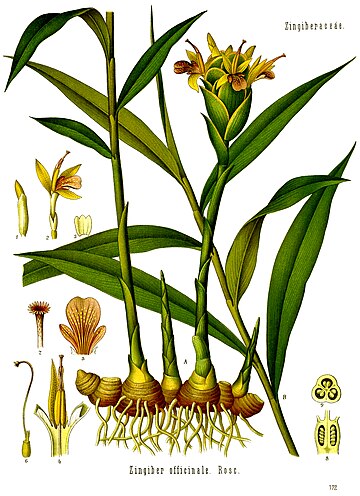
Family
Zingiberaceae
Actions
Carminative, anti-emetic, anti-inflammatory, circulatory stimulant, diaphoretic (Mao et al., 2019)
Energetics
Warming, drying (Holmes, 2007)
Chemical Constituents
- Gingerols (6-gingerol, 8-gingerol, 10-gingerol)
- Shogaols (6-shogaol, 8-shogaol, 10-shogaol)
- Zingiberene
- β-sesquiphellandrene
- α-curcumene
- Flavonoids
- Phenolic acids
The pungent compounds gingerols and shogaols are primarily responsible for ginger‘s biological activities (Semwal et al., 2015).
Part of Plant Used
Rhizome (fresh or dried)
Uses
- Supports digestive health
- Promotes healthy nausea response
- Supports healthy inflammatory response
- Promotes circulatory health
- Supports respiratory wellness
- Promotes healthy immune function
A comprehensive review by Mao et al. (2019) highlighted ginger’s potential in supporting various aspects of health, particularly in digestive and inflammatory wellness.
Contraindications
- Bleeding disorders
- Gallstones
- Scheduled surgery (within two weeks)
Side Effects
- Mild gastrointestinal discomfort in some individuals
- Potential for heartburn at high doses
- Possible skin irritation with topical use
While generally well-tolerated, these side effects have been noted in some individuals, particularly at higher doses (Bode & Dong, 2011).
Interactions with Other Drugs
- May interact with blood-thinning preparations
- May interact with certain diabetes preparations
- May interact with certain blood pressure preparations
Caution is advised when combining ginger with these types of preparations due to potential interactions (Chrubasik et al., 2005).
Dosage
- Fresh root: 1-4 grams daily
- Dried powder: 0.25-1 gram, three times daily
- Standardized extract (5% gingerols): 75-2000 mg daily
Clinical studies have used a wide range of doses, typically 1-3 grams of ginger powder daily for various applications (Marx et al., 2017).
Mode of Administration
Oral consumption as fresh root, dried powder, tea, tincture, or capsules. Topical application as compress or in oils.
Duration of Administration
Can be used long-term when consumed in food amounts. For higher doses or therapeutic use, consult with a qualified herbalist.
Risks
- Potential for increased bleeding in high doses
- May lower blood sugar levels
- Possible interactions with certain medications
A review by Bode & Dong (2011) emphasized the importance of considering individual health conditions and potential interactions when using ginger therapeutically.
Recipes
- Ginger Tea
- 1-inch piece fresh ginger, sliced
- 1 cup boiling water
- Honey to taste (optional)
Steep for 5-10 minutes, strain, and enjoy.
- Ginger Honey
- 1 cup fresh ginger, grated
- 1 cup raw honey
Combine in a jar, let sit for 2 weeks, stirring daily. Strain and use as needed.
- Ginger Compress
- 2 tablespoons grated fresh ginger
- 1 cup hot water
Steep ginger in water for 10 minutes, strain. Soak a clean cloth in the liquid and apply to affected area.
Fresh, Dried, and Kept Well
Fresh and dried ginger are not quite the same physic. Drying converts much of the gingerols into shogaols, so dried ginger is more heating and better for warming a cold stomach. Fresh ginger is brighter and more diffusive — better for a chill, a cold coming on, or a steam (Semwal et al., 2015).
Ginger is warming and drying (Holmes, 2007), which makes it a natural fit for cold, damp constitutions. For someone who runs hot, I pair it with peppermint or chamomile.
Choosing and storing: pick firm roots with smooth, taut skin. Scrape the skin off with the edge of a spoon rather than peeling with a knife, because much of the aromatic oil sits just underneath. Wrap whole roots in paper and keep them in the refrigerator for up to three weeks. Freeze grated ginger in small portions for longer.
Steam for congestion: grate about 5 cm of fresh root into a large bowl and pour about a litre of boiling water over it. Make a towel tent and breathe the steam for 5–10 minutes.
Candied ginger: a mother once wrote to tell me that candied ginger slices, which her daughter could carry to school when pills were not allowed, eased her period cramps. Her stomach complaint settled at the same time.
Pairings
- Fennel and peppermint after heavy meals.
- Chamomile when digestion is upset by nerves.
- Thyme or mullein for the chest.
Remember to always consult with a qualified herbalist before incorporating new herbs into your wellness routine, especially if you have existing health concerns or are taking other preparations.
Return to: A Wise Woman’s Guide to Reducing Inflammation with Herbs, Foods, and Lifestyle
© 2024 Carolyn Smith-Kizer
If this work is useful to you, you can buy me a coffee — buymeacoffee.com/cskizer

References
Bode, A. M., & Dong, Z. (2011). The Amazing and Mighty Ginger. In I. F. F. Benzie & S. Wachtel-Galor (Eds.), Herbal Medicine: Biomolecular and Clinical Aspects (2nd ed.). CRC Press/Taylor & Francis. https://www.ncbi.nlm.nih.gov/books/NBK92775/
Chrubasik, S., Pittler, M. H., & Roufogalis, B. D. (2005). Zingiberis rhizoma: A comprehensive review on the ginger effect and efficacy profiles. Phytomedicine, 12(9), 684-701. https://doi.org/10.1016/j.phymed.2004.07.009
Holmes, P. (2007). The energetics of Western herbs: A materia medica integrating Western and Chinese herbal therapeutics (4th ed.). Snow Lotus Press.
Mao, Q. Q., Xu, X. Y., Cao, S. Y., Gan, R. Y., Corke, H., Beta, T., & Li, H. B. (2019). Bioactive Compounds and Bioactivities of Ginger (Zingiber officinale Roscoe). Foods, 8(6), 185. https://doi.org/10.3390/foods8060185
Marx, W., Ried, K., McCarthy, A. L., Vitetta, L., Sali, A., McKavanagh, D., & Isenring, L. (2017). Ginger-Mechanism of action in chemotherapy-induced nausea and vomiting: A review. Critical Reviews in Food Science and Nutrition, 57(1), 141-146. https://doi.org/10.1080/10408398.2013.865590
Semwal, R. B., Semwal, D. K., Combrinck, S., & Viljoen, A. M. (2015). Gingerols and shogaols: Important nutraceuticals from ginger. Phytochemistry, 117, 554-568. https://doi.org/10.1016/j.phytochem.2015.07.012