
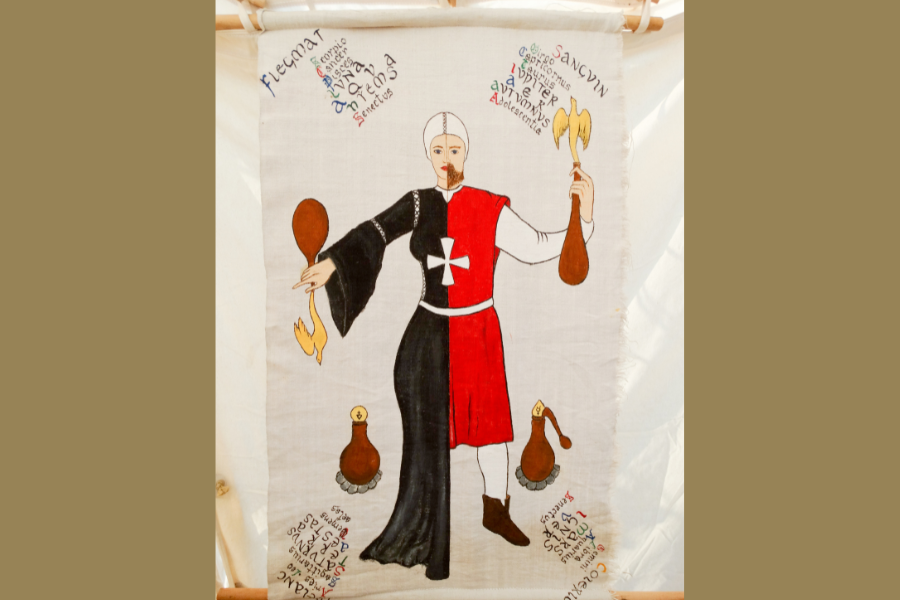
The Four Galenic Constitutional Types or the Four Humours
Galenic medicine does not begin with a plant. It begins with a person.
Before Charlemagne’s physicians reached for wormwood or sage, fennel or nettle, they looked at the person in front of them — and asked what kind of body this was. How did it run–hot or cold? How did it hold moisture or tend toward dryness? What season made it thrive, and what season brought it low?
The answers to those questions defined the four Galenic constitutional types. And the constitutional type determined everything: which plants were appropriate, which were contraindicated, which season called for intervention, and what kind of balance the body was naturally trying to maintain.
This is the constitutional framework behind the Capitulare de Villis plant list. It is the clinical logic that makes the 73 mandated plants a coherent pharmacopoeia rather than a random collection of useful herbs. And it is the framework that the At Charlemagne’s Behest series works to restore to active use.
REF 2 is the companion document to REF 1: The Capitulare de Villis Plant List. Together they form the standing reference foundation of the ACB series.
The Four Humours: A Brief Introduction to the Four Galenic Constitutional Types
Galenic medicine is built on the doctrine of the four humours: Blood, Yellow Bile, Phlegm, and Black Bile. These are not metaphors. In Galen’s system they are physiological realities — actual substances produced by the body, in ratios that determine health or disease.
Each humour has a quality pairing: hot and moist, hot and dry, cold and moist, cold and dry. Each corresponds to an element, a season, an organ, and a stage of life. And each, when present in its natural proportion, supports the body’s characteristic function. When humours fall out of balance — through diet, season, illness, or constitutional tendency — the herbalist’s task is to restore proportion.
This is not a primitive system. It is a systems-level model of constitutional terrain that modern terrain-based herbalism and functional medicine have been quietly rediscovering for decades. The vocabulary has changed; the underlying logic has not.

The Four Galenic Constitutional Types
Every person was understood to have a dominant constitutional temperament derived from their humoral balance. These are not personality categories in the modern pop-psychology sense — they are clinical observations about how a person’s body characteristically behaves, what conditions it is prone to, and what interventions are most appropriate.
- Sanguine: hot and moist. Good circulation, resilient, sociable — but prone to excess and inflammatory conditions when out of balance. Element: Air. Humour: Blood. Season: Spring.
- Choleric: hot and dry. Energetic, decisive, driven — but prone to inflammatory conditions, acidity, and rapid burnout. Element: Fire. Humour: Yellow Bile. Season: Summer.
- Phlegmatic: cold and moist. Steady, empathic, enduring — but prone to sluggishness, fluid retention, and the kind of diffuse, cold, damp conditions that are hard to name and slow to shift. Element: Water. Humour: Phlegm. Season: Winter.
- Melancholic: cold and dry. Thoughtful, precise, perceptive — but prone to obstruction, anxiety, and the kind of dry, rigid, slow-moving conditions that tend toward chronicity. Element: Earth. Humour: Black Bile. Season: Autumn.
No one is a pure type. Most people carry a dominant constitution with secondary tendencies that shift with season, age, diet, and circumstance. The herbalist’s task is not to classify but to observe — and to work with what is actually present.
The Innate Heat and Radical Moisture
Two concepts underlie all four Galenic constitutional types assessments: the innate heat (calor innatus) and the radical moisture (humidum radicale).
The innate heat is the vital fire at the centre of Galenic physiology. It is seated in the heart, expressed through the blood, and manifest in the body’s capacity for digestion, transformation, and warmth.
When innate heat is strong, the body digests well, resists cold, and maintains its characteristic vitality. When it weakens — through illness, age, cold exposure, or constitutional tendency — every metabolic process slows. Warming herbs act primarily by sustaining or restoring innate heat.
The radical moisture is the original vital fluid — distinct from ordinary body moisture, and not replaceable once consumed. It is the constitutional substrate of life. It can be preserved through appropriate diet, adequate rest, and herbs that support tissue moisture, but it cannot be manufactured anew. Preserving radical moisture is one of the central concerns of Galenic longevity medicine.
These two concepts — the fire and the fluid — sit behind everything in the four Galenic constitutional types framework. A Phlegmatic constitution in winter is dealing with excess cold and moisture pressing against an innate heat that is already constitutionally moderate. A Melancholic type in autumn faces increasing cold and dryness depleting radical moisture from a constitution already prone to dryness. Understanding these dynamics is what makes constitutional herbalism clinical rather than categorical.
The Capitulare de Villis and Constitutional Herbalism
The Capitulare de Villis (c. 812 CE) lists 73 plants required on Charlemagne’s imperial estates. These plants were not selected by chance. They reflect a working Galenic pharmacopoeia of the Carolingian period — assembled by physicians and monastic healers who had access to the late Roman transmission of Galen, Dioscorides, and the Salernitan tradition.
When mapped against the four Galenic constitutional types, the Capitulare plants reveal a systematic logic: herbs for warming cold-damp constitutions, herbs for cooling hot-dry ones, herbs for drying phlegmatic excess, herbs for moistening melancholic dryness.
The list is, among other things, a constitutional pharmacy for northern European conditions.
The full botanical identification of all 73 plants is in REF 1: The Capitulare de Villis Plant List. Individual episode monographs in the ACB series apply constitutional analysis to specific plants from the list: sage (EP.2), wormwood (EP.3), fennel (EP.5), nettle (EP.7), and more as the series grows.
The Capitulare is not a plant list. It is a constitutional pharmacy for a northern European climate, assembled by people who understood both the plants and the bodies they were treating.
How to Use REF 2 ~ Four Galenic Constitutional Types
The downloadable PDF companion to this post contains the full reference tables for all four constitutional types: foundational attributes, observable signs, herbal approach, and Carolingian plant connections. It is designed to be a working document — something you keep open alongside the episode monographs, not something you read once and set aside.
The tables in REF 2 are not a substitute for clinical observation. They are a map. The map is useful precisely because the territory — the actual person, in their actual season, in their actual year of life — is always more complex than any table can capture.
Use the tables to orient yourself. Use the episode monographs to go deep on individual plants. Use the Capitulare de Villis plant list in REF 1 to see which Carolingian plants address which constitutional terrain. That triangulation — constitution, plant, season — is the core clinical method of this series.
What’s in the PDF
- Quick-reference overview table: all four Galenic constitutional types side by side — element, humour, qualities, season, organ, age
- Full colour-coded cards for each constitution: Sanguine, Choleric, Phlegmatic, Melancholic
- Observable signs tables: physical build, complexion, pulse, sleep, digestion, mood, tongue, and seasonal tendency for each type
- Herbal approach tables: general principle, core herbs, bitters guidance, seasonal support, Capitulare plant connections, and clinical cautions for each type
- Mixed and compound constitutions: working principles for dual-quality excess and seasonal overlays
- Innate Heat and Radical Moisture: the two concepts underlying all constitutional assessment
- Further reading: Galen primary sources and key secondary scholarship
A Living Reference: Four Galenic Constitutional Types
REF 2 will be updated as the ACB series grows. When the astrological herbalism article publishes, the constitutional types will be mapped to their planetary rulers. When the salt and moisture article publishes, the innate heat and radical moisture section will expand.
This document is not finished — it is in active use.
If you are new to the series, the place to begin is the pillar post: The Capitulare de Villis and the Lost Science of Constitutional Plant Medicine. From there, REF 1 and REF 2 are the reference backbone. The episode monographs are where the plants come alive.