
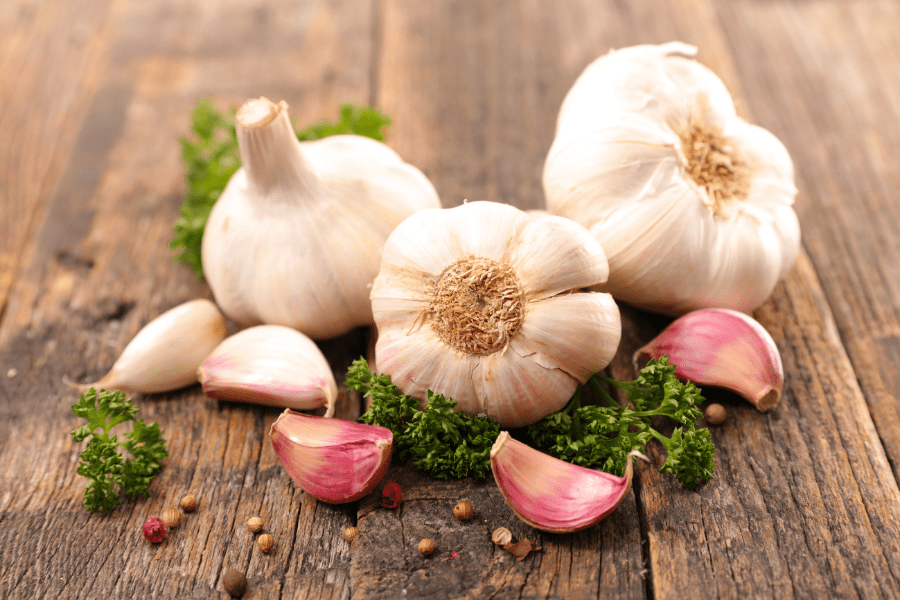
Garlic in the Kitchen Garden: Allium sativum, Mars Among the Herbs
Garlic in the kitchen garden goes back to Charlemagne’s list. Chapter 70 of the Capitulare de Villis, the ordinance for the royal estates, names alia among the plants every imperial garden was to grow, set between the onions and the madder.1 By then it was already ancient. The Greek physicians Hippocrates and Galen both used it, and in the twelfth century Hildegard of Bingen gave it a place in her Physica.2
Today garlic is sold in capsules as an anti-inflammatory and a heart herb. I want to put it back where the Carolingians kept it, in the kitchen garden and the cooking pot, and to read it the way the old physicians did: as one of the hottest, driest foods we eat.
At a Glance
- Botanical name: Allium sativum L.
- Common names: garlic, ail (French), alium (Latin), alia in the Capitulare
- Family: Amaryllidaceae (the onion family, formerly Alliaceae or Liliaceae)
- Part used: the bulb, fresh, dried or aged
- Taste: pungent and sharp raw; sweet and mellow cooked
- Galenic qualities: hot and dry, among the strongest of the kitchen herbs
- Planetary ruler: Mars (Culpeper)
- Actions: warming, circulatory, antimicrobial, expectorant, carminative
- Main cautions: blood thinners and surgery, some HIV drugs, sensitive stomachs, supplements in pregnancy, raw garlic on the skin
- Conservation status: a cultivated crop; not at risk
The Plant
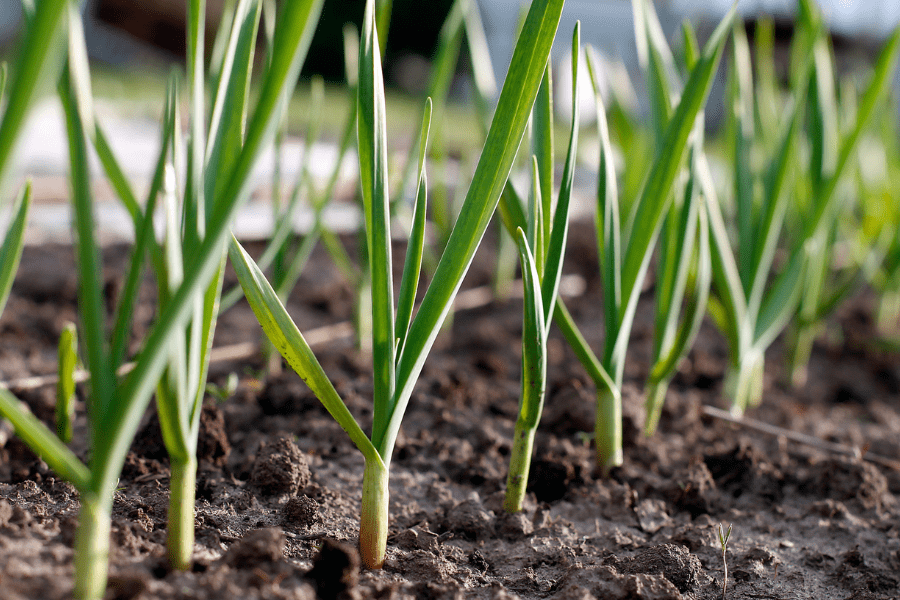
Garlic is a bulbous perennial that we grow as an annual. Its flat, keeled, blue-green leaves rise from a bulb of six to twenty cloves, each wrapped in papery skin. Hardneck types send up a curling flower stalk, the scape, in early summer, topped with tiny bulbils rather than seed; softneck types rarely flower at all. Garlic sets almost no viable seed and is grown from single cloves, so every head in your kitchen is a clone of a plant someone grew centuries ago. Its wild ancestor came from Central Asia, and it has been cultivated around the Mediterranean since antiquity.
The Galenic Reading
Pungency is the taste of heat, and garlic is among the most pungent foods there is. Raw, it reddens and can even blister the skin. Culpeper put it plainly: “Mars owns this Herb.”3 Mars is the hot, dry planet of fire, iron and vigour, and garlic shares his temper. The same writer warned that “in choleric men it will add fuel to the fire,” and told his readers to take it inwardly “in great moderation.”4
- Phlegmatic (cold and moist): the best match of all. Garlic warms, dries and cuts through cold, damp catarrh, a heavy winter chest and a slow, watery digestion.
- Melancholic (cold and dry): welcome for its warmth, but drying. Take it cooked and softened in butter, oil or honey; roasted garlic is the gentlest form.
- Choleric (hot and dry): sparingly, and cooked. Raw garlic can inflame an already hot stomach and temper.
- Sanguine (hot and moist): moderate amounts in food. The sanguine body is already warm.
Garlic is an everyday seasoning, but its physic season is autumn and winter, when cold and damp settle into the chest and the Galenic body needs fire.
Uses
1. The Circulation and the Heart
This is where the modern evidence is strongest. A 2016 meta-analysis of twenty trials found that garlic preparations lowered systolic blood pressure by about 5 mmHg on average, and by about 8.7 mmHg systolic and 6.1 mmHg diastolic in people whose pressure was high. An earlier analysis found that garlic lowered total and LDL cholesterol by about 10 percent after two months or more in people with slightly raised levels.5 The European Medicines Agency accepts garlic as a traditional herbal product to support the arteries alongside other measures.6 If you already take blood pressure or cholesterol medication, garlic is something to discuss with your doctor, not a substitute.
2. Winter Chests and Colds
To a Galenist, a cold is phlegm: cold, wet and heavy. Garlic is the classic hot, dry corrective, and that is how country households across Europe used it every winter. The modern evidence is thinner than its reputation. A Cochrane review found only one good trial: 146 people took a garlic supplement or a dummy pill daily for twelve weeks over winter, and the garlic group reported 24 colds against 65. The reviewers judged that a single trial is not enough to be sure.7 The European Medicines Agency accepts garlic for relieving the symptoms of the common cold on the strength of long-standing use.8
3. A Cold Stomach
Garlic is carminative: it warms a cold, sluggish stomach and moves wind. This is why the cuisines of cold, damp places, and of the Mediterranean peasant, lean on it so heavily with beans, cabbage and salt meat. Raw garlic on an empty stomach can be harsh, though, so take it with food.
4. Getting the Most from a Clove
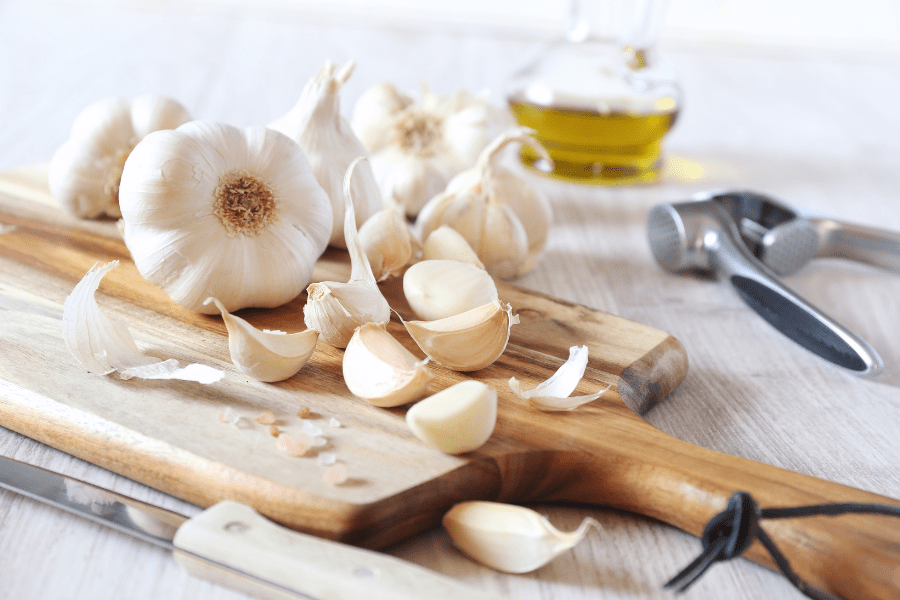
A whole clove is fairly mild. Its main sulfur compound, alliin, only turns into pungent allicin when the clove is crushed or chopped and the enzyme alliinase is released.9 Heat destroys that enzyme. In laboratory work, crushed garlic that was left to stand for ten minutes before heating kept more of its activity than garlic heated straight away.10 So crush or chop your garlic first, let it sit while you prepare everything else, and add it to the pan last.
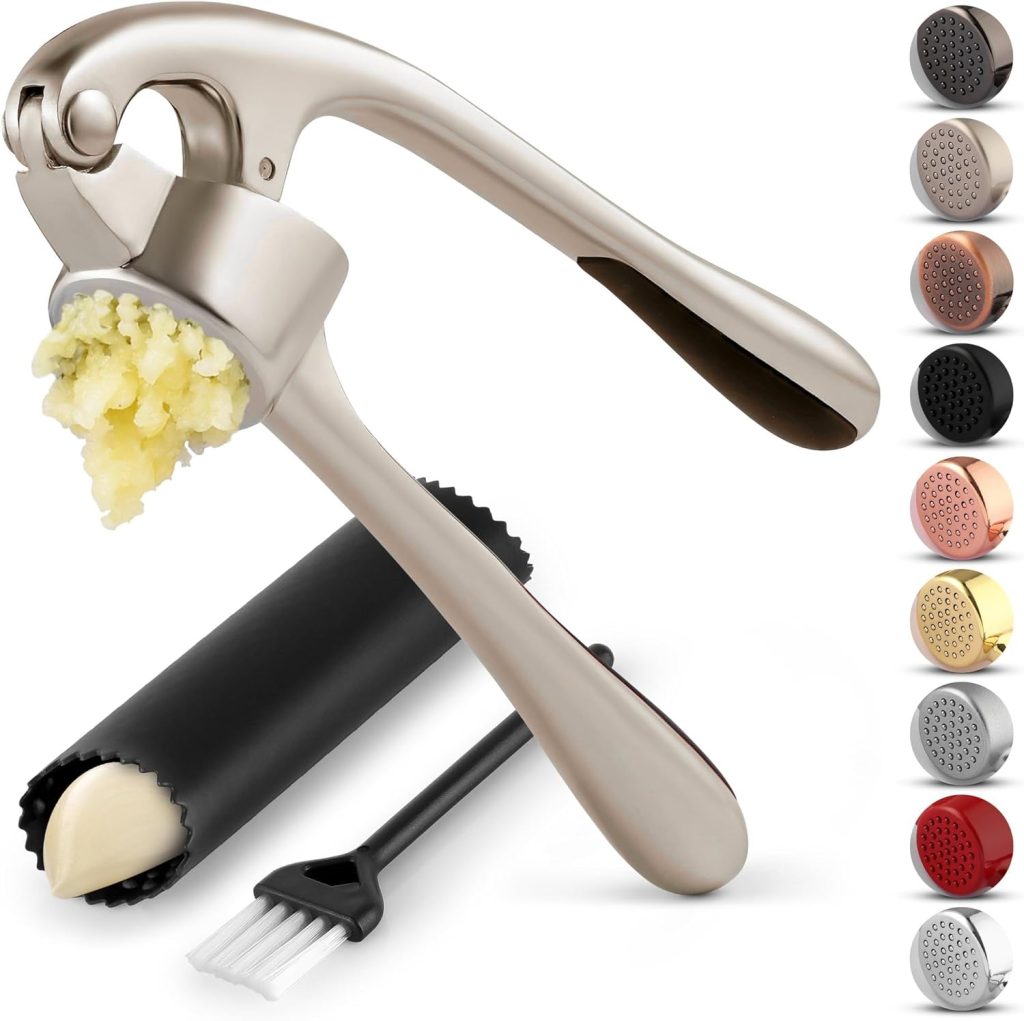
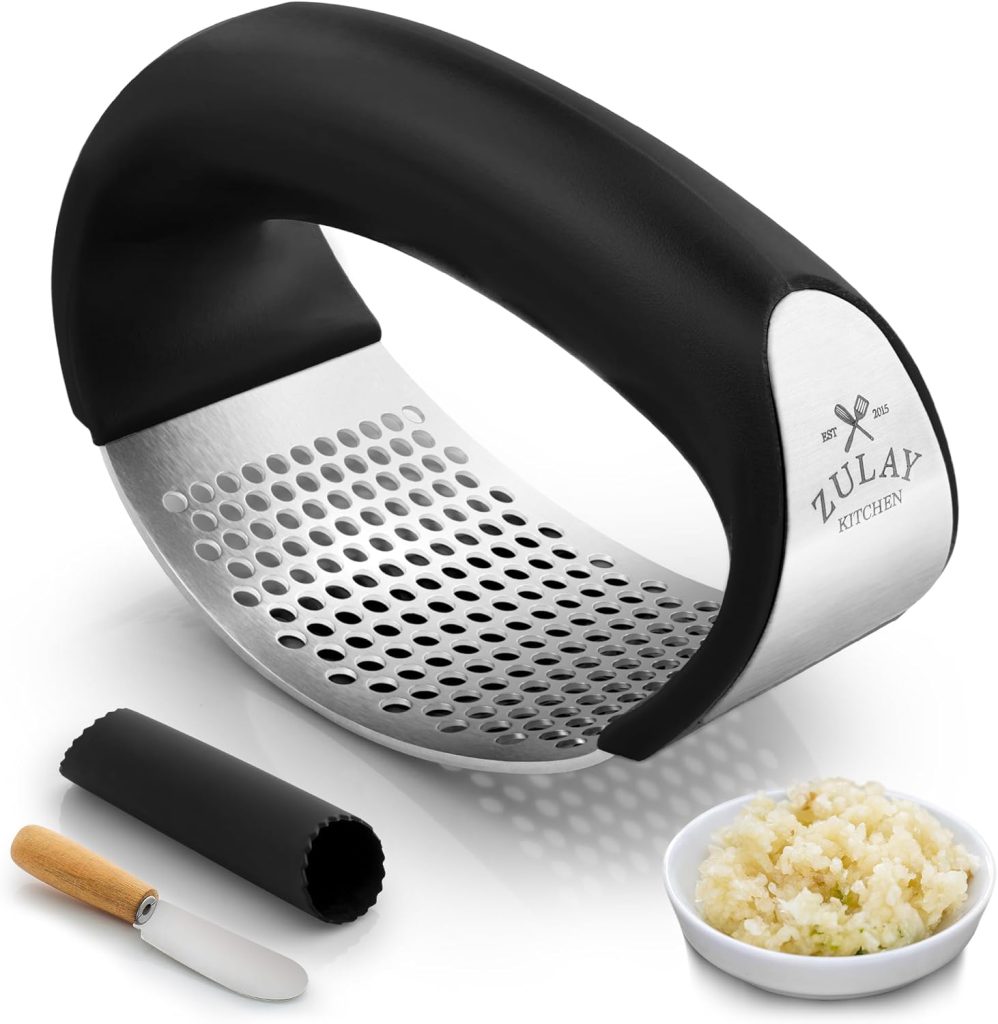
Both of my presses work well for old hands. The rocker press needs only a downward lean of the palm rather than a squeeze.
Constituents
The bulb contains:11
- Alliin: the main sulfur compound of the intact clove
- Allicin: formed from alliin by alliinase when the clove is crushed; very unstable, and responsible for the sharp smell
- Ajoene and vinyldithiins: formed as allicin breaks down in oil
- S-allylcysteine: a water-soluble compound that builds up in aged garlic extract
- Fructans, amino acids and minerals
Preparations and Dosage
- In food: one or two fresh cloves a day, about 2–5 g, the World Health Organization’s average daily amount.12
- Dried powder: 0.4–1.2 g a day.13 Good powder is pale cream and smells strongly of garlic.
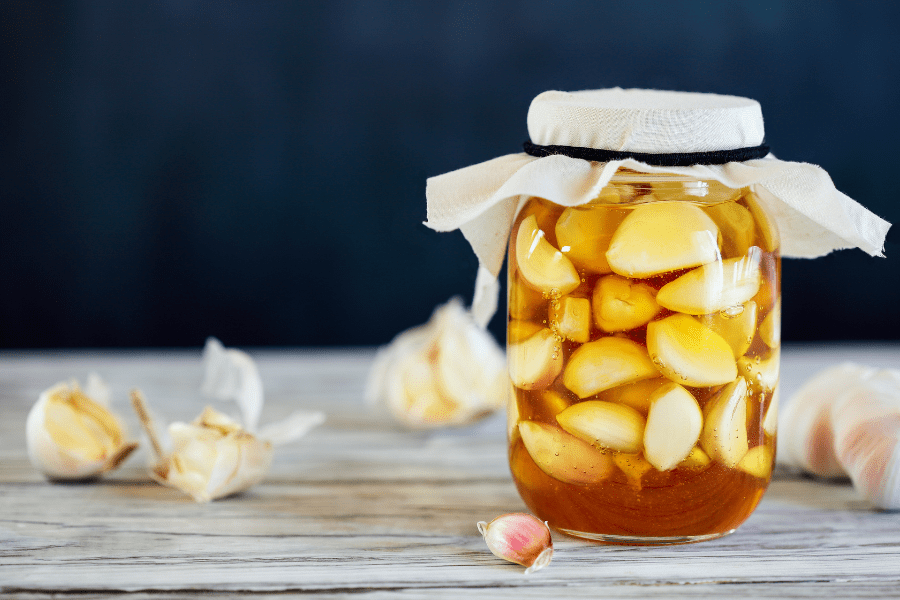
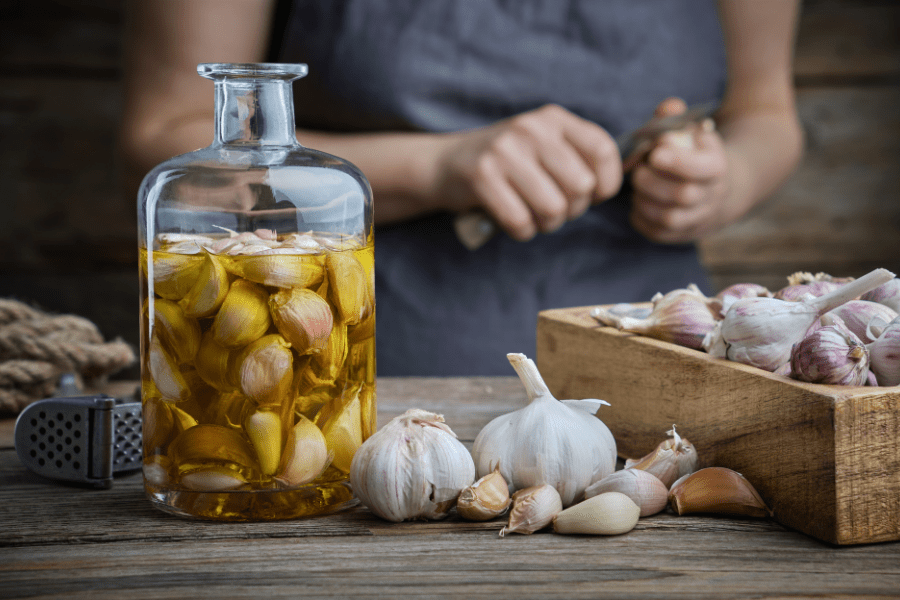
- Garlic honey: peel and lightly crush a head of cloves, put them in a clean jar and cover with raw honey. Leave for a couple of weeks, turning the jar now and then. Take a spoonful, with a clove if you like, through the winter.
- Garlic oil: make it fresh, keep it in the refrigerator and use it within a few days. Garlic stored in oil at room temperature carries a risk of botulism.
- Roasted garlic: roast whole heads in a little olive oil until soft and spread the cloves on bread. The gentlest form for choleric and melancholic people.
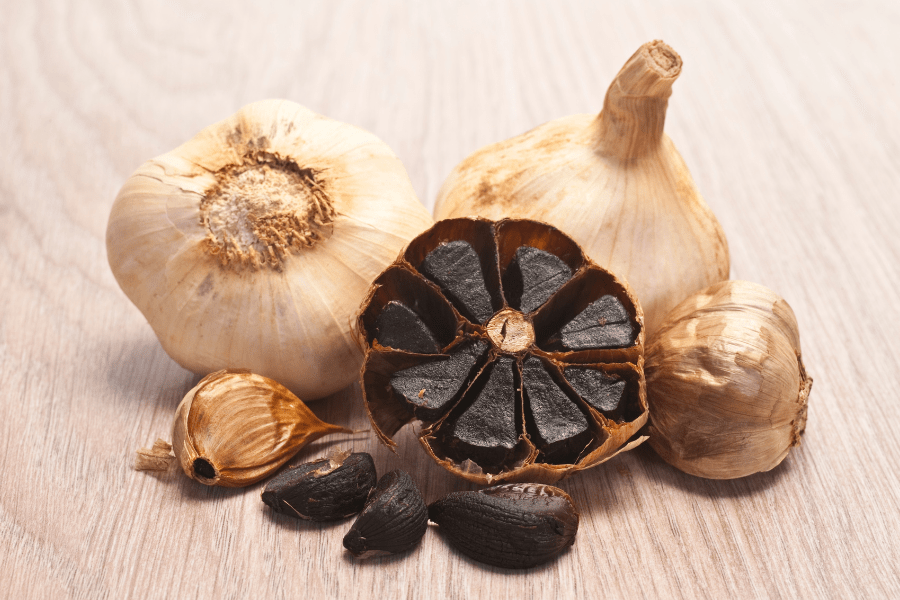
- Black garlic: whole heads kept warm and humid for several weeks until the cloves turn black, soft and sweet. Mild on the stomach.

Harvesting, Growing and Sustainability
Garlic is one of the easiest plants in the Carolingian garden. Here in the Creuse I plant single cloves in October or November, pointed end up, about 5 cm deep and 15 cm apart, in sunny, well-drained soil. They need the winter cold to divide into cloves. Keep them weeded, stop watering in early summer, and lift the bulbs in July when the lower leaves have browned.
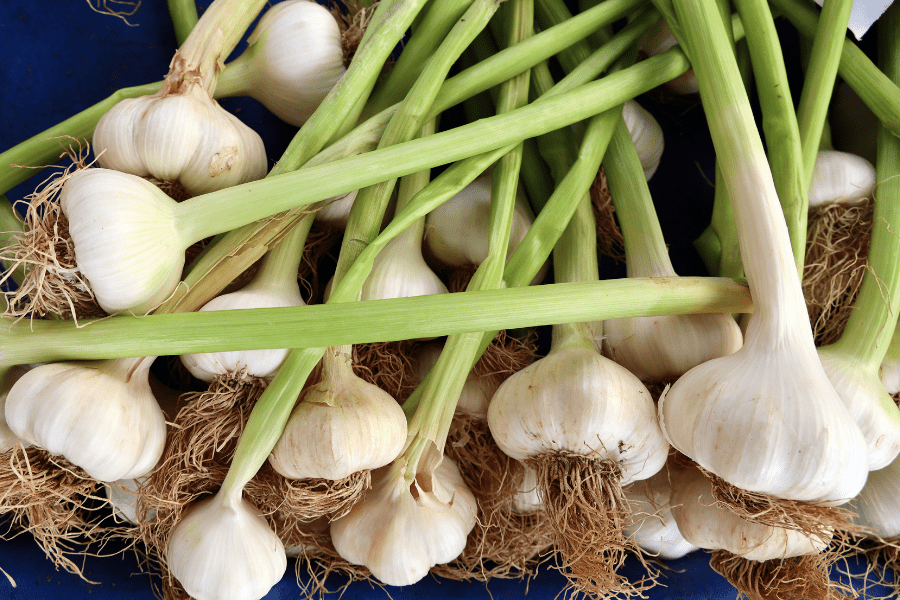
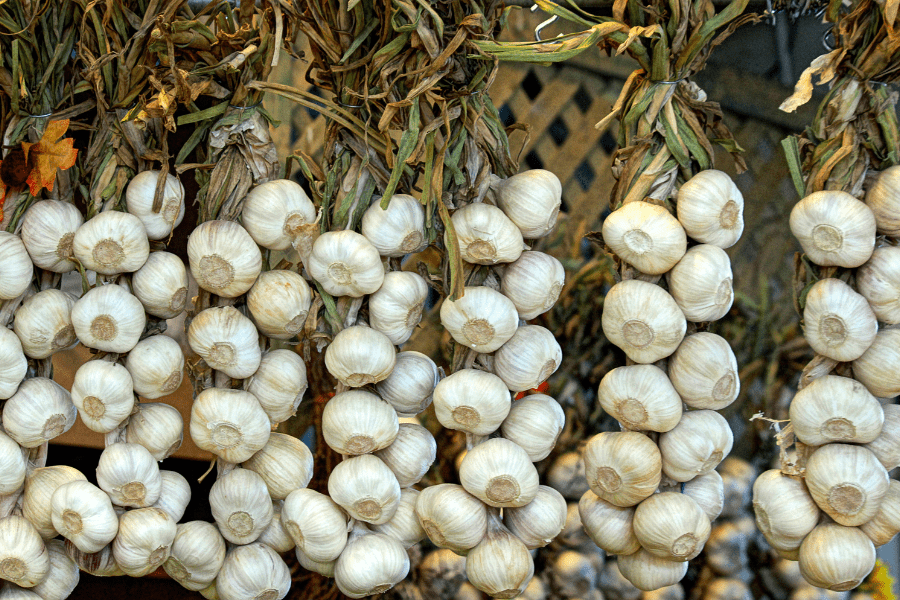
Dry the bulbs in an airy, shady place for two or three weeks, then trim the roots and store them cool and dry. Softneck types can be braided and hung in the kitchen, as they have been for centuries. Save your best heads to plant next autumn. Garlic is a cultivated crop grown all over the world and is not at risk.
Safety and Interactions
- Bleeding and surgery: garlic supplements may increase the risk of bleeding. If you take blood thinners or aspirin, talk to your doctor before using garlic supplements, and tell your surgeon that you take them.14
- HIV medication: in a study of healthy volunteers, garlic supplements cut blood levels of the HIV drug saquinavir by about half.15 Anyone on HIV drugs should avoid garlic supplements unless their doctor agrees.
- Pregnancy and breastfeeding: garlic in food is fine; amounts larger than those in food may not be safe.16
- The stomach: bad breath, body odour, heartburn, wind and nausea are the usual complaints.17 Take garlic with food, and cooked if raw garlic disagrees with you.
- The skin: raw garlic left on the skin can cause chemical burns. Never tape a clove to the skin or leave a poultice on for long.
- Allergy: uncommon, but some people react to garlic on the skin or in food.
Common Questions
Raw or cooked?
Raw garlic is hotter and sharper, cooked garlic sweeter and easier on the stomach. Crush it and let it stand ten minutes before cooking, and you keep much of the benefit of both.
Does garlic powder count?
Yes. Good dried powder keeps some of its alliin and alliinase, and it is easy to add to food every day. Buy it in small amounts so it stays fresh.
Why did my pickled garlic turn blue or green?
Sulfur compounds in garlic react with acid and trace metals to make harmless pigments. It is safe to eat.
Which constitution benefits most?
In Galenic terms, the cold, damp phlegmatic type, especially in winter. Choleric people should go gently and cook it.
Can I take garlic with blood thinners?
Garlic in ordinary cooking is generally fine. Garlic supplements are another matter: talk to your doctor first.
© 2024 Carolyn Smith-Kizer
If this work is useful to you, you can buy me a coffee — buymeacoffee.com/cskizer

Notes
- Alfred Boretius, ed., Capitularia regum Francorum, vol. 1, Monumenta Germaniae Historica, Leges 2 (Hannover: Hahn, 1883), no. 32, cap. 70; see also “Essential Capitulare de Villis Plant List,” At Charlemagne’s Behest, https://atcharlemagnesbehest.com/capitulare-de-villis-plant-list. ↩
- European Medicines Agency, Committee on Herbal Medicinal Products, Assessment Report on Allium sativum L., bulbus, EMA/HMPC/7686/2013 (London: European Medicines Agency, 2017). ↩
- Nicholas Culpeper, The English Physitian Enlarged (London: Peter Cole, 1653), s.v. “Garlick.” ↩
- Culpeper, English Physitian Enlarged, s.v. “Garlick.” ↩
- Karin Ried, “Garlic Lowers Blood Pressure in Hypertensive Individuals, Regulates Serum Cholesterol, and Stimulates Immunity: An Updated Meta-analysis and Review,” Journal of Nutrition 146, no. 2 (2016): 389S–96S, https://doi.org/10.3945/jn.114.202192. ↩
- European Medicines Agency, Committee on Herbal Medicinal Products, Opinion of the HMPC on a European Union Herbal Monograph on Allium sativum L., bulbus, EMA/HMPC/171136/2017 (London: European Medicines Agency, 18 July 2017). ↩
- Elizabeth Lissiman, Alice L. Bhasale, and Marc Cohen, “Garlic for the Common Cold,” Cochrane Database of Systematic Reviews 2014, no. 11: CD006206, https://doi.org/10.1002/14651858.CD006206.pub4. ↩
- EMA, Opinion on Allium sativum. ↩
- EMA, Assessment Report on Allium sativum. ↩
- Kiwon Song and John A. Milner, “The Influence of Heating on the Anticancer Properties of Garlic,” Journal of Nutrition 131, no. 3 (2001): 1054S–57S, https://doi.org/10.1093/jn/131.3.1054S. ↩
- EMA, Assessment Report on Allium sativum. ↩
- EMA, Assessment Report on Allium sativum. ↩
- EMA, Assessment Report on Allium sativum. ↩
- National Center for Complementary and Integrative Health, “Garlic: Usefulness and Safety,” last updated February 2025, https://www.nccih.nih.gov/health/garlic. ↩
- Stephen C. Piscitelli et al., “The Effect of Garlic Supplements on the Pharmacokinetics of Saquinavir,” Clinical Infectious Diseases 34, no. 2 (2002): 234–38, https://doi.org/10.1086/324351. ↩
- NCCIH, “Garlic.” ↩
- NCCIH, “Garlic.” ↩
Bibliography
Boretius, Alfred, ed. Capitularia regum Francorum. Vol. 1. Monumenta Germaniae Historica, Leges 2. Hannover: Hahn, 1883.
Culpeper, Nicholas. The English Physitian Enlarged. London: Peter Cole, 1653.
European Medicines Agency, Committee on Herbal Medicinal Products. Assessment Report on Allium sativum L., bulbus. EMA/HMPC/7686/2013. London: European Medicines Agency, 2017.
European Medicines Agency, Committee on Herbal Medicinal Products. Opinion of the HMPC on a European Union Herbal Monograph on Allium sativum L., bulbus. EMA/HMPC/171136/2017. London: European Medicines Agency, 2017.
Lissiman, Elizabeth, Alice L. Bhasale, and Marc Cohen. “Garlic for the Common Cold.” Cochrane Database of Systematic Reviews 2014, no. 11: CD006206. https://doi.org/10.1002/14651858.CD006206.pub4.
National Center for Complementary and Integrative Health. “Garlic: Usefulness and Safety.” Last updated February 2025. https://www.nccih.nih.gov/health/garlic.
Piscitelli, Stephen C., et al. “The Effect of Garlic Supplements on the Pharmacokinetics of Saquinavir.” Clinical Infectious Diseases 34, no. 2 (2002): 234–38. https://doi.org/10.1086/324351.
Ried, Karin. “Garlic Lowers Blood Pressure in Hypertensive Individuals, Regulates Serum Cholesterol, and Stimulates Immunity: An Updated Meta-analysis and Review.” Journal of Nutrition 146, no. 2 (2016): 389S–96S. https://doi.org/10.3945/jn.114.202192.
Song, Kiwon, and John A. Milner. “The Influence of Heating on the Anticancer Properties of Garlic.” Journal of Nutrition 131, no. 3 (2001): 1054S–57S. https://doi.org/10.1093/jn/131.3.1054S.