
Evergreens for Winter Solstice: Traditions, Uses and Cautions
Evergreens for winter solstice traditions are among the oldest greenery we bring indoors. The solstice, Grianstad an Gheimhridh in Irish, falls on 21 or 22 December, the longest night of the year, and across the northern world people have marked it with the plants that stay green when everything else has gone to sleep. Here is what the record really shows about the solstice and the evergreens, how one evergreen tree saved a French crew in Canada, and how to use pine and its kin safely today.
In short: Evergreens for the winter solstice have a real history: Newgrange in Ireland was built to catch the solstice sunrise, and an evergreen drink brought Jacques Cartier’s crew back from scurvy in the winter of 1536. Some conifers, such as pine, spruce and fir, make a fragrant tea or steam, but yew is deadly and some pines can harm a pregnancy, so know your tree before you use it.
The Longest Night at Newgrange
Newgrange, in the Boyne valley of County Meath, was built more than five thousand years ago, older than the pyramids of Giza. Above its entrance its builders set a small opening, the roof-box, placed so that at sunrise on the winter solstice a beam of light runs the length of the passage and reaches the chamber at its heart. Local people had long said the tomb filled with light at midwinter, but no one in modern times had seen it until the archaeologist Michael O’Kelly stood in the chamber at dawn on 21 December 1967.1
Today the light lasts about seventeen minutes on the mornings around the solstice.2 What Newgrange tells us is that the turning of the year mattered enormously to the people who built it. It does not tell us what plants they used: no evergreen remains or plant preparations have been tied to its solstice, and I would rather leave that silence honest than fill it.
The Tree That Saved Cartier’s Men
In the winter of 1535 to 1536 Jacques Cartier’s three ships lay frozen in the St. Lawrence beside the Iroquoian town of Stadacona, where Québec City stands now. Scurvy broke out, first among the Iroquoians and then among the French; by spring twenty-five of his men had died and most of the rest were too weak to work. Then Cartier saw Domagaya, the son of the chief, walking about well, though days before he had been as sick as the sailors. Domagaya showed him how his people boiled the leaves and bark of a tree they called annedda, and the crew drank it.3
Cartier wrote that if all the doctors of Louvain and Montpellier had been there with all the drugs of Alexandria, they could not have done in a year what that tree did in eight days.3 Which tree it was is still argued: eastern white cedar, white pine, white spruce, hemlock and balsam fir have all been proposed.4 What they share is foliage rich in vitamin C, which is what a scurvy-stricken crew in a frozen winter lacked.
Using Evergreens Safely Today
This is the part the old version of this post got badly wrong, so I want to be careful. Not every evergreen is safe, and a few are dangerous.
- Never use yew (Taxus). Every part of the yew except the soft red flesh around the seed contains taxine alkaloids, which act on the heart and can kill; there is no antidote.5 Yew grows in churchyards and garden hedges all over France and Britain, so learn it before you gather anything.
- Pregnancy: the needles of ponderosa pine cause late-term abortion in cattle, and the same compound, isocupressic acid, has been found in lodgepole pine, common juniper and Monterey cypress.6 No one has tested this in women, and I would not be the first. Leave evergreen teas alone while pregnant.
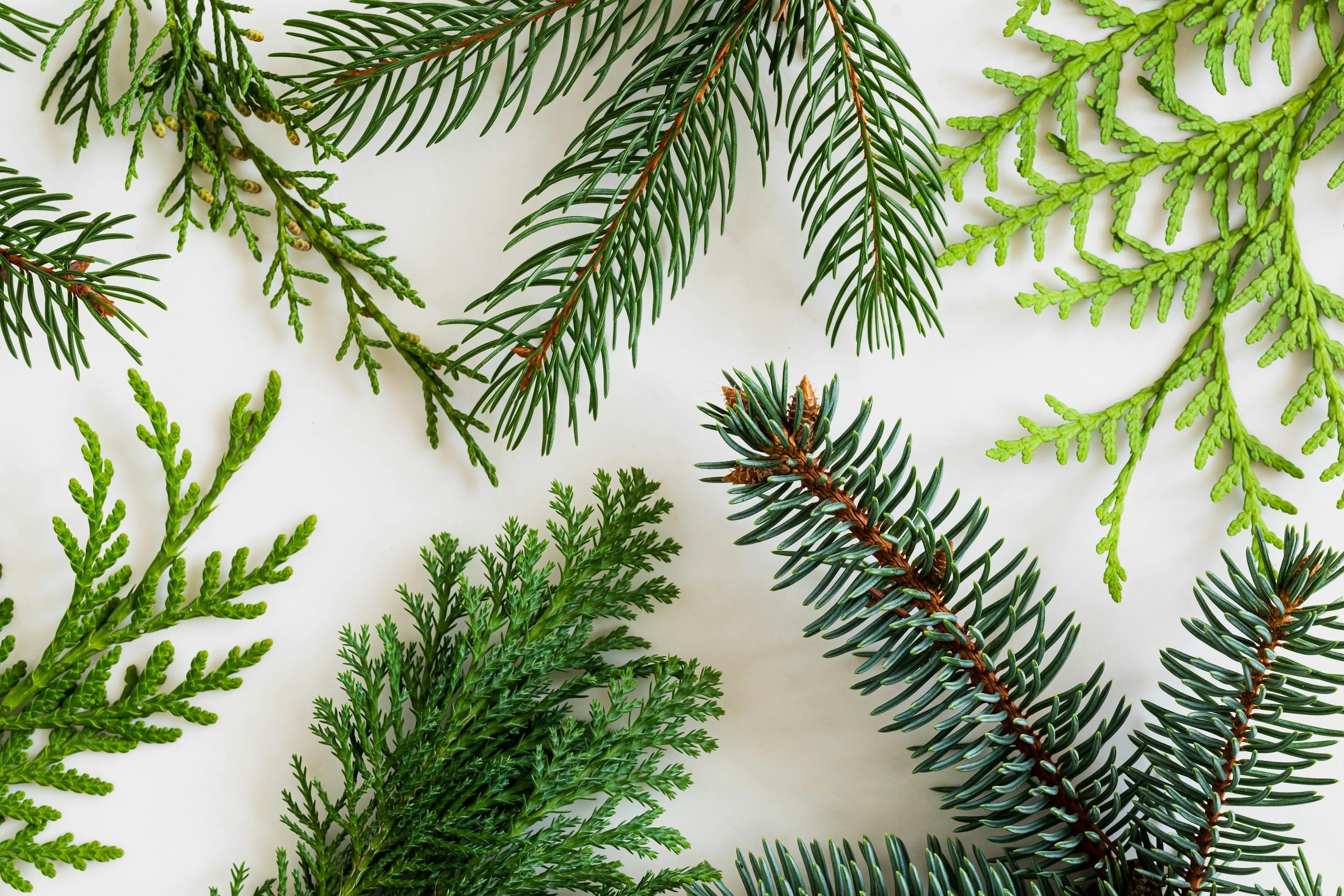
- Know your species. The trees usually used for tea are true pines such as Scots pine (Pinus sylvestris), spruces and firs. Norfolk Island “pine” is not a pine at all, and cedars and cypresses belong on the windowsill, not in the cup.
- Know your tree. Gather from places you trust, away from roads, and skip cut or nursery trees: you rarely know how they were grown or sprayed.
A Simple Evergreen Tea, Steam and Bath
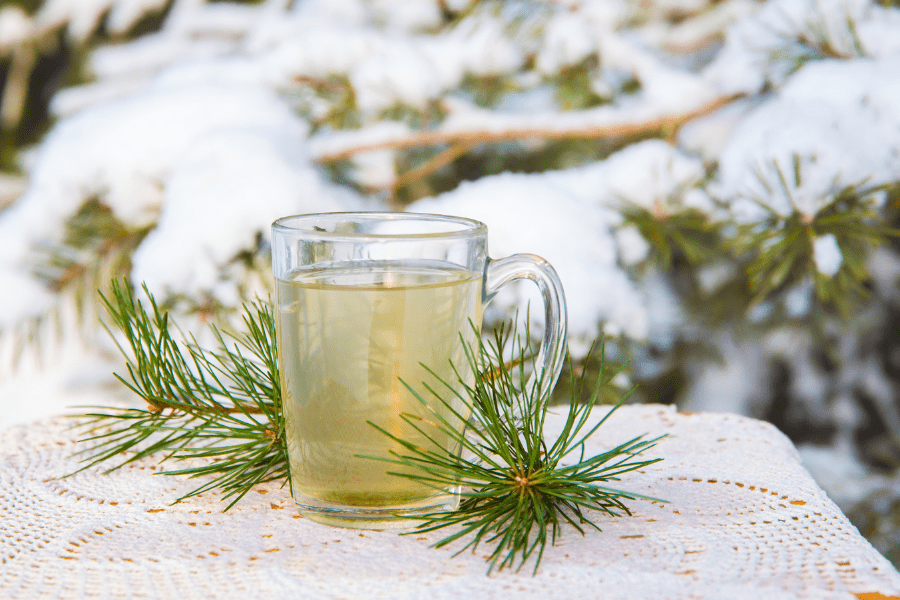
Pine Needle Tea
- Gather a small handful of fresh green needles from a pine you have identified with certainty.
- Rinse them and snip them into short pieces to open them.
- Pour just-boiled water over a tablespoon of needles in a covered cup and steep 10 minutes. Keep the cup covered so the scent stays in.
- Strain and drink plain or with a little honey. It tastes bright, resinous and faintly lemony.
Evergreen Steam
Put a handful of needles in a bowl, pour boiling water over them, and breathe the steam with a towel over your head for 10 to 15 minutes, keeping your face a comfortable distance from the water. Stop if it makes you cough or your eyes sting.
Pine Needle Bath
Tie two tablespoons of fresh needles and two of rosemary in a muslin bag and let it steep in the hot bath as it fills. It is pure pleasure on a dark December evening.
Gathering with Care
- Take only a little from any one tree, and only from trees with plenty to spare.
- Choose small side branches and leave the growing tips alone.
- Ask the landowner, and follow local rules on protected land.
Frequently Asked Questions
Can I make tea from any evergreen?
No. Use only trees you can identify with certainty, usually true pines, spruces and firs. Never use yew, and avoid all evergreen teas in pregnancy.
How long do fresh needles keep?
A few days in a closed container in the refrigerator. They are best the day you gather them.

The solstice is the turn of the year, the night after which the light begins to come back. Bringing something green indoors to keep it company is one of the oldest and gentlest things we do, and you can read more about the turning points of the year in my post on the cross-quarter days.
© 2024 Carolyn Smith-Kizer
If this work is useful to you, you can buy me a coffee — buymeacoffee.com/cskizer

Notes
- Sharon Weadick, “The Winter Solstice at Newgrange,” National Museum of Ireland, museum.ie; Michael J. O’Kelly, Newgrange: Archaeology, Art and Legend (London: Thames and Hudson, 1982). ↩
- Office of Public Works, “Newgrange’s Ancient Secrets Revealed: Join Us for Live Streaming of the Winter Solstice,” press release, gov.ie. ↩
- H. P. Biggar, ed., The Voyages of Jacques Cartier (Ottawa: Public Archives of Canada, 1924), as quoted in Glen Blouin, “Medicinal Use of Forest Trees and Shrubs by Indigenous People of Northeastern North America,” XII World Forestry Congress (Québec, 2003), FAO. ↩
- On the identity of annedda, see the FAO paper above, and Jacques Mathieu, L’Annedda: L’arbre de vie, discussed in “L’histoire méconnue d’un arbre de vie,” ULaval nouvelles, Université Laval. ↩
- Natasha G. et al., “Fatal Heart Block from Intentional Yew Tree (Taxus baccata) Ingestion: A Case Report,” European Heart Journal: Case Reports 4, no. 1 (2019): 1–4, https://doi.org/10.1093/ehjcr/ytz226. ↩
- Kevin D. Welch et al., “Pine Needle Abortion in Cattle,” USDA Agricultural Research Service, Poisonous Plant Research Laboratory, summary; Daniel Cook et al., “Differences in Ponderosa Pine Isocupressic Acid Concentrations Across Space and Time,” Rangelands, University of Arizona. ↩