
The Book of Noah: The Roots the Watchers Taught and Heaven Gave Back
The Book of Noah is a lost book, and it belongs to every herbalist who has ever worried over a line in 1 Enoch. I have read that line more times than I can count. Among the things the fallen Watchers taught the women they took, the text lists “charms and enchantments, and the cutting of roots,” and says they “made them acquainted with plants.”1 That is my own craft, written on the rebels’ list.
So is the garden tainted? The ancient writers asked the same question, and they gave an answer worth knowing.
What 1 Enoch Charges
The charge comes twice. In 1 Enoch 8:3 the list of teachers is repeated: Shemihazah taught enchantments and root-cuttings, and Armaros the undoing of enchantments.2 Each time root-cutting appears, it sits beside spells.
That pairing would have made sense to any ancient reader. In the Greek world the rhizotomoi, the root-cutters, were known for rituals around digging: when to cut, which way to face, what to say. Theophrastus records some of these customs and finds a good many of them far-fetched.3 What 1 Enoch condemns is plant lore bound up with sorcery and handed over by rebels. The plants themselves are not on trial.
The Watchers’ other lessons, the swords and metals and ornaments, belong to a companion piece on cskizer.com, The Day of Small Things.
Jubilees 10: The Book Given Back
The Book of Jubilees picks up the story after the flood. The spirits of the Watchers’ offspring begin leading Noah’s grandsons astray, blinding them and killing them (Jubilees 10:1–2). Noah prays for his family. God orders nine parts of the spirits bound and leaves a tenth under their chief, Mastema (10:7–9).
Then comes the part that matters for us. One of the angels is commanded to teach Noah what the plants could do against those spirits, “how he might heal them with herbs of the earth” (10:10–12). The text goes on:
“And Noah wrote down all things in a book as we instructed him concerning every kind of medicine. Thus the evil spirits were precluded from (hurting) the sons of Noah. And he gave all that he had written to Shem, his eldest son; for he loved him exceedingly above all his sons” (Jubilees 10:13–14).4
R. H. Charles noted that the medieval Hebrew Book of Noah names that angel as Raphael.5 In 1 Enoch 10, Raphael is the one sent to bind Azazel and to restore the earth the Watchers had corrupted.6 The same angel stands at both ends of the story.
The plants in Noah’s book are the same roots and herbs that grow in any field. What changed was the teacher, and with him the purpose. Root-cutting had come down wrapped in enchantment. Now it came from heaven as a defense for Noah’s grandchildren, written down plainly and handed on to the son who carried the promise.
Ben Sira: Out of the Earth
Ben Sira, writing around 180 BC, says the same thing without any angels. “The most High hath created medicines out of the earth, and a wise man will not abhor them” (Sirach 38:4).7 In the Latin Bible the Carolingians knew, it reads Altissimus creavit de terra medicamenta.
His next verse points to Marah: “Was not bitter water made sweet with wood?” (38:5). In Exodus 15:23–25 the people find the water bitter, Moses cries to the LORD, and “the LORD shewed him a tree, which when he had cast into the waters, the waters were made sweet.” For Ben Sira that is the first lesson in the virtue of plants, and God taught it.
Galen in the Cloister
At Charlemagne’s Behest starts from Galen, and so did the Carolingian monks, though they met him at second and third hand through late Latin texts. They had to answer a hard question: did a pagan’s learning belong inside a monastery at all?
The Lorsch book, the Lorscher Arzneibuch, gives their answer. It was written at Lorsch Abbey around 800 and is kept today at the Staatsbibliothek Bamberg. Besides its 482 recipes, it opens with a long preface (folios 1r–5r) defending the whole art. The anonymous author tells his brothers to read the pagan writers and argues that this work is an act of Christian charity.8 In 2013 UNESCO added the manuscript to its Memory of the World register.
Joel Gamble, who made the first English translation of that preface, shows that Sirach 38 is its key scriptural text.9 There is little sign the Carolingians ever read Jubilees, so Jubilees and Lorsch stand as two separate witnesses to the same conviction. The monks did not need Noah’s book to know that the plants came out of the earth from God’s hand. That conviction carried through to Hildegard three centuries later, as I traced in Hildegard von Bingen’s Herbalism.
Bed by Bed
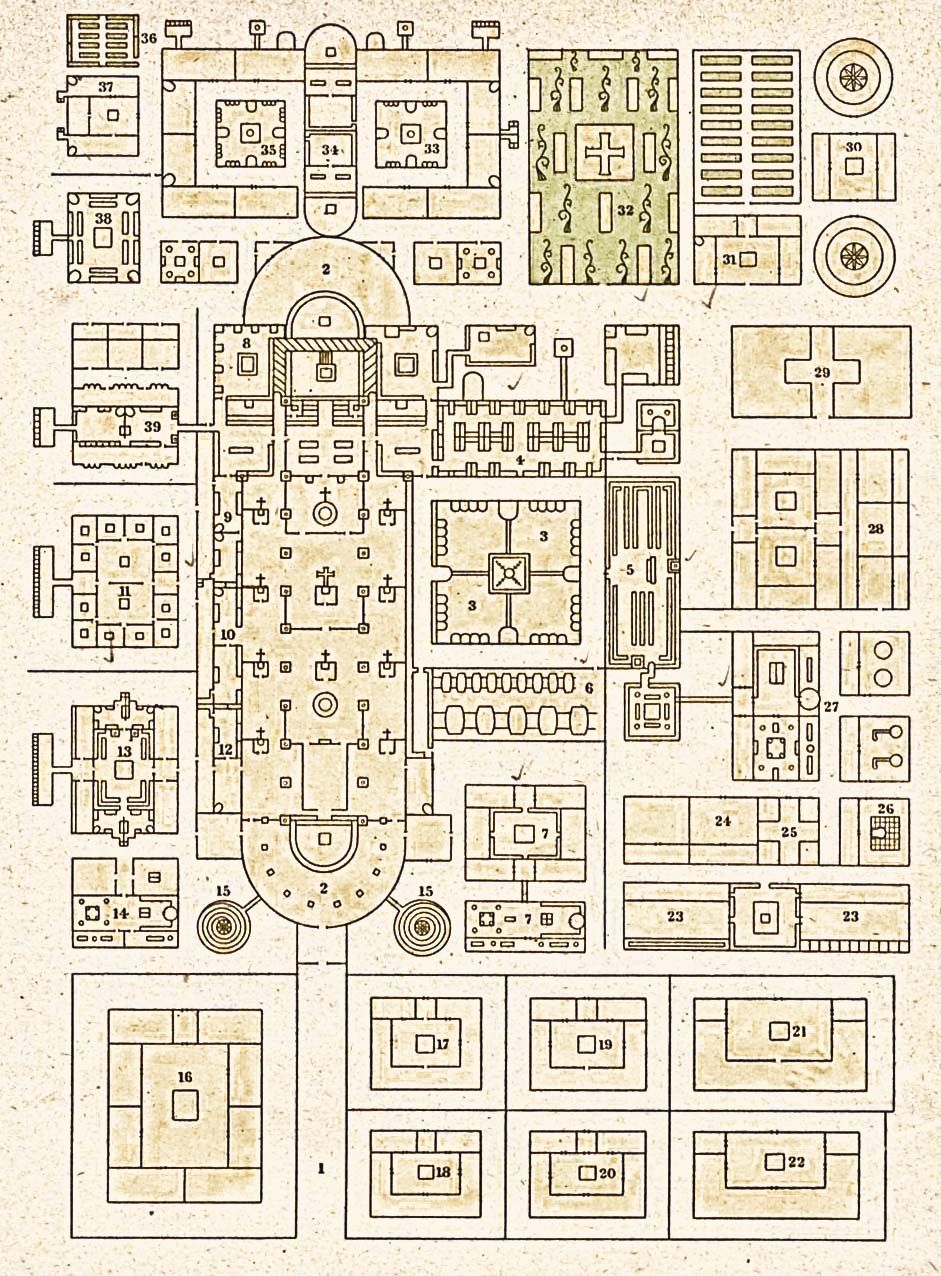
You can see the answer in the gardens. Around 800, chapter 70 of the Capitulare de Villis set out the plants Charlemagne wanted grown on his estates; every one is identified in the Capitulare de Villis plant list.10 About twenty years later the Plan of St Gall laid out a small herb garden of sixteen beds beside the physician’s house.11 In the 840s Walafrid Strabo, abbot of Reichenau, wrote the Hortulus about his own small garden.12 I have set the three side by side in Carolingian Garden Plants: 3 Lists, One Garden.

This is what Noah’s book looked like by the time it reached the Franks: named beds, a monk’s hands in the soil, and a written book handed on to the next generation, the way Noah handed his to Shem.
The Day of Small Things
Zechariah asked, “who hath despised the day of small things?” (Zechariah 4:10). He was speaking of a temple foundation that looked like nothing beside Solomon’s. I think the herb garden belongs under that verse too. The Watchers handed out knowledge for might and vanity. God gave the plants back in a book, and His people kept that knowledge small and close to home, bed by bed.
The Whole Thread
This essay follows one strand of a longer story. My free reference, Gift or Theft? Plant knowledge from Noah to the Carolingians and Paracelsus, lays out the whole thread side by side: 1 Enoch, Jubilees, Sirach, Galen, the Church Fathers on both sides of the question, the Lorsch preface, Hildegard and Paracelsus, with a comparison table and the sources for each. Download Gift or Theft? here.
The Name I Carry
My name is the feminine of Charles. I have always felt that tie to the Carolingians as more than an accident of spelling, and I feel it most in the garden. My fruit trees here in Clugnat live in pots, and my work with plants is small. It is also some of the oldest work there is, and after reading Jubilees again I believe it was given back to us on purpose.
© 2026 Carolyn Smith-Kizer
If this work is useful to you, you can buy me a coffee — buymeacoffee.com/cskizer

Notes
1. 1 Enoch 7:1, in R. H. Charles, ed., The Apocrypha and Pseudepigrapha of the Old Testament, vol. 2 (Oxford: Clarendon Press, 1913).
2. 1 Enoch 8:3, in Charles, Apocrypha and Pseudepigrapha, vol. 2.
3. Theophrastus, Enquiry into Plants 9.8, trans. Arthur Hort, Loeb Classical Library (London: Heinemann, 1916).
4. Jubilees 10:13–14, in Charles, Apocrypha and Pseudepigrapha, vol. 2.
5. R. H. Charles, trans., The Book of Jubilees (London: SPCK, 1917), note on 10:10.
6. 1 Enoch 10:4–8, in Charles, Apocrypha and Pseudepigrapha, vol. 2.
7. Sirach 38:4–5, Douay-Rheims; Latin from the Clementine Vulgate.
8. Bamberg, Staatsbibliothek, Msc.Med.1, fols. 1r–5r, digital facsimile; Ulrich Stoll, Das “Lorscher Arzneibuch”: Ein medizinisches Kompendium des 8. Jahrhunderts (Stuttgart: Franz Steiner, 1992).
9. Joel L. Gamble, “A Defense of the Carolingian ‘Defense of Medicine’: Introduction, Translation, and Notes,” Traditio 75 (2020): 87–125.
10. Capitulare de villis, ch. 70, in Alfred Boretius, ed., Capitularia regum Francorum, vol. 1, MGH Leges (Hanover: Hahn, 1883), no. 32.
11. St. Gallen, Stiftsbibliothek, Cod. Sang. 1092 (Plan of St Gall).
12. Walafrid Strabo, Hortulus, trans. Raef Payne (Pittsburgh: Hunt Botanical Library, 1966).
Bibliography
Boretius, Alfred, ed. Capitularia regum Francorum. Vol. 1. MGH Leges. Hanover: Hahn, 1883.
Charles, R. H., ed. The Apocrypha and Pseudepigrapha of the Old Testament. Vol. 2. Oxford: Clarendon Press, 1913.
Charles, R. H., trans. The Book of Jubilees. London: SPCK, 1917.
Gamble, Joel L. “A Defense of the Carolingian ‘Defense of Medicine’: Introduction, Translation, and Notes.” Traditio 75 (2020): 87–125.
Stoll, Ulrich. Das “Lorscher Arzneibuch”: Ein medizinisches Kompendium des 8. Jahrhunderts. Stuttgart: Franz Steiner, 1992.
Theophrastus. Enquiry into Plants. Translated by Arthur Hort. Loeb Classical Library. London: Heinemann, 1916.
Walafrid Strabo. Hortulus. Translated by Raef Payne. Pittsburgh: Hunt Botanical Library, 1966.