
Medieval Spices and Galen: Why Taillevent Seasoned the Way He Did
Medieval spices and Galen belong in the same sentence, and once you see why, a fourteenth-century recipe stops looking strange. I have spent this week with the Viandier of Taillevent, the cookbook attached to Guillaume Tirel, cook to Charles V of France. Every page asks for ginger, cinnamon, cloves, saffron and grains of paradise, worked up in verjuice or vinegar and stirred in at the end. To a modern cook it can read like a spice cupboard turned upside down. To a cook trained in the Galenic tradition, it was simply good sense.1
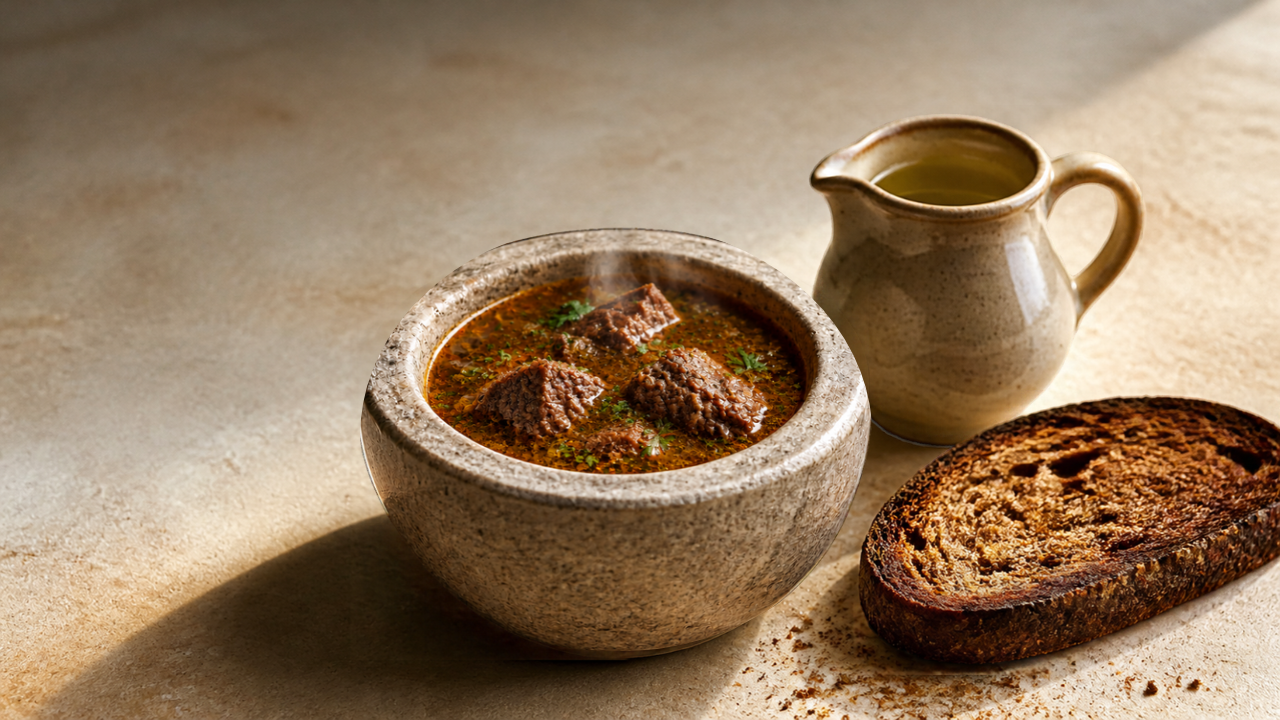
What set me off was a French Cooking Academy video in which the instructor made Taillevent’s civé, a bread-thickened stew finished with a great deal of spice. He did a fine job, and he was honestly surprised by how good it tasted. Then he repeated the old story that medieval cooks used spice to hide bad meat. That story deserves to be put away, because the real reasons are far more interesting, and they sit right in the territory this site was built for.
The spoiled-meat story
The idea that spices covered the taste of rotting meat has been around for a long time, and historians of food have spent the last few decades taking it apart. Paul Freedman of Yale makes the plain economic point: anyone who could afford pepper, cinnamon and saffron could certainly afford fresh meat, and a lord’s household ate meat killed that week, often that day.2 Spices were costly enough that Venetian merchants could multiply their price many times over between India and a European table.3 Nobody pours that kind of money over spoiled food.
So we need a better explanation. The cook’s own book gives us most of it, if we read it alongside the physicians he worked beside.
Every food had a temperament: Medieval Spices and Galen
Galen, the second-century physician whose writings shaped European thinking about the body for more than a thousand years, taught that foods, like people, have a complexion: some balance of hot, cold, moist and dry.4 (If you are new to this, my post on the four Galenic constitutional types sets out the framework.) Food was meant to nourish the eater without pushing the body out of its own balance, so a meal was something to be adjusted.
The cook had three tools for adjusting it: the method of cooking, the spices, and the sauce. Taillevent uses all three, and he uses them consistently.
The method follows the meat
Moist meats were roasted, because the fire dries them. Dry meats were boiled, because the water moistens them. Terence Scully, whose edition of the Viandier remains the standard, traces this pattern across the medieval French cookbooks.5
You can watch it happen in the Viandier. Geese, a moist bird, go on the spit and are roasted without larding, since they need no added fat. Beef and mutton, the “grosse chair,” go into the pot with salt, parsley, sage and hyssop.6 Fresh boar is plunged into boiling water and then roasted and basted, a two-step method for a meat that sat between the two. The cook was not choosing by habit. He was choosing by the nature of the animal.
The sauce corrects the dish
Here is where medieval cooking parts company with ours. We tend to match a sauce to a dish, gravy with beef and cream with chicken. The medieval cook often set the sauce against the dish, so that it supplied what the meat lacked.
The clearest statement of the rule comes from Magninus of Milan, a physician writing in the first half of the fourteenth century. In his short treatise on sauces he explains that foods leaning toward cold, moist and heavy want sauces that are hot, dry and penetrating, while hot and dry foods want sauces that cool and moisten. He also adjusts by season, with sour, cooling sauces of verjuice and vinegar in summer and warmer spices, garlic and mustard in winter.7
Read the Viandier’s fish chapter with that in mind. Fish was the coldest and moistest food on the table, so it arrives with heat: freshwater fish with green sauce sharpened by ginger and pepper, salmon and gurnard with cameline (cinnamon, ginger and cloves), mackerel with mustard, salt shad with garlic.8 Goose, moist and rich, gets white garlic or jance. The pairings are not random, and once you know the rule you can almost predict them.
Why the spice goes in with verjuice
Again and again Taillevent tells the cook to grind the spice and deffaire it, to slake it, in verjuice, vinegar or wine before it goes into the pot. There is a practical reason. Powdered ginger floats and clumps on a hot broth (the instructor in that video found this out), while a spice already worked into liquid blends evenly and passes through the straining cloth with the bread. The spices usually go in late, near serving, which keeps their scent from boiling away.
There may be a Galenic reason too. Ginger, cinnamon and cloves are hot; verjuice and vinegar are cold and dry. The French verb destremper means to temper as well as to dilute. Taillevent never states the theory, only the method, so I offer this as a likely influence rather than his stated intention. But a cook who spent his life beside court physicians would have known that a hot spice carried in a cold, sour liquid makes a more even-tempered sauce.
The physician in the kitchen
The best evidence that physicians and cooks worked together is in the Viandier itself. Its short section of dishes for the sick includes a coulis of perch, boiled, boned and ground with a dozen blanched almonds. The instruction is to salt it and add nothing else, unless the physician orders sugar.9
That one line tells us a great deal. The cook expected a physician to be directing the diet of an ailing member of the household, and he expected the physician’s word to govern even a pinch of sugar. Sugar itself was valued then as a warm, gentle food for the weak, which is why it turns up in the barley water, the capon coulis and the almond dishes made for the sickroom. The household book of a Parisian bourgeois, written in the 1390s, has a whole chapter of these preparations.10
An old inheritance
None of this began with Taillevent. Galen’s dietetics reached the French court by a long road, through Byzantine and Arabic physicians, the school of Salerno, and the Latin regimens of men like Magninus. But the road passed through Carolingian ground on the way. The Lorsch Pharmacopoeia, copied at the abbey of Lorsch in the late eighth century, opens with a defence of the physician’s art as a Christian duty of charity, and it gives whole chapters to spices such as pepper and ginger and where they come from.11

The heart of the Viandier’s spice cupboard was already known to the monks in Charlemagne’s day. I wrote recently about the table Charlemagne kept, and this is the same table, five centuries further on and dressed for a king’s feast.
Status, and a little paradise
Health was not the only reason, and it would be dishonest to pretend otherwise. Spices were luxury goods, and a dish glowing with saffron announced the wealth of the house. Freedman also shows how strongly spices were tied to the imagination of the East and of paradise itself. Grains of paradise, the peppery seed Taillevent reaches for constantly, carried that association in its name.12 A great table was meant to delight the eye and the nose as well as to keep the body in balance, and the cooks managed all of it at once.
Taillevent’s spices in a modern kitchen
If you want to cook from the Viandier, keep the method and keep the logic. Grind your spices fresh, slake them in verjuice or a mild vinegar, and add them near the end. Find grains of paradise; in France they are sold as maniguette, and they are the single ingredient that makes these dishes taste like their period. Then think the way the cook did. A moist meat wants the fire and a warming sauce, while a dry one wants the pot. Fish wants heat and sharpness.
I am working through the clean dishes in the Viandier for my own kitchen, starting with the civé made with veal, and I will be cooking it on the channel. Taillevent’s book is six hundred years old, but the reasoning behind it is older still, and it still makes sense at the stove.
© 2026 Carolyn Smith-Kizer
If this work is useful to you, you can buy me a coffee — buymeacoffee.com/cskizer

Notes
1. Taillevent, Le viandier de Taillevent (Paris, c. 1486), transcribed from the Bibliothèque nationale de France copy, Project Gutenberg eBook #26567, 2008, https://www.gutenberg.org/ebooks/26567. For all four manuscripts with an English translation, see Terence Scully, ed., The Viandier of Taillevent: An Edition of All Extant Manuscripts (Ottawa: University of Ottawa Press, 1988).
2. Paul Freedman, Out of the East: Spices and the Medieval Imagination (New Haven: Yale University Press, 2008).
3. Paul Freedman, “The Medieval Taste for Spices,” Historically Speaking (September/October 2008), as summarized in “Spice and Status,” Wilson Quarterly (Winter 2009), https://www.wilsonquarterly.com/quarterly/_/spice-and-status.
4. Galen, On the Properties of Foodstuffs (De alimentorum facultatibus), trans. Owen Powell (Cambridge: Cambridge University Press, 2003).
5. Terence Scully, The Art of Cookery in the Middle Ages (Woodbridge: Boydell Press, 1995).
6. Taillevent, Viandier, “Chapitre de rost” (Oyes) and “Boulatures de grosse chair.”
7. Terence Scully, “The Opusculum de saporibus of Magninus Mediolanensis,” Medium Ævum 54, no. 2 (1985): 178–207; see also Lynn Thorndike, “A Medieval Sauce-Book,” Speculum 9 (1934): 183–90.
8. Taillevent, Viandier, “Poissons deaue doulce,” “Gournaulx & rougetz,” “Saulmon,” “Macquereaulx fraitz,” and the recipe for cameline.
9. Taillevent, Viandier, “Coulis a poisson.”
10. Gina L. Greco and Christine M. Rose, trans., The Good Wife’s Guide (Le Ménagier de Paris): A Medieval Household Book (Ithaca: Cornell University Press, 2009).
11. Lorscher Arzneibuch, Bamberg, Staatsbibliothek, Msc.Med.1, digitized at https://bibliotheca-laureshamensis-digital.de/view/sbbam_mscmed1; inscribed on UNESCO’s Memory of the World Register in 2013.
12. Freedman, Out of the East.
Bibliography
Flandrin, Jean-Louis, and Massimo Montanari, eds. Food: A Culinary History from Antiquity to the Present. New York: Columbia University Press, 1999.
Freedman, Paul. “The Medieval Taste for Spices.” Historically Speaking, September/October 2008.
Freedman, Paul. Out of the East: Spices and the Medieval Imagination. New Haven: Yale University Press, 2008.
Galen. On the Properties of Foodstuffs (De alimentorum facultatibus). Translated by Owen Powell. Cambridge: Cambridge University Press, 2003.
Greco, Gina L., and Christine M. Rose, trans. The Good Wife’s Guide (Le Ménagier de Paris): A Medieval Household Book. Ithaca: Cornell University Press, 2009.
Lorscher Arzneibuch. Bamberg, Staatsbibliothek, Msc.Med.1.
Pichon, Jérôme, and Georges Vicaire, eds. Le Viandier de Guillaume Tirel dit Taillevent. Paris: Techener, 1892.
Scully, Terence. The Art of Cookery in the Middle Ages. Woodbridge: Boydell Press, 1995.
Scully, Terence. “The Opusculum de saporibus of Magninus Mediolanensis.” Medium Ævum 54, no. 2 (1985): 178–207.
Scully, Terence, ed. The Viandier of Taillevent: An Edition of All Extant Manuscripts. Ottawa: University of Ottawa Press, 1988.
Taillevent. Le viandier de Taillevent. Project Gutenberg eBook #26567, 2008. https://www.gutenberg.org/ebooks/26567.
Thorndike, Lynn. “A Medieval Sauce-Book.” Speculum 9 (1934): 183–90.