

Carolingian Height and Diet: The Table Charlemagne Kept
What the Bones Remember About Plenty, from the Royal Estates to the American Frontier
There is an old idea, still common, that people in the past were small. We picture knights who could not fit into modern armor and peasants who would barely reach our shoulders. The bones tell a more interesting story, and the history of Carolingian height and diet turns the old idea upside down. People in Charlemagne’s world were tall. Their descendants a thousand years later were not. And the people who finally outgrew them both were ordinary farm families on the far side of the Atlantic.
Height works like a record. A child’s body grows on what the table gives it, and when the table is thin, the body keeps the account. Economic historians now read that account the way we read a ledger, from thigh bones in cemeteries and from the measurements armies took of every recruit. What they found runs straight through the Capitulare de Villis.
This post is a companion to From the Pays Illinois to the Gas Station: How Charlemagne Explains American Portions. That piece followed the habits of scarcity from the Carolingian estates to the French table and across the ocean to the American portion. This one brings the measurements: what the skeletons and the army muster rolls say happened to the people who ate at those tables.
An Ordinance Written After Hunger
The Capitulare de Villis is usually remembered for its garden list, the plants Charlemagne wanted grown on every royal estate. Charlemagne lived through two great famines, the first in 778–79 and the second in 792–93. The historian Adriaan Verhulst points out that the Capitulare was most likely drawn up in the aftermath of the second.1 That changes how we read it. We are watching a king, freshly frightened by hunger, order his estates so that hunger would not come again.
And what he ordered was a mixed table. Every estate was to keep cow sheds, pigsties, sheepfolds and goat pens, as many as it could.2 The stewards were told to make bacon, smoked meat, sausage, salted meat, cheese and butter, along with honey, beer, mead and flour, and to make all of it with the greatest cleanliness.3 Cheese and butter appear again among the foods allowed on fast days, two-thirds of which were to be sent to the king each year.4 The annual accounting each steward owed at Christmas listed the ploughing oxen, the pigs, the hens and eggs, the geese, the hides and horns, and the old grain against the new.5
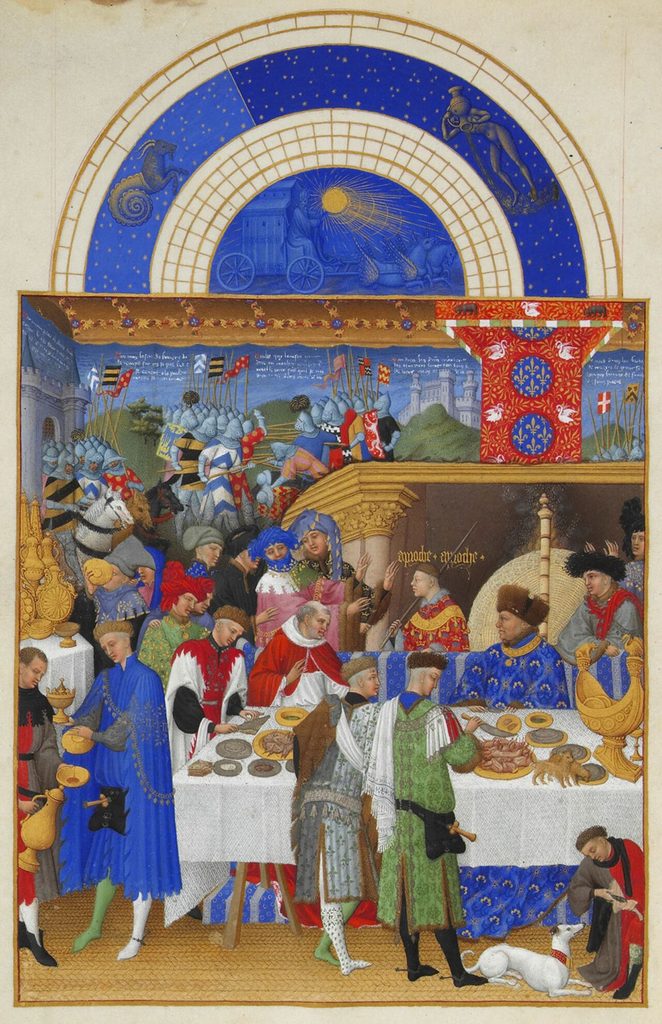
The same ordinance opens with a principle we should not skip past: the king’s people were to be well looked after, and no one was to reduce them to poverty.6 Ordinances describe an ideal, not always the reality. But the ideal itself is telling. Meat, milk, grain and herbs, counted and kept, against the next bad year.
Tall in the Early Middle Ages: Carolingian Height and Diet
Richard Steckel of Ohio State University gathered skeletal data from some thirty studies of northern European burials. Men of the early Middle Ages averaged about 173.4 centimetres, roughly five feet eight. That is nearly the height of modern Americans.7
Then the line falls. Heights slipped through the twelfth to sixteenth centuries and reached their lowest point in the seventeenth and eighteenth, somewhere around 166 to 167 centimetres. Northern Europeans did not win back their early medieval stature until the early twentieth century.8
Steckel does not blame one cause. He points to the cooling climate of the Little Ice Age, whose coldest stretch in the mid-1600s matches the lowest heights; to growing inequality; to crowded cities and the trade routes that carried disease; and to the wars of state and religion.9 The early Middle Ages, by contrast, sat in a warmer climate, with scattered settlements and no great cities in the north. Charlemagne’s estates were working ground in a kinder season.
France at the Bottom of the Curve
France shows the low point sharply. John Komlos studied the records of more than 38,000 French soldiers from the reigns of Louis XV and Louis XVI. Frenchmen born between 1666 and 1694, the age of Louis XIV and Versailles, averaged only about 161.7 centimetres, roughly five foot three and a half.10
Komlos ties this to what historians call the crisis of the seventeenth century. When the weather improved around 1700, the next generation grew nearly four centimetres taller within about twelve years.11 The body follows the harvest that closely.
Here is the part that matters for the question of money. The French upper classes were about seven centimetres taller than the average Frenchman.12 Money did buy something. Wealthy families ate better, and their sons showed it. Komlos found the same gap in the elite students of the École Polytechnique in the early nineteenth century, who stood some seven centimetres above ordinary French youth.13 So it would not be true to say that wealth bought nothing in France. It bought a margin. What it could not buy was a whole country that was fed.
The Farm Boys Who Outgrew the Gentry
Across the ocean, the picture turns over. Kenneth Sokoloff and Georgia Villaflor, working from colonial and Revolutionary muster rolls, found that native-born Americans had nearly reached modern heights by the time of the Revolution, standing two to four inches taller than Europeans. Country-born men were taller than town-born, and southerners taller than northerners.14
Komlos, reading the descriptions in runaway notices for apprentices and deserters, found American men by the 1780s as much as 6.6 centimetres taller than Englishmen. At sixteen, American apprentices stood about twelve centimetres taller than the poor boys of London.15
A study of French and Indian War records adds a telling detail. Men born in America were taller at every age than men who had migrated from Europe.16 Same stock, different table. The author credits a strong colonial economy and direct access to good food.
Put the numbers side by side and the point makes itself. Add the seven centimetres the French elite enjoyed to the eighteenth-century French average, and you arrive at roughly the height of an ordinary American-born farm boy. A colonial ploughman stood about as tall as a French gentleman, and some three inches taller than the French peasant. The plenty of open land, cattle, pork and milk lifted a whole people to a level that, in France, only the privileged could reach.
What the Herbalist Sees
A herbalist reads the body as something built from the outside in, from food, air, work and rest. The height record is that principle written across centuries. The body is honest. It does not care whether a man is noble or common, French or American. It grows on what it is given in childhood and stops where the table stopped.
That is why the Capitulare de Villis deserves more attention than its plant list alone. Charlemagne was not only planting sage and fennel. He was building a system of meat, dairy, grain, vegetables and herbs, counted every Christmas and held in reserve, so that the people on his lands would not be reduced to want. For a few centuries, in a warmer climate, it worked, and the skeletons from that age bear it out.
Plenty Is Kept, Not Owned
There is a last turn in the story. The American lead did not last. Komlos has shown that American heights levelled off in the twentieth century while Europeans kept climbing, until the Dutch stood about three inches above Americans, a reversal of the 1800s, when Americans had stood about three inches above the Dutch.17
Plenty is not a possession. It is a practice. Charlemagne’s estates had it while they kept the cattle counted and the stores full. Early America had it while the land was open and the table was wide. Every generation either keeps the table or loses it, and the next generation’s bones will tell which.
© 2026 Carolyn Smith-Kizer
If this work is useful to you, you can buy me a coffee — buymeacoffee.com/cskizer

Notes
1. Adriaan Verhulst, The Carolingian Economy (Cambridge: Cambridge University Press, 2002), chap. 9, “The Economy and the State.” Verhulst dates the text to between 792–93 and 800.
2. Capitulare de villis, c. 23, in Alfred Boretius, ed., Capitularia regum Francorum, vol. 1, MGH Leges 2 (Hanover: Hahn, 1883), no. 32.
3. Capitulare de villis, c. 34; trans. in James Harvey Robinson, ed., Readings in European History, vol. 1 (Boston: Ginn, 1904), 137–39.
4. Capitulare de villis, c. 44; Robinson, Readings, 137–39.
5. Capitulare de villis, c. 62; Robinson, Readings, 137–39.
6. Capitulare de villis, c. 2; Boretius, Capitularia, no. 32.
7. Richard H. Steckel, “Health and Nutrition in the Preindustrial Era: Insights from a Millennium of Average Heights in Northern Europe,” NBER Working Paper 8542 (Cambridge, MA: National Bureau of Economic Research, 2001); see also Ohio State University, “Men from Early Middle Ages Were Nearly as Tall as Modern People,” news release, September 2004.
8. Steckel, “Health and Nutrition.” The working paper gives a low of 165.8 cm; the later published summary gives roughly 167 cm.
9. Steckel, “Health and Nutrition”; Richard H. Steckel, “The Little Ice Age and Health: Europe from the Early Middle Ages to the Nineteenth Century” (paper, 2010).
10. John Komlos, “Histoire anthropométrique de la France de l’Ancien Régime,” Histoire, économie & société 22, no. 4 (2003); John Komlos, “An Anthropometric History of Early-Modern France,” European Review of Economic History 7, no. 2 (2003): 159–89.
11. Komlos, “Anthropometric History of Early-Modern France.”
12. Komlos, “Anthropometric History of Early-Modern France.” Komlos adds that a gap of this size was standard across Europe at the time.
13. John Komlos, “The Nutritional Status of French Students,” Journal of Interdisciplinary History 24 (1994): 493–508.
14. Kenneth L. Sokoloff and Georgia C. Villaflor, “Colonial and Revolutionary Muster Rolls: Some New Evidence on Nutrition and Migration in Early America,” NBER Working Paper 374 (1979); published as “The Early Achievement of Modern Stature in America,” Social Science History 6, no. 4 (1982).
15. John Komlos, “On the Biological Standard of Living of Eighteenth-Century Americans: Taller, Richer, Healthier,” Research in Economic History 20 (2001): 223–48.
16. A. Theodore Steegmann Jr., “Stature Variation in the British American Colonies: French and Indian War Records, 1755–1763,” American Journal of Physical Anthropology 75, no. 3 (1988): 413–21.
17. Kate Connolly, interview with John Komlos, reported in “Americans Have Lost Their Advantage as Tall People,” History News Network, 2004.
Bibliography
Boretius, Alfred, ed. Capitularia regum Francorum. Vol. 1. MGH Leges 2. Hanover: Hahn, 1883.
Komlos, John. “An Anthropometric History of Early-Modern France.” European Review of Economic History 7, no. 2 (2003): 159–89.
Komlos, John. “Histoire anthropométrique de la France de l’Ancien Régime.” Histoire, économie & société 22, no. 4 (2003).
Komlos, John. “The Nutritional Status of French Students.” Journal of Interdisciplinary History 24 (1994): 493–508.
Komlos, John. “On the Biological Standard of Living of Eighteenth-Century Americans: Taller, Richer, Healthier.” Research in Economic History 20 (2001): 223–48.
Robinson, James Harvey, ed. Readings in European History. Vol. 1. Boston: Ginn, 1904.
Sokoloff, Kenneth L., and Georgia C. Villaflor. “The Early Achievement of Modern Stature in America.” Social Science History 6, no. 4 (1982).
Steckel, Richard H. “Health and Nutrition in the Preindustrial Era: Insights from a Millennium of Average Heights in Northern Europe.” NBER Working Paper 8542. Cambridge, MA: National Bureau of Economic Research, 2001.
Steckel, Richard H. “The Little Ice Age and Health: Europe from the Early Middle Ages to the Nineteenth Century.” Paper, 2010.
Steegmann, A. Theodore, Jr. “Stature Variation in the British American Colonies: French and Indian War Records, 1755–1763.” American Journal of Physical Anthropology 75, no. 3 (1988): 413–21.
Verhulst, Adriaan. The Carolingian Economy. Cambridge: Cambridge University Press, 2002.