
Holy Basil: Tulsi, Nature’s Answer to Stress and Inflammation
Holy basil has been grown in Indian courtyards for at least three thousand years, and it still is. It is not the basil of your pesto. It is a different species with a different job: Ayurveda calls it a rasayana, a herb taken over long periods to strengthen the whole person, and it is one of the gentlest adaptogens I know.1 As a clinical herbalist and a cancer survivor, I have leaned on it myself through more than one hard season.
Holy basil never entered the Galenic pharmacy. It reached Western herbalism only in the twentieth century, long after Galen’s system had been set down. But the Galenic method still works on it. Taste and temperament tell you what a plant does, whatever its origin, and that is the lens I use here.
At a Glance
- Botanical name: Ocimum tenuiflorum L. (syn. O. sanctum L.)
- Common names: holy basil, tulsi (Hindi), basilic sacré (French)
- Family: Lamiaceae (the mint family)
- Part used: leaf and flowering tops
- Taste: pungent, slightly bitter, aromatic
- Galenic qualities: warming and drying (by taste; no classical entry)
- Modern energetics: warm, dry, pungent — the two systems agree
- Actions: adaptogen, nervine, carminative, diaphoretic, anti-inflammatory
- Main cautions: pregnancy and conception, diabetes medication, thyroid conditions
- Conservation status: widely cultivated; not at risk
The Plant
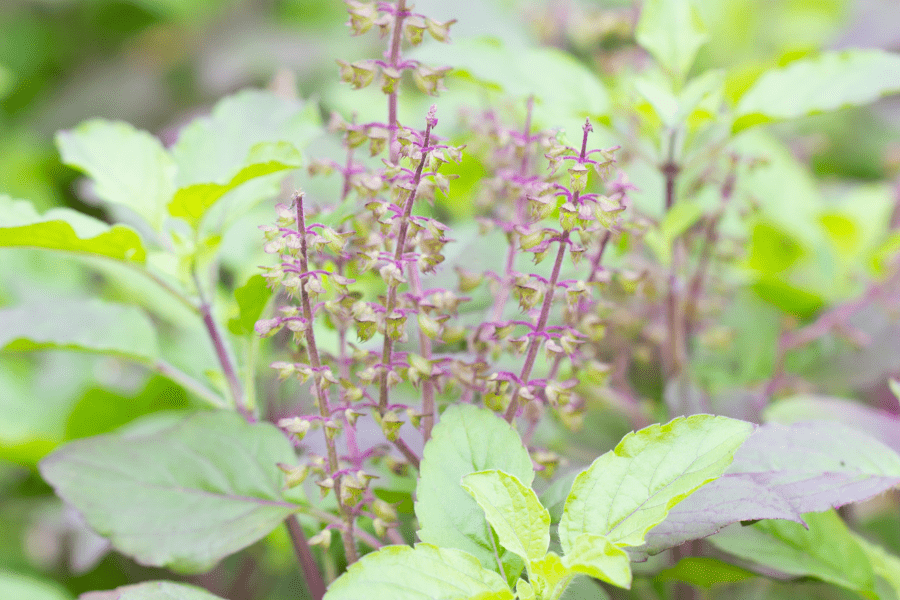
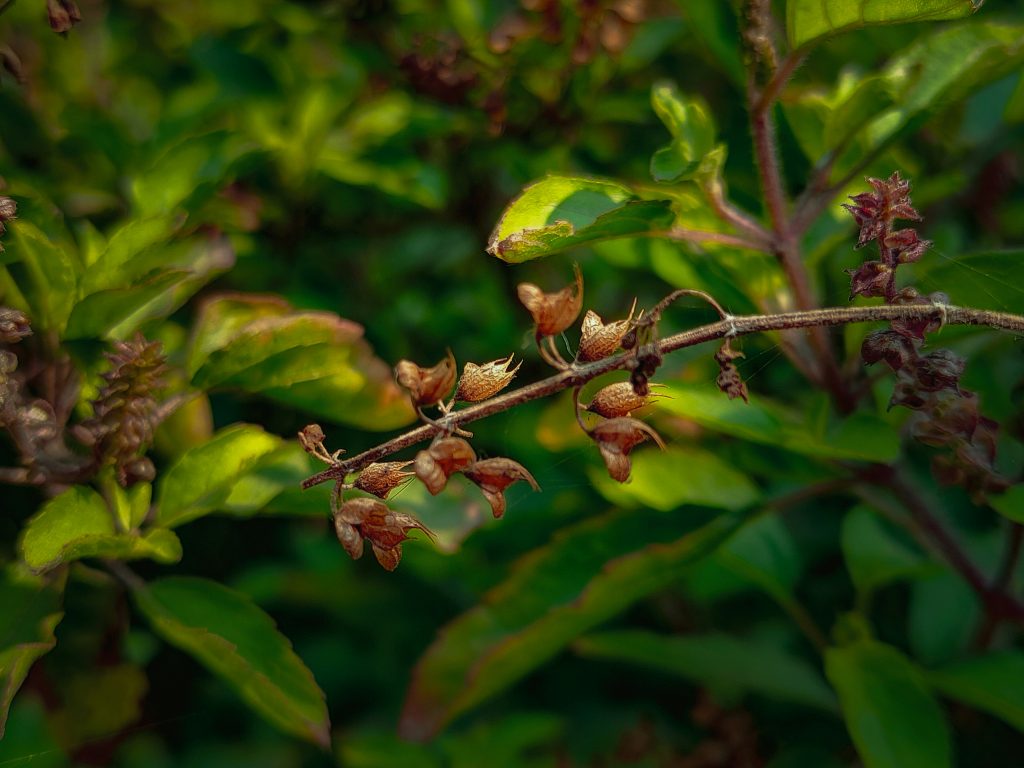
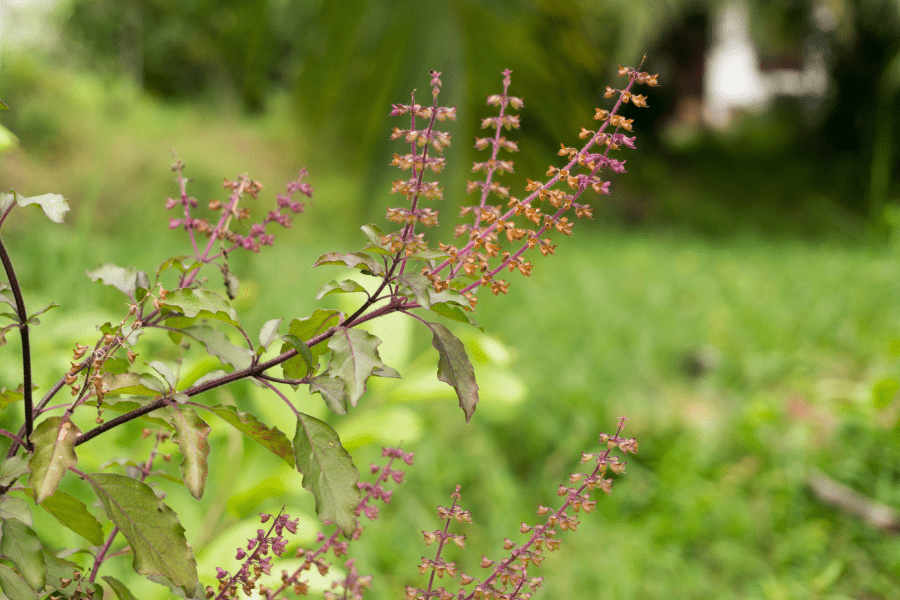
Holy basil is an aromatic, much-branched little shrub, usually 30–60 cm tall, with softly hairy stems that turn woody at the base. The leaves are opposite, oval, 2–5 cm long, with shallowly toothed edges. Crush one and you smell clove first, then pepper, then something like camphor. The small two-lipped flowers, white to pale purple, sit in whorls along long slender spikes, and each one ripens into tiny dark nutlets.
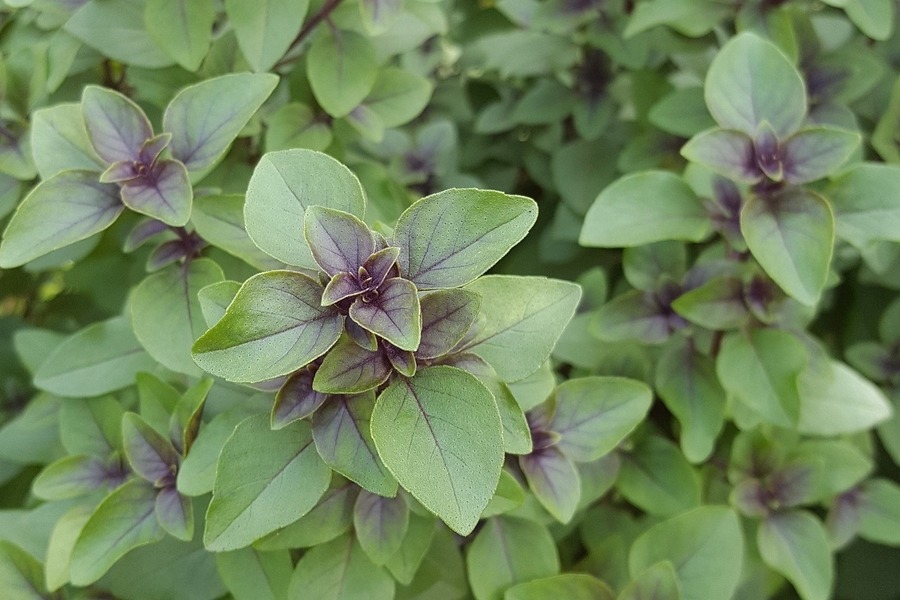
There are three traditional kinds. Rama tulsi has green leaves and the mildest, sweetest scent. Krishna tulsi has purple leaves and a sharper bite. Vana tulsi is the tall wild forest type, strongly aromatic. All three are used the same way; Krishna is the warmest and Rama the gentlest. A native of the Indian subcontinent, holy basil is a tropical plant and cannot survive a European winter outdoors.
The Galenic Reading
You will not find holy basil in Dioscorides, Galen, Hildegard or the Capitulare de Villis. What the Galenic method gives us instead is a way of reading it. A pungent, aromatic, slightly bitter leaf is warming and drying. That places holy basil squarely as a corrective for the phlegmatic constitution: the cold, damp person who is slow to start, heavy after meals, prone to catarrh and to the kind of low, foggy fatigue that long strain leaves behind. For that person holy basil lifts, clears and warms without the jangle of caffeine.
- Phlegmatic (cold and moist): the best match. A daily cup or two through winter and early spring.
- Melancholic (cold and dry): the warmth helps, but the dryness does not. Take it the Indian way, simmered briefly in milk, or pair it with oat tops or a little licorice to add back moisture.
- Choleric (hot and dry): use sparingly. A short, light infusion is enough, and rose petals in the pot will temper it.
- Sanguine (hot and moist): rarely needs it, except in seasons of overwork.
Seasonally, holy basil belongs to late autumn, winter and the cold, wet weeks of early spring, the phlegmatic time of year. In the heat of high summer most people need less of it.
Uses
1. Stress and the Nervous System
This is holy basil’s great modern use, and the best supported. In a six-week double-blind trial, adults with stress symptoms who took a holy basil extract reported significantly greater improvement than those on placebo, including in forgetfulness, sleep trouble and exhaustion.2 A smaller Indian trial gave people with generalised anxiety the leaf extract twice daily for sixty days and recorded lower anxiety, stress and depression scores.3 Adaptogens as a class seem to work by steadying the stress-hormone system rather than suppressing it, which is why holy basil calms without sedating.4
In Galenic terms, chronic strain often shows as cold and damp settling over a tired system: poor digestion, catarrh, heaviness, a mind that can’t lift. A warming, drying aromatic is the classic answer, and holy basil is a gentle one.
2. Colds, Coughs and Immunity
In India holy basil tea is the household first response to a cold, a cough or a fever. Its warmth and pungency open the pores and encourage a gentle sweat, and its aromatic oils loosen catarrh in the chest. Modern research points the same way: healthy volunteers taking holy basil leaf extract for four weeks showed higher levels of several immune markers, including natural killer and T-helper cells, than those on placebo.5
3. Blood Sugar and Metabolism
In a small placebo-controlled trial, people with type 2 diabetes who took holy basil leaves daily had lower fasting and after-meal blood sugar than when they took placebo.6 This is useful, but it is also a caution: anyone on diabetes medication should watch their levels closely if they add holy basil.
4. Digestion
Like its cousins in the mint family, holy basil is carminative. It warms a cold stomach, eases wind and cramping, and wakes a sluggish appetite. In my experience it is especially good for the person whose digestion closes down under stress.
Across all these uses, a systematic review of 24 human studies concluded that holy basil helps with physical, chemical, metabolic and psychological stress and is well tolerated, while calling for larger trials.7
Constituents
The main active groups are:8
- Volatile oil: eugenol (the clove note), methyl eugenol and β-caryophyllene
- Triterpenes: ursolic and oleanolic acids
- Phenolic acids: rosmarinic acid
- Flavonoids: apigenin, luteolin, orientin and vicenin
The volatile oil explains the warming, drying, carminative and diaphoretic qualities; the triterpenes and rosmarinic acid account for much of the anti-inflammatory action.
Preparations and Dosage
- Tea: 1–2 teaspoons of dried leaf (or a small handful of fresh) per cup of just-boiled water. Cover and steep 5–10 minutes. Two or three cups a day.
- Holy basil in milk: for the dry, worn-out, sleepless person, simmer a teaspoon of leaf in a cup of milk for a few minutes, strain, and sweeten with a little honey at bedtime.
- Fresh leaves: a few leaves chewed each morning is the traditional Indian practice.
- Tincture (1:5): 2–3 ml, two or three times a day.
- Extract (as in the trials): roughly 300 mg to 3 g of leaf or extract daily, taken for several weeks.9
Holy basil is a slow herb. Give it at least two to four weeks before you judge it.
Harvesting, Growing and Sustainability
Holy basil dies at the first touch of frost. Here in the Creuse I grow it in pots on the sunniest step and bring it indoors in late September.
- Sow indoors in April in warm, free-draining compost. The seed needs warmth, around 21–27 °C, to germinate.
- Plant out only when nights stay above 10 °C, in full sun.
- Pinch out the tips often to keep it bushy and delay flowering.
- Harvest the leafy tops just as the first flowers open, when the aroma is strongest. Dry them in bunches in a warm, airy, shaded place, and store whole in a dark glass jar for up to a year.
Holy basil is grown on a large scale and is not on any at-risk list, so there are no sustainability concerns. Choose organic leaf where you can.
Safety and Interactions
- Pregnancy and conception: avoid. In animal studies, large doses reduced embryo implantation and litter size; safety in breastfeeding has not been established.10
- Diabetes medication: holy basil may lower blood sugar. Monitor closely.11
- Thyroid: in a mouse study, holy basil lowered thyroid hormone (T4) levels.12 If you have an underactive thyroid or take thyroid medication, talk to your practitioner first.
- Drug interactions: none documented.13 As always, tell your doctor about any herb you take regularly.
- General tolerance: the human studies report very few side effects.14
Common Questions
Is holy basil the same as the basil I cook with?
No. Sweet basil is Ocimum basilicum. Holy basil is Ocimum tenuiflorum, a different species with a sharper, clove-like scent and a long medicinal tradition of its own.
How long before I notice anything?
Most people notice a steadier mood and better sleep after two to four weeks of daily use. Holy basil works gradually.
Can I drink holy basil tea every day?
For most adults, yes. Check the safety section if you are pregnant or trying to conceive, take diabetes medication, or have a thyroid condition.
Which constitution benefits most?
In Galenic terms, the cold, damp phlegmatic type, because holy basil is warming and drying. Hot, dry choleric types should use it lightly.
© 2024 Carolyn Smith-Kizer
If this work is useful to you, you can buy me a coffee — buymeacoffee.com/cskizer

Notes
- Marc Maxwell Cohen, “Tulsi – Ocimum sanctum: A Herb for All Reasons,” Journal of Ayurveda and Integrative Medicine 5, no. 4 (2014): 251–59, https://doi.org/10.4103/0975-9476.146554. ↩
- R. C. Saxena et al., “Efficacy of an Extract of Ocimum tenuiflorum (OciBest) in the Management of General Stress: A Double-Blind, Placebo-Controlled Study,” Evidence-Based Complementary and Alternative Medicine 2012 (2012): 894509, https://doi.org/10.1155/2012/894509. ↩
- D. Bhattacharyya et al., “Controlled Programmed Trial of Ocimum sanctum Leaf on Generalized Anxiety Disorders,” Nepal Medical College Journal 10, no. 3 (2008): 176–79. ↩
- Alexander Panossian and Georg Wikman, “Effects of Adaptogens on the Central Nervous System and the Molecular Mechanisms Associated with Their Stress-Protective Activity,” Pharmaceuticals 3, no. 1 (2010): 188–224, https://doi.org/10.3390/ph3010188. ↩
- Shankar Mondal et al., “Double-Blinded Randomized Controlled Trial for Immunomodulatory Effects of Tulsi (Ocimum sanctum Linn.) Leaf Extract on Healthy Volunteers,” Journal of Ethnopharmacology 136, no. 3 (2011): 452–56, https://doi.org/10.1016/j.jep.2011.05.012. ↩
- P. Agrawal, V. Rai, and R. B. Singh, “Randomized Placebo-Controlled, Single Blind Trial of Holy Basil Leaves in Patients with Noninsulin-Dependent Diabetes Mellitus,” International Journal of Clinical Pharmacology and Therapeutics 34, no. 9 (1996): 406–9. ↩
- Negar Jamshidi and Marc M. Cohen, “The Clinical Efficacy and Safety of Tulsi in Humans: A Systematic Review of the Literature,” Evidence-Based Complementary and Alternative Medicine 2017 (2017): 9217567, https://doi.org/10.1155/2017/9217567. ↩
- Cohen, “Tulsi.” ↩
- Jamshidi and Cohen, “Clinical Efficacy and Safety of Tulsi.” ↩
- Zoë Gardner and Michael McGuffin, eds., American Herbal Products Association’s Botanical Safety Handbook, 2nd ed. (Boca Raton, FL: CRC Press, 2013), s.v. “Ocimum tenuiflorum.” ↩
- Agrawal, Rai, and Singh, “Holy Basil Leaves.” ↩
- S. Panda and A. Kar, “Ocimum sanctum Leaf Extract in the Regulation of Thyroid Function in the Male Mouse,” Pharmacological Research 38, no. 2 (1998): 107–10. ↩
- Gardner and McGuffin, Botanical Safety Handbook. ↩
- Jamshidi and Cohen, “Clinical Efficacy and Safety of Tulsi.” ↩
Bibliography
Agrawal, P., V. Rai, and R. B. Singh. “Randomized Placebo-Controlled, Single Blind Trial of Holy Basil Leaves in Patients with Noninsulin-Dependent Diabetes Mellitus.” International Journal of Clinical Pharmacology and Therapeutics 34, no. 9 (1996): 406–9.
Bhattacharyya, D., T. K. Sur, U. Jana, and P. K. Debnath. “Controlled Programmed Trial of Ocimum sanctum Leaf on Generalized Anxiety Disorders.” Nepal Medical College Journal 10, no. 3 (2008): 176–79.
Cohen, Marc Maxwell. “Tulsi – Ocimum sanctum: A Herb for All Reasons.” Journal of Ayurveda and Integrative Medicine 5, no. 4 (2014): 251–59. https://doi.org/10.4103/0975-9476.146554.
Gardner, Zoë, and Michael McGuffin, eds. American Herbal Products Association’s Botanical Safety Handbook. 2nd ed. Boca Raton, FL: CRC Press, 2013.
Jamshidi, Negar, and Marc M. Cohen. “The Clinical Efficacy and Safety of Tulsi in Humans: A Systematic Review of the Literature.” Evidence-Based Complementary and Alternative Medicine 2017 (2017): 9217567. https://doi.org/10.1155/2017/9217567.
Mondal, Shankar, B. R. Varma, V. D. Bamola, et al. “Double-Blinded Randomized Controlled Trial for Immunomodulatory Effects of Tulsi (Ocimum sanctum Linn.) Leaf Extract on Healthy Volunteers.” Journal of Ethnopharmacology 136, no. 3 (2011): 452–56. https://doi.org/10.1016/j.jep.2011.05.012.
Panda, S., and A. Kar. “Ocimum sanctum Leaf Extract in the Regulation of Thyroid Function in the Male Mouse.” Pharmacological Research 38, no. 2 (1998): 107–10.
Panossian, Alexander, and Georg Wikman. “Effects of Adaptogens on the Central Nervous System and the Molecular Mechanisms Associated with Their Stress-Protective Activity.” Pharmaceuticals 3, no. 1 (2010): 188–224. https://doi.org/10.3390/ph3010188.
Saxena, R. C., R. Singh, P. Kumar, et al. “Efficacy of an Extract of Ocimum tenuiflorum (OciBest) in the Management of General Stress: A Double-Blind, Placebo-Controlled Study.” Evidence-Based Complementary and Alternative Medicine 2012 (2012): 894509. https://doi.org/10.1155/2012/894509.